Silchar, Jan. 28: Widespread violence marked the 12-hour blockade along NH 6 and the Silchar-Guwahati railway route at Panchgram in Hailakandi district today.
The blockades were imposed by the Joint Trade Union Action Committee, a conglomeration of all trade unions of the Cachar Paper Mill, a unit of Hindustan Paper Corporation Ltd, as part of the protest to demand steps to revive the mill, which had been non-functional since October 20 last year.
Different social organisations of the district also supported the blockades.
The situation turned violent early this morning when the police urged the agitators to withdraw the railway blockade at Panchgram and to let go the 55616 Silchar-Guwahati fast passenger train, which left Silchar station at 5am and reached Panchgram at 5.45am.
The police and CRPF resorted to a lathicharge and fired tear gas shells to disperse the "unlawful assembly".
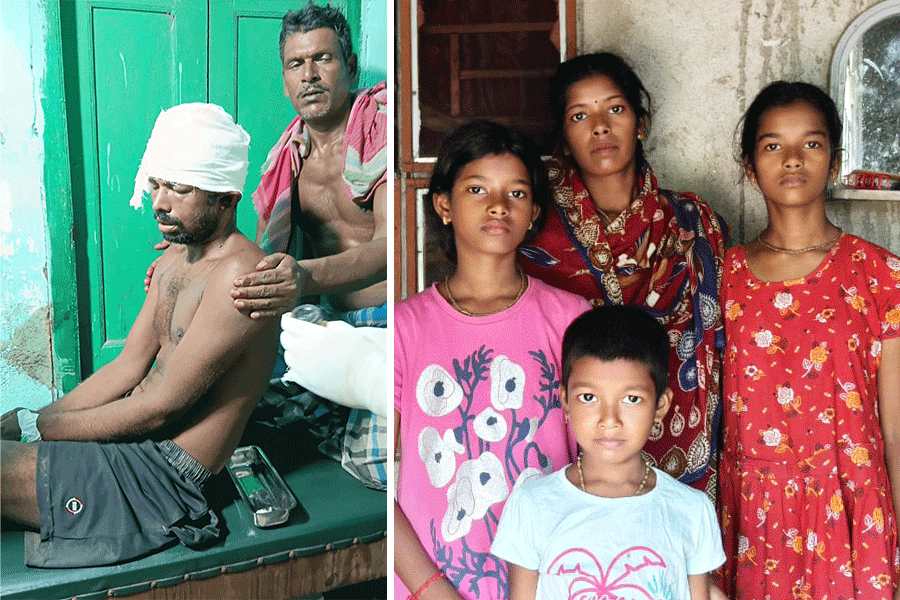
The protesters threw stones at the security forces, leaving three injured. Vehicles of police and security personnel were vandalised. The situation turned worse in the afternoon after the protesters imposed another blockade along the railway route, stopping the passenger train again. The police again resorted to a lathicharge and blank fired to disperse the mob.
The forces also resorted to caning to remove the road blockades in different areas in and round Panchgram.
Police sources said altogether 30 agitators were detained and released in the evening.
Manabendra Chakraborty, the president of the Cachar Paper Project Workers Union, told The Telegraph today they had made several representations to both the central and state governments.
"But our pleas fell on deaf ears. As no concrete step has been taken to revive the industry, we decided to launch a movement, which will continue for an infinite period till the government takes any positive step," he added.
The mill, which commenced production in April 1988, could surpass its annual target output of 1 lakh tonnes only twice in 2005-06 and 2006-07 fiscals. Sources said problems in procuring raw material led to the plant being able to acquire only half of its annual requirement of 2,50,000 muli bamboos in the past few years. As a result, the mill faced a financial crisis with the annual output being only 60,000 tonnes of paper since 2007.