
Jorhat, Oct. 28: A study by a group of scientists of Tezpur University has proved why mohi, a unique and traditional ink formulation of early and medieval Assam, has weathered better than ink produced in Europe during the same period.
The study will be published in the next issue of Current Science.
Robin Kumar Dutta, department of chemical sciences, Tezpur University, said iron gall ink produced in Europe during the same period did not have this durability.
" Mohi has a fast and deep colour and uses cow urine along with other herbal materials; it has little aerial oxidation and is also resistant to fungi. Our study is of importance not only for the physiochemical aspect but also from the social and historical perspective," Dutta said.
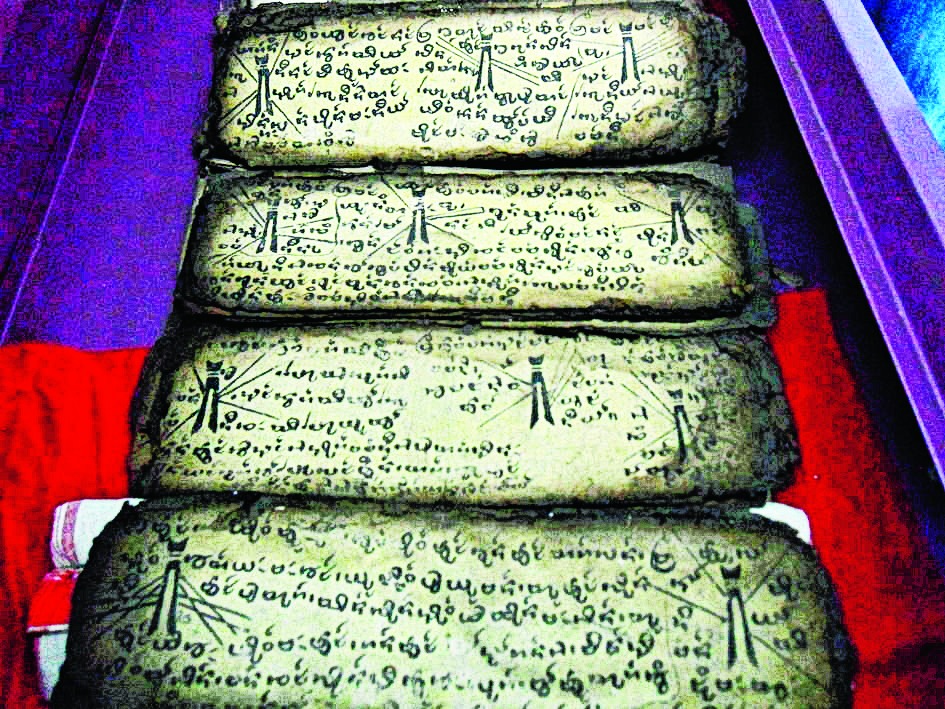
The xansi paat manuscripts, written with mohi, exist from the seventh century and were gifted to Harshavardhan.
Dutta further said the non-destructive nature of the ink has been proven by the centuries-old xansi paat (cellulose folios made of the bark of xansi tree, Aquilaria agallocha) manuscripts that still exist in Assam, without losing the glaze of ink. They stand testimony to a rich literary and socio-cultural heritage and hold the secret of ink formulation.
There is hardly any scientific report available in our literature on preparation and properties of mohi and its possible contribution in survival of xansi manuscripts for centuries in the hot and humid climate of Assam.
Describing how it is prepared, Dutta said the ingredients used in mohi are fruit pulp of xilikha ( Terminalia chebula), amlakhi ( Emblica officinalis) and bhomora ( Terminalia belerica), bark of xilikha, bhomora, mango , jamuk (Eugenia jambolana), bahat (monkey jack, Artocarpus lakoocha) and the whole herbs of keharaj (Eclipta alba), bar manimuni (Centella asiatica) and sharu manimuni (Hydrocoryl rotundifolia), all mashed together and soaked in cow urine in earthen pots (with small holes underneath) during winter. Winter was the chosen season as decomposition of the dyes occurs faster.
"The raw materials varied depending upon availability and usually a red hot iron tool was dipped into the mixture for extracting iron. Rust from iron nails, blood of kuchiya (Monopterus cuchia, a kind of eel) or hirakoch (Pangasius sutchi, a kind of catfish) are also added. Drops of clear mohi percolate through the bottom of the earthen pots in nine to 10 days and are used as ink," he said.
The major phytochemical constituents in mohi have been identified as phenolic acids, flavonoids and tannins and it has been observed that a small amount of iron sourced from rusted iron form a complex with these constituents that intensifies the colour of the ink, imparting an intense black hue and giving it resistance to high humidity in the region.
The xansi paat manuscripts, written with mohi, are free from destructive effects of acid hydrolysis, oxidative decomposition and fungus, enabling them to survive for centuries in harsh climate, unlike paper manuscripts written with IGI (iron gall ink). The constituents also emit a fluorescent glow.
Others involved in the project are Barsha R. Goswami, Monoj K. Das, Pranjal P. Das, Tapas Medhi and Anand Ramteke of Tezpur University and Simanta Hazarika of Gauhati University.