 |
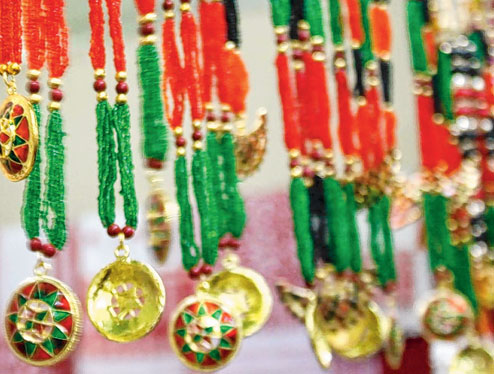
Dressed in muga xaaj with gamkharu on the hands, golpota on the neck, thuria on the ears and kopou phool on the graceful bun — this is probably how every Assamese woman desires to dress up for Rongali Bihu.
However, not everyone can afford traditional Assamese jewellery like gamkharu, golpota and thuria as these are expensive. But women don’t need to fret, as these designs are now available in cheaper versions.
Apart from traditional designs like dugdugi, bena, jethipotai, japi, xilikha, dhul and lokaparo, which have always been worn by Assamese women, they are now spoilt for choice.
There are many showrooms specialising in traditional jewellery but a bit of twist in the design to give them a modern look makes them really trendy. These new designs go well with not only mekhela sador and sari but also with salwar kameez, churidar, jeans and skirts.
While the original Assamese jewellery is plated with 24-carat gold (locally known as paat xun) and starts from Rs 15,000, the new ones, made from silver and then electroplated with gold, start from Rs 1,200.
The technique of making the original jewellery and the gold-plated versions also differs.
“Traditionally, Assamese jewellery is made from paat xun and the technique and designs date back to the Ahom era. In this technique, we make a piece of jewellery from lacquer and then plate it with 24-carat gold. The technique of making jewellery is a tradition with many families — handed down from generation to generation,” said Lakhimi Baruah Bhuyan, an Assamese jewellery designer and owner of Zangfai, a showroom in the city.
Besides, original meena work and Jaipuri semi-precious stones are used in the traditional jewelleries.
“The price of a pair of original earrings and a neckpiece starts from Rs 15,000 while the entire set, together with bracelets and rings, costs about Rs 50,000. The price increases based on the size and design of a piece of jewellery,” Bhuyan said.
The designs worn by people in Upper Assam districts are a bit different from those in lower Assam. “While the designs from Upper Assam are carved from lacquer and plated with 24-carat gold, the designs in lower Assam districts are such that they cannot be made from lacquer. They are embossed from dice with silver and then plated with 22-carat gold,” said Mrigakshi Bora, a jewellery designer, who owns the showroom, Mrigakshi.
The newer versions of Assamese traditional designs are made from silver and then electroplated.
There are also several qualities of such jewellery and these can be made by any jeweller.
 |
Barnali Handique