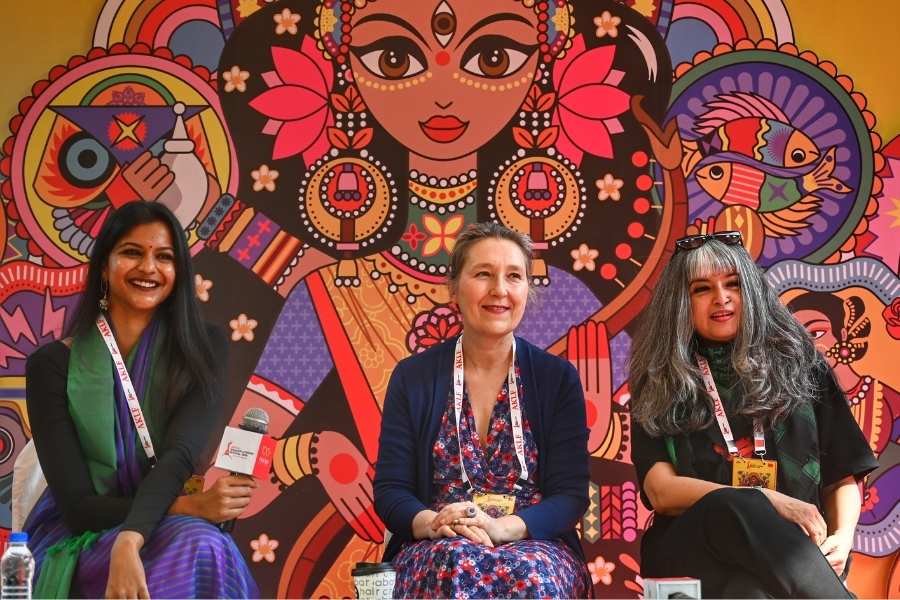
Parenting coach Riri G Trivedi opined that new-generation parents were more ‘permissive’ in their parenting style, which has an impact on the emotional and mental well-being of the Gen-Z generation.
Trivedi, who is also a psychotherapist and author, was speaking at a session titled ‘Growing Pains: Gen Z and Preparing for Tomorrow’ at the Apeejay Kolkata Literary Festival 2026. She was in conversation with University of Delhi professor and academic influencer Vijender Singh Chauhan, moderated by educator and social worker Sujata Sen.
The session focussed on the challenges faced by Gen Z, including mental health concerns, academic pressure, identity formation, digital fatigue and the growing need for emotionally secure environments at home and in educational spaces. The speakers focussed on how changing family structures, technology and shifting social expectations are shaping young people’s experiences.
Speaking on parenting styles and their impact on mental and emotional well-being, Trivedi reflected on her own generation’s upbringing.
“My generation has grown up with belt treatment, punishment, threats, my way or highway, one-way communication, highly authoritarian, disciplinarian, violence-based parenting,” she said.
She contrasted this with current trends, noting that “the new generation parents are now going more and more for permissive parenting,” describing it as “a complete polarised opposite.”
According to Trivedi, this often translates into an environment where parents say, “no rules, you know, you do what you want.”
She warned that both extremes can harm children and adolescents. Trivedi linked authoritarian parenting to outcomes such as addiction and depression, while permissive parenting, she said, can lead to entitlement and a lack of discipline.
Stressing the need for balance, she observed that “the toughest is the right kind of parenting, which is authoritative and balanced,” adding that while shortcuts may appear easier, sustained effort and open communication are essential for emotionally secure homes.


Chauhan extended the discussion to academic pressure and aspiration-building among Gen Z, arguing that young people’s goals are increasingly shaped by forces beyond parents and educators.
“It's something else which is curating their dreams, which is algorithmic,” he said. He clarified that “it's not even the content of social media, because the content on social media is only a product.”
Pointing to deeper, less visible influences, he added, “what lies behind that content are those algorithms which none of us really understand.”
According to Chauhan, these algorithm-driven aspirations contribute significantly to stress, regardless of outcomes. He noted that young people experience pressure “both if they are successful or unsuccessful in achieving them,” and emphasised the need for parents to develop critical awareness of these influences.
Highlighting a generational shift, he said, “In our generation, it was very clear,” but added that today, “you do not have that kind of agency over our own next generation.”
Despite the concerns, both panellists acknowledged Gen Z’s growing self-awareness, particularly around digital fatigue. They pointed to behaviours such as young people using applications to limit phone usage and recognising the emotional costs of constant online engagement.
Moderating the session, Sen connected the discussion to the lived realities of young people negotiating uncertainty and questioned whether parents still exert meaningful influence.
The conversation concluded with a shared view that as traditional authority weakens, Gen Z needs not less involvement but more balanced guidance, emotional security and honest communication to build resilience in an unpredictable world.