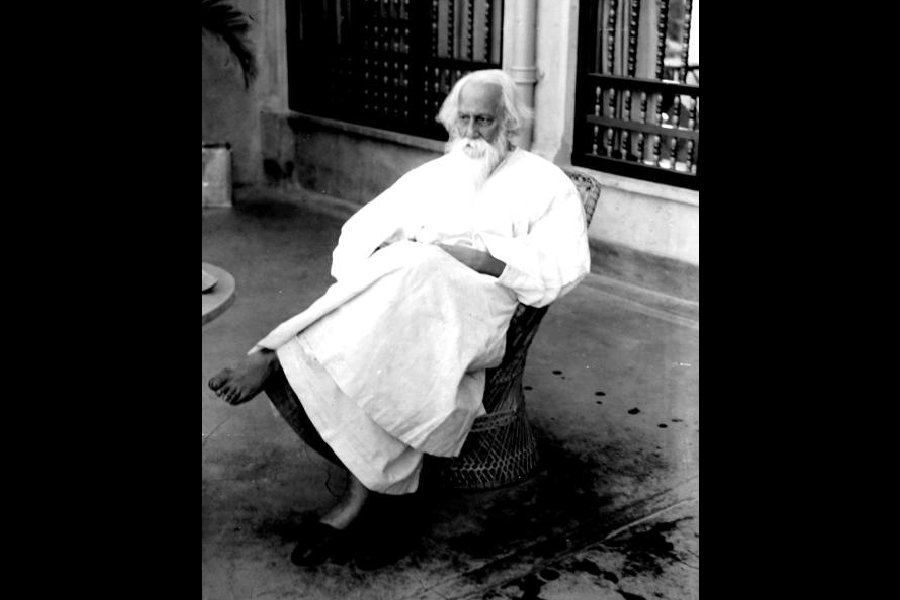
What began in 2009 as a tribute to Rabindranath Tagore recently marked its tenth edition at Madhusudan Mancha. Organised by Abhigyan and conceptualised by Agnibha Bandopadhyay, Swolposhruto Rabindrasangeeter Asor aimed to connect the legend and the listener by reviving Tagore’s overlooked melodies.
Despite repeated requests, this reviewer was not provided with images of the event. This speaks of a glaring lack of professionalism. But the organisers’s efforts to celebrate lesser-known Tagore melodies are heartening since many listeners of Tagore are only familiar with his popular works. For singers, as Srikanta Acharya pointed out during his performance, it opens up new avenues to learn and think about Tagore.
The evening began in a unique way, with a chorus of 101 performers, marking a grand opening. This was followed by a series of dance performances accompanied by live music. The microphones at the base of the stage occasionally captured the sounds of the ghungroo, drowning out the off-stage vocals — a detail that the organisers should have anticipated, especially since this was a Kathak fusion act where footwork is central. Worse, the sound systems failed to do justice to the more intricate, nuanced portions of the compositions in this section. However, Rahul Chattopadhyay’s sitar was a standout, particularly in “Aji dokkhino pobone”.
In the evening’s second segment, Subrata Sengupta mostly selected compositions from Tagore’s later years. The esraj accompaniment — particularly during the opening of “Adhar ratey ekla pabo” — was mesmerising, mirroring the song’s sombre mood and Sengupta’s voice. Pramita Mallik focused her selection on songs that Tagore composed during his 1912 European journey. Her rendition of “Jibon jokhon chilo phuler moto” highlighted how the essence of spring — whether experienced in Berlin or Santiniketan — remains universal. Mallik’s experience was evident not just in her vocal delivery but in her knowledge of each composition. Srikanta Acharya’s performance was poised and controlled, especially in “Mohabishye mohakashey”, which was one of the most memorable performances of that evening.