When the rice mills replaced the traditional dheki in the hinterland, when power looms replaced manual ones, when the old method of chhad petano — the process of repeatedly beating a newly built roof to level it and make it leak-proof — changed, they simplified the lives of many women, but the new technology also devoured something precious.
For thousands of years, women have composed songs while at work, be it in the fields, rivers, forests or some corner of their home. They had songs for sowing, harvesting, winnowing, weaving, collecting wood, sweeping, grinding, cradling babies… They are called srom gaan.
“For unlettered women, these songs were emotional expressions. They alleviated the great physical strain to an extent and also created a bond between them,” says Chandra Mukhopadhyay, 71, who is a researcher, collector and writer based in Calcutta.
For the last four decades, Mukhopadhyay has travelled across eastern India collecting hundreds of songs in Bengali passed down from one generation to the next orally.
Some of these songs are collected in her book titled Naarir Gaan, Sromer Gaan (Songs of Women, Songs of Labour). She has also curated some of them in Geedali, which is a YouTube channel.
The oral tradition of women singing at work is considered a socio-cultural record of unheard voices in India as well as abroad. Similar to dhekir gaan, songs of cornmeal grinding constitute a feminine legacy of many South American and African tribes. Women in southern and western India, especially Maharashtra, also have a rich collection of grindmill songs about the trials and tribulations of everyday life, celebrations and even intimate self-expression.
The People’s Archive of Rural India, an online repository, has collected over a lakh of such songs from Maharashtra and Karnataka for its Grindmill Song Project.
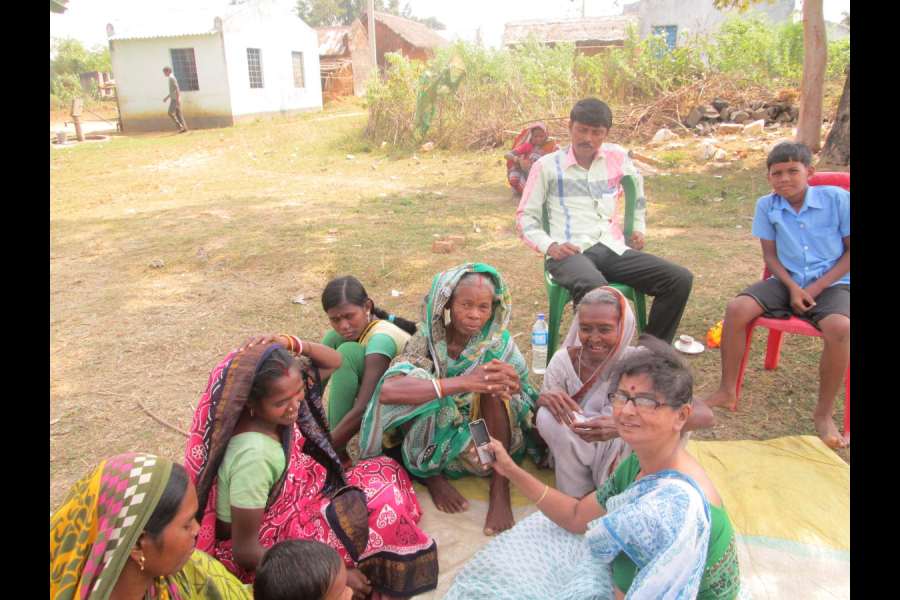
Mukhopadhyay’s collection has no institutional support. She says, “Initially, I used a cassette recorder, but later I converted those recordings to compact discs. Now I use a smartphone and digitise them.”
Mukhopadhyay started collecting songs in the early 1990s when she was teaching in a girls’ school in Birati. Women from a nearby refugee settlement — they were from Sylhet and Faridpur — would sing a variety of songs there. Later, she visited almost all the districts of West Bengal and even beyond to record songs.
While travelling, she learnt that a majority of the songs relate to agriculture, production and gathering food for the family. The rice paddy culture in eastern India requires intensive labour by women — from growing paddy saplings to making puffed/flattened rice and even making pithe puli during festivities.
The songs reflect sorrow, grief, protests, pleasure and even physical longings. For instance, a song collected from a group of women peasants in Purulia goes: “Dewdrops can’t quench the thirst of soil, you need rain/A lover must not stay away, but cling to you.
Songs are sung even as the bountiful harvest is weighed. There is a song that talks about how a landowner promised women new saris while employing them to plant paddy saplings, but later reneged on it.
In Purulia, Bankura, Birbhum and the districts of northern Bengal, women still sing while sowing, tending to and winnowing paddy. Some rural communities believe that since women symbolise fertility, they must sow and sing specific songs for a good harvest. “Ushering in rain is also considered women’s responsibility in northern Bengal,” says Mukhopadhyay.
Many of the songs stress women’s independence in a pastoral society and identify certain skills in which women excel.
Naba Dutta, a labour and human rights activist, laments that as organised labour is slowly disappearing with automation, we are losing many types of jobs and related songs. “Since tea plucking and bidi making are continued to be done manually by women, I still hear labour songs of these workers,” he says.
Mukhopadhyay talks about a new trend among village girls. They have come forward to preserve these songs in the form of reels.