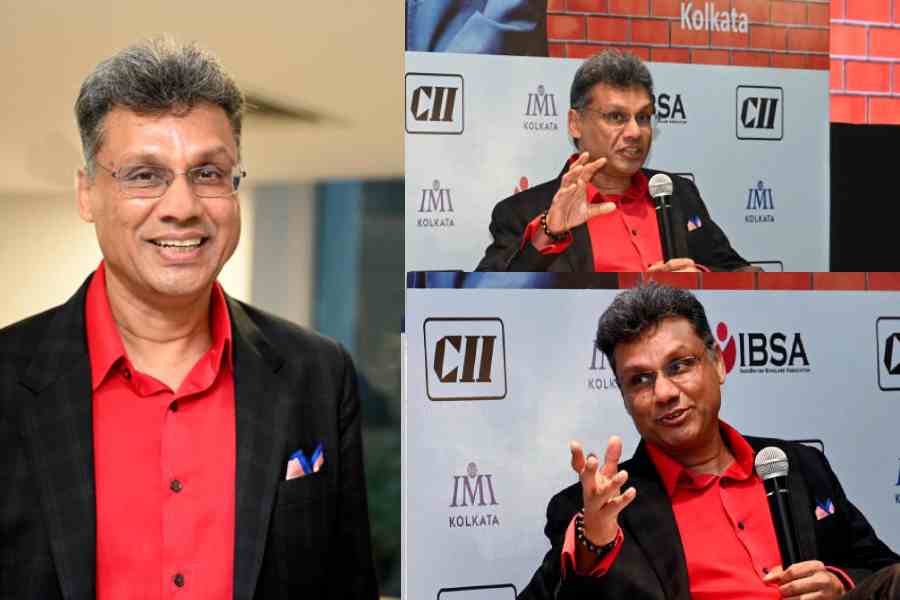
Marketing strategist Nirmalya Kumar has taught at top business schools across the globe and headed strategy for top corporations like the Tata Group. On the sidelines of an Indo-British Scholars Association (IBSA) event in Calcutta to talk about the clash between Walmart and Amazon in the retail space, Kumar shared his vision of the future with t2oS and talked about his love of Bengal art as well. Excerpts.
In the last couple of years we’ve seen AI come up very, very quickly and it has proliferated into all sorts of things. How do you think this is going to influence the way marketing is going to be done in the future?
See, AI is very good at optimisation of tactical things. So, it is very good, for example, in helping us understand how to schedule our advertisements, how to place the advertisements, where to place the advertisements, what are the ranked vehicles and all. It will be very good in helping us optimise all of that. Where AI will be less useful or marginally useful is in making creative strategy.
The creative strategy part, those brilliant ideas that people get which makes their advertising stand out, that part is still missing. In fact, a recent paper was published in Harvard Business Review, where they looked at strategy and they asked AI, they looked at various platforms of AI from ChatGPT to Grok to everything and they asked AI to make strategy and what they found was most of the strategy made by AI was very undifferentiated. You see, it was more of the commonality rather than what we are looking at in marketing — differentiation.
As we say in marketing, be distinct or be extinct. If I’m not different, there’s no reason for a customer to buy me, no reason to pay a price premium for me. All of marketing really has one goal only, how to create a differentiation between what my brand is and what the competitors’ brands are offering in the mind of the customer on an attribute that is important to the customer. This is the holy grail of marketing that we’ve been looking for, every brand is looking for. And, so, in that kind of creative strategy part and marketing strategy part AI will be less important.
Basically what AI is going to be very good at is reducing the number of people we have doing background research. On all the brands. You know, we spend so much time having MBAs doing background research on all the brands, what is each brand’s pricing, what it stands for, where is the distribution channel — this AI can do in two minutes. But what it can’t do is what should my brand do next. Where should I be? Once I’ve decided my creative strategy, and I want to know how to advertise that creative strategy, which vehicles I should have, which Google optimisation I should do, AI can help over there.
You are talking about AI doing what MBAs have been doing, analysing and all of that. That is going to eventually wipe out a lot of jobs, right?
Mostly white-collar jobs. Blue-collar jobs are well protected. So it’s not going to replace my plumber. We are talking about those people who were manipulating information. Gathering, manipulating, organising information, those kind of jobs. What they can’t do is things which require real skills.
So, what we’re talking about is it’s wiping out a lot of jobs which require average merit… it won’t be taking over from the food delivery guy or a surgeon...
Food delivery guy remains, surgeon I don’t know. Because, right now, the latest data shows that surgery done by robots is superior to surgery done by humans. So, once I marry AI with robots, then I have a different equation going. Looking into the future, essentially people are going to lose a lot of work. But there is this flip side that I need a lot of people to manage AI. You see the hiring that is going on in the AI world and how much they are paying these AI experts who they are hiring, NVIDIA and all of that.
Right now it’s in the early stages...
Yeah, but they will need to hire people, you see, and they will also need people to manage and run the robots. The skill set differs. So, there’s creative destruction. Jobs will be destroyed and jobs will be created but many of the jobs that we covet today may not be of value tomorrow.
But will people be able to skill up in new things as fast, as quickly as the change?
Some will and some won’t. Now what we hope is that the young people are gearing up for the skills of tomorrow and not for the skills of yesterday because the skills of tomorrow are going to be the AI-enabled skills. If you were learning coding, this is not going to be a useful exercise anymore. But learning how to improve AI engines, that’s a good skill. Learning how to use AI more valuably, what prompts to use, that’s a good skill to have.
So, for somebody who’s a youngster today and coming into a world where technology and paradigms are shifting like every two three years, how does that person manage to stay relevant?
So, firstly when young people come to me I tell them — I don’t tell them this in India because if I tell them this in India they think I’m an idiot — become a plumber, become a roofer, become a carpenter. You know how much I pay my plumber in the UK a day? One thousand pounds a day. And he has a waiting list. So, those jobs don’t go away. Those are jobs based on skill and human dexterity.
All these years we’ve been trying for these white-collar mid-management jobs. These jobs will be a lot fewer.
Coming back to the messaging and marketing and so on, nowadays we get literally bombarded with all kinds of messages, be it political, be it product marketing. So how does one negotiate this landscape? I mean there is as much authentic information as false information...
What has happened is advertising clutter has been increasing over the years, over the decades. The number of advertisements a person sees has been growing every year. Earlier, we used to have one minute advertisements, now we have 30-second advertisements. We used to have two, three-minute reels in the movies, now we have 60-second reels in the movies. So the number is going up, the attention span of people is limited. What it means is that for brands and for companies, we have to work a lot harder to create the differentiation. Differentiation then has to be executed through the creative strategy, which is the advertising. Even if I have a good message but I don’t have a good execution of that message in advertising, it’s not going to land on the people because of what you said, the advertising clutter.
Now, in terms of the second point that you brought up, which is about the false information, which there is a lot of and we do need some guardrails to penalise people who do put out blatantly false information. You know there’s some amount of exaggeration, that is okay. That is normal marketing. But we need to make sure that if you do false advertising you are taken to task. We also need to protect our children, that certain amount of social media they cannot access. So we have to put these guardrails in.
On a different note, I wanted to ask you about your interest in art and your art collection. So, for starters, how did you develop an interest in the Bengal School?
I was brought up in Calcutta, so I was always interested in art. I still have my home only 200m from here in Alipore. When I saw a Jamini Roy painting for the first time in my life, in 1988, I fell in love with him. And so I started collecting Jamini Roy and, from there, I started collecting other Bengal school art also.
That time they didn’t have any price, it didn’t cost anything. And same thing with Rabindranath Tagore. You know for ₹1lakh you could buy a Rabindranath Tagore in those days. And people told me ‘How can you spend this amount of money on a painting?’. Let me just tell you that because the wealth creation in India is in other parts of India rather than Bengal, so the prices of Bengal school art have not really gone up. Indians like to buy Indian art, within that, Bengalis like to buy Bengal art and the Bombay people like to buy Bombay art and the Delhi people like to buy Delhi based art, right? So the only artists from Calcutta whose prices have gone up dramatically, I would say, [are] Jamini Roy, the second would be Hemen Mazumdar, and the third would be Ganesh Pyne. And these are three brilliant artists. So, I have no problem with their prices being very high.
Jamini Roy should be as high as any of them, but his prices are not that high. But he is, for most Westerners... if you show Indian art, most Westerners will say Jamini Roy is what Indian art should be. So foreigners love Jamini Roy because they feel he is the amalgamation of what modern plus Indian should be. In that way he is the father of Indian modern art and, in fact, when I did an exhibition of his in Nehru Centre in London, it was opened by M.F. Husain and he said, ‘I only came because of Jamini’s exhibition and I want to tell you I used to go to Calcutta and I used to visit him in his house and he was a true patua, sitting on the floor and painting away and I still will say that I agree he is the father of Indian Modern Art’. And that was M.F. Husain in his usual magnanimous style acknowledging Jamini Roy was the father of Indian Modern Art.
The problem is that Indian art collectors and even the Indian art advisors have all been in the market less than 20 years. They have never had a course in art history. Especially the collectors. You see, in the UK, US, Europe, if you go to school, you will have had a course in art history sometime along the way, which makes you appreciate what art is. In India, we have not developed that appreciation as to what is modern art. Modern art is art when you start painting what the mind can see and not what the eye can see.
And Jamini was the first coming from a tradition of Indian art, which was basically the patuas from Bengal and Kalighat, and he took their painting, which was very traditional, and he brought the sophistication of modern contemporary art to it for that time. That’s what makes him such a unique figure. Even Partha Mitter in his book on Indian art says that.
And now some people think of art as an investment vehicle. And I just want to say that is the worst idea ever because art is a terrible investment.
And why so?
Art is a terrible investment for five reasons. First reason is there is no price transparency.Second reason is very high transaction cost. To buy and sell art in the auction, there’s 30 per cent commission. That is what the auction house is charging. Third, storage cost. You have to insure it, you have to clean it, you have to look after it, you have to secure it. Number four is that unlike real estate which gives you rent, unlike bonds which give you interest, unlike stocks which give you dividends, art has no underlying cash flow. You see, so it’s a bad investment. So you should only buy art where it is your extra money and you can enjoy.
You have a particular affinity for Hemen Mazumdar?
For Jamini especially. And then Hemen. And then Rabindranath Tagore. So, those are the three.
So Hemen Mazumdar is the first artist really to capture Indian feminity using a Western academic style, which is what the eye can see, reproducing that faithfully. And he used that to capture Indian femininity. And he was modern only for one reason — because he broke the rules. He was showing upper-class Bengali women in undress. You have to remember this is 1920. Bengal is under purdah, especially the upper-class women. And he was painting them nude.
Now of course the question becomes where did he get the models? Because no upper-class woman is going to pose for him. So, we think all the models are his wife. And that’s why you see the more nude the picture is, he never shows the face. He only shows the back. And he is the one who invented, with Pallipran, the wet sari concept. How do you show a nude without showing a nude? This is what Bollywood picked up. Bollywood’s wet sari comes from Hemen Mazumdar. He was a dramatic guy.
Rabindranath Tagore, Hemen Mazumdar and Jamini Roy were having an argument as to what is modern Indian art, in the 1920s and 1930s, not physically but through paintings. Hemen is painting Indian women in the Western academic style and he is saying Indian modern art is Indian subjects painted in a Western style. Jamini Roy is saying that this cannot be Indian art. Indian art must be Indian not only in its subject but also in its conception. So, he is drawing from the Kalighat [style] and the patuas and converting that into modern art. Tagore is observing this argument and then he writes an article in which he says I don’t understand why we have to produce something like Indian art. We are not branded cattle. He says ‘Anything I paint is Indian modern art’ and his art is totally unique because basically it is nothing like anything that came before or after. His paintings are just an outpouring of his luxurious imagination on paper. And he was never trained to be an artist... at some level though, of course, you have to remember that in the Tagore household all the kids were trained in everything. But he was never professionally trained as an artist but he started painting at the age of 60. After winning the Nobel prize in literature, he said that there are some things that I cannot express in words and he started painting. And his paintings are deep, dark, depressing, and they are also very ambiguous. You never know in his paintings who he is painting. Just like in his writing you cannot make out, is he talking about himself, his lover or God. It is always ambiguous.
Do you collect other artists as well?
Na, I only collect Bengal School, 1860 to 1940. That’s it, because that is the birth of Indian modern art. Bengal was the place where Indian modern art was born. And the story of the birth of Indian modern art that has been said beautifully by Partha Mitter in his book The Triumph of Modernism - India’s Artists and the avant-garde 1922-1947 is actually not as well-known as it should be in the general population. Of course, in the art world it is known. And today, perhaps, when Bengal is eclipsed on many dimensions, it still made that contribution as we did in many other fields.
And how big is your collection now?
We have about 200 paintings.
Why do you think Indians spend less on art than people do in the rest of the world? I mean prices are rarely similar to what global art fetches.
We have been living in a scarce society till 25 years ago. Where will we spend money on art when we can barely eat and drink and buy a car.
But there was always a bunch of people who always had money and they still do.
They always collected art. The Birla collection is fantastic. The Tata group had a great collection of art. And there were rich people in Calcutta who were collecting art like crazy. But the thing was that in those days art was not a very popular subject, nobody outside the homes knew. Some of the Marwaris in Calcutta, by the way, were the biggest sponsors of the Bengali artists. The other great collections of Bengal art was with the zamindars. Many of them have now fallen on hard times and they are short on cash. So those paintings are finally coming out.