Marcel Proust argued that the past survives in unexpected sensations, waiting to be awakened by an image, a texture or a fragment of landscape. An Ancient Ballad at Emami Art unfolds in much the same way. The exhibition allows images to return like memories, familiar yet transformed. Landscape, foliage, animals and the human figure recur across the works of 12 artists, revealing artistic traditions that endure through reinvention rather than repetition. The exhibition evokes the cyclical rhythms of memory while tracing the many ways artists revisit inherited forms through changing materials, social realities and visual languages.
An Ancient Ballad opens with works by L.M. Sen and K.C. Pyne, whose practices establish two distinct trajectories within twentieth-century Bengali art. Sen’s
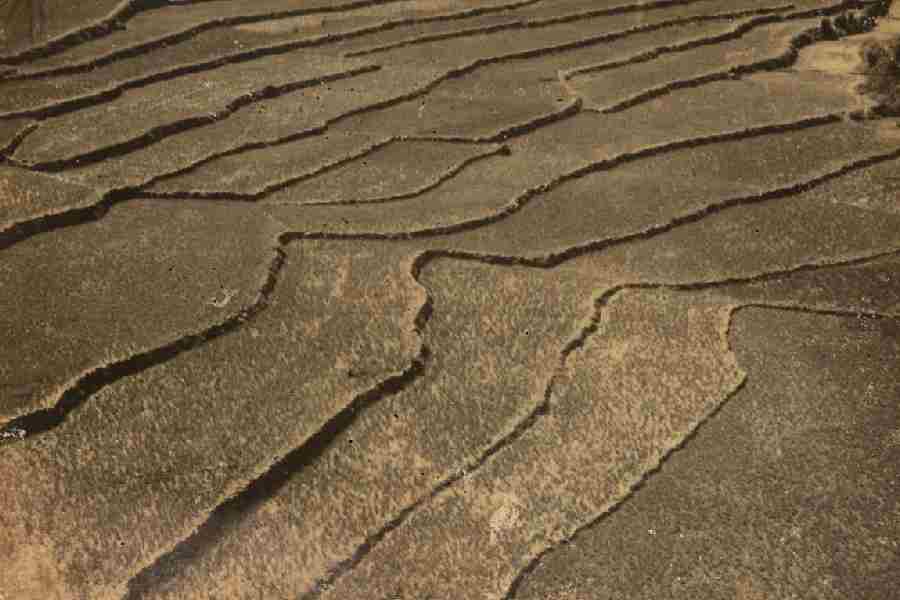
photographs (picture) and landscapes retain the lyricism associated with the Bengal School where atmosphere, light and place became vehicles for cultural self-definition during the nationalist period. Pyne’s paintings move in another direction altogether. His enigmatic figures, suspended between the human and the animal, draw upon folklore, surrealism and the psychological imagination, recalling the dream worlds
of European modernism while remaining deeply rooted in Bengali storytelling. Together, they frame the exhibition as a conversation between observation and imagination.
Nature becomes both subject and material in the works of Arunima Choudhury and Ajit Kumar Das. Choudhury’s eco-prints preserve the physical imprint of leaves and plants, allowing the environment to participate directly in the act of image-making. Das’s kalamkari paintings, created with natural dyes, celebrate fish, lotus leaves
and organic forms through painstaking craftsmanship. Their practices resonate with the idea that the handmade object carries ethical and ecological significance while simultaneously affirming South Asia’s long traditions of textile-based visual culture.
Alakananda Sengupta’s terracotta sculptures command attention through their quiet, emotional intensity. Her distinctive method of introducing colour into the clay before firing creates surfaces that appear inseparable from the body itself. The female figures, adorned with floral motifs, suggest fertility, resilience and kinship with the natural world without descending into allegory. Nearby, the sculptural works of Tapas Biswas, Subrata Biswas and Partha Dasgupta extend this dialogue between body and material, drawing upon folk idioms while embracing the formal freedom of contemporary sculpture.
The exhibition broadens further through Chandra Bhattacharjee’s atmospheric landscapes where colour dissolves form into memory; Raja Boro’s structural investigations of balance and space; Rahul Sarkar’s woodcuts, which employ the graphic force of printmaking to examine queer identity and social visibility; and Sayandeep Kangsabanik’s monumental monochromatic studies of foliage whose rhythmic repetition recalls both miniature painting and modern abstraction.
Each of the artists understands that medium is a repository of memory. Clay retains the pressure of the hand, cloth absorbs pigment, wood records every cut of the carving tool, and the photographic print preserves a fleeting moment that has already become history. In that sense, the works on display at An Ancient Ballad do not reproduce the past; they return to remind viewers that every act of seeing is also an act of remembering.