The competitive section of the 59th Annual Exhibition of the Birla Academy of Art and Culture was distinguished by the presence of highly-talented young award winners who have mostly emerged from the districts. They are gifted with a capacity for independent thinking and display an awareness of political and environmental
problems facing India. Their talents deserve to be nurtured for fruition without depending too much on the market.
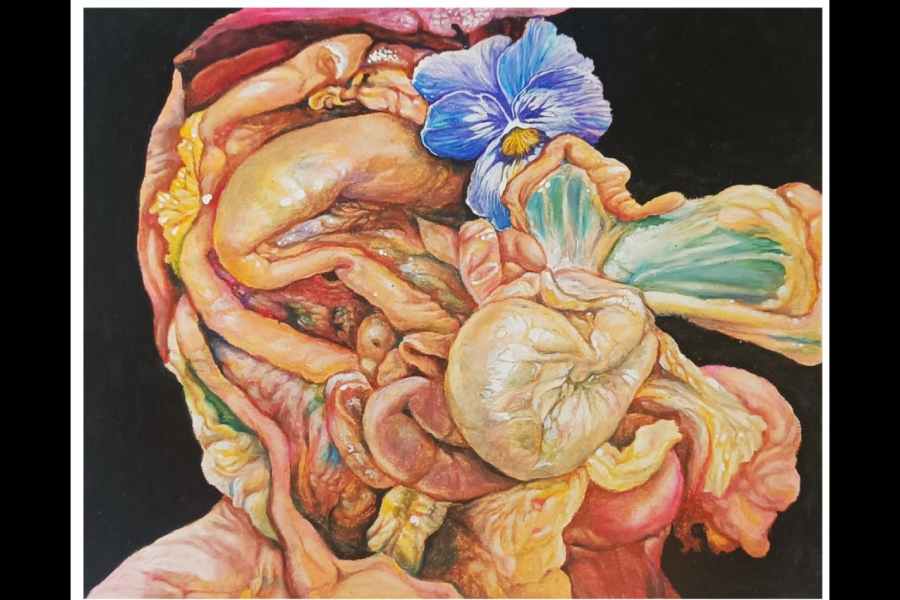
One of the most arresting works is an oil pastel by Pralay Mistri. A flower blooms amidst the garlands of viscera painted to glossy perfection like the ghoulish maquillage
of a fading star (picture). Another fascinating image was Mousumi Roy’s pen-and-ink drawing of a section of a vertebral column with fungi that resemble moths sprouting from them. Both have the imaginations of Jacobean dramatists, and they have the potential to flourish. Subho Dibbya Mudi creates complex hybrid forms by weaving discarded rubber cords used in heavy vehicles that are major pollutants. He learnt the craft from traditional weavers who had to give it up for more lucrative jobs. Mudi’s installations resemble intricate jottings with pen and ink. Aishi Biswas explores the shock value of a dark, black-and-white portrait. It is hard to believe that it was taken with a mobile phone. The candlelight procession by the self-taught artist, Prasanta Mandal, created with Indian ink, shows the futility of protests unless followed through. His figures are animated by tremendous energy.
Two eye-catching, if somewhat disturbing, large works were Arnab Das Adhikari’s acrylic and charcoal depiction of an aborted calf foetus and Rumpa Sasmal’s levitating,
rumpled bed and pillow. Sunil Lingu Shirodkar’s malformed marine creature with udders is typical of an artist who was brought up in a Goa village. Manik Kumar Ghosh’s etchings of lacy lingerie with intricate drawings become symbols of oppressed women. Subhajit Hazra’s delicate watercolours of the vanishing sickle stand for the crisis facing Indian peasantry and the mechanisation of farming.
The concern for the use/misuse of land and intertwined memories and artists’ response to this are the issues explored in the exhibition, Zameen, curated by Ina Puri and also a part of the 59th Annual Exhibition. Map-making is a theme that runs through the works of a good number of participants. It begins with Zarina Hashmi’s woodcut prints based on the maps of Delhi with a dense network of lines, resurfaces in Debasish Mukherjee’s rice paper and mixed-media work based on the changing face of Benares, where, recently, centuries-old built heritage is being bulldozed in the name of progress, and appears again in Shambhavi Singh’s large iron plates on which lines have been pierced through to trace memories of woods and ponds. These are part of an ‘inheritance’ as opposed to a piece of property. Riyas Komu’s Stepwell reflects timeless memories of life that revolved around these architectural wonders.
At first sight, Birendra Yadav’s work may appear to be an example of crazy china, but closer inspection reveals the tools of labour drawn on each fragment, implying violence and erasure. Ratheesh T.’s apparently peaceful paddy fields conceal the uprisings of outcast peasants who struggled for dignity. Human limbs surface through the tsunami of lines in Vikrant Bhishe’s fine work. The struggle for identity and dignity is never-ending.