Ekushe, tucked inside one of College Street’s narrowest lanes, opened its shutters briefly one day last week. There was something bereft about the place. The books looked like a family come undone — The Making of Indian Diplomacy, Odysseus Abroad, Towards Another Reason, classics, books on Islam, Hinduism, Hegel… A blue flask and some overturned paper cups made for a solemn huddle. And the lone bench rubbing shoulders with an ochre door was missing an occupant.
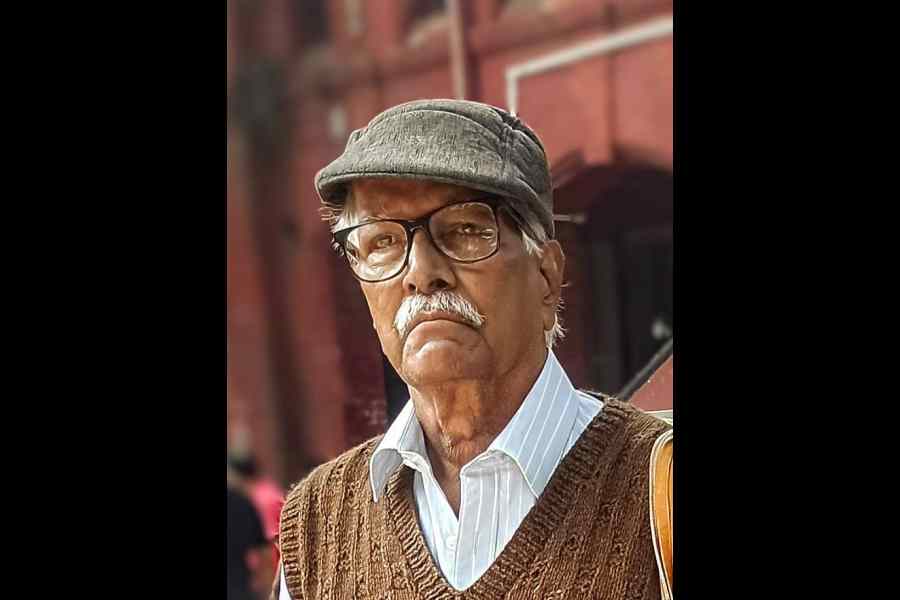
The guardian in chief of Ekushe, Kamal Krishna Mukherjee, known to all as Kajalda, died earlier this month at the age of 87 following a brief illness. “This is where Kajalda would sit and pour each of us a cup of tea. Only then would the day’s work begin,” said Debnath Majhi, who was Kajalda’s assistant at Ekushe.
A student wandered in, picked up a copy of Expanding Frontiers in South Asian and World History and started to flip the pages. Chayan Mukherjee, who also worked at Ekushe many years ago, told The Telegraph, “Ekushe is not a bookseller’s shop. It is for readers.” He added, “Kajalda could not bear the thought that a student might not get to read a book just because he or she was not able to afford it. He was always lending books without so much as a receipt.”
Ekushe was not founded by Kajalda but by his friend Asit Sen in the late 1970s. In the initial years, it stocked only Bangladeshi publications; the name itself is a nod to the Bengali language movement of 1952. In the late 1980s, when Sen died, Kajalda took over the shop.
In the course of the interviews conducted for this piece, some over phone and some at Ekushe that day, one thing became clear — books meant more than one thing to Kajalda. Through books he connected with people — some more than others; books were the mainstay of his conversations; and books were his window to a great big world. As Soumitra Sreemani, associate professor of history at Netaji Subhas Open University, said of Ekushe, “Ek chilte ghar kintu onek gyan.” Meaning, a tiny room but filled with knowledge.
They, his bookfriends, discovered him at different points in their lives. Prabhat Kumar met Kajalda when he joined Presidency University as an assistant professor in 2012. Kumar, who now teaches history at the Centre for the Study of Developing Societies in New Delhi, said, “Back then, we could not find copies of expensive books on the Internet. So we went to Kajalda. He would tell me, ‘Aap le jayiye, jab paisa ayega de dijiyega, nahin to koi baat nahin’.” Hia Sen, who teaches sociology at Presidency University, said, “I remember finding a copy of Three Ways to Be Alien by Sanjay Subrahmanyam in Kajalda’s shop. And when I was designing the syllabus for some of the core and optional courses, I would go to Ekushe and browse the shelves, discuss the books with him, even consult him. I know many of my colleagues from the history department did this too.”
Assistant professor of political science at Calcutta University Jigme Yeshe Lama said, “Kajalda used to bring books for our library and personally oversee every delivery.” He continued, “Kajalda got me the 10-volume set of Subaltern Studies: Writings on South Asian History and Society edited by Ranajit Guha. I couldn’t find it anywhere.” Sarbani Bandopadhyay, who teaches at St Xavier’s College, spoke about how Kajalda helped her with her doctoral thesis. She said, “I didn’t know where to begin. It was he who guided me and put me in touch with people.”
Writing about Kajalda, having never met him, feels a bit like piecing together a puzzle. It was Chayan Mukherjee who explained what Bandopadhyay left out. He said, invoking the present tense, “Kajalda has a strong network of friends across the universities in and around Calcutta.” And just like that for a brief moment Kajalda was alive again.
As it often happens with puzzles, random pieces find their way into random gaps, constantly altering an emerging picture. Sunish Deb, 73, is one such puzzle piece. Deb remembered Kajalda in all his avatars — idealist, rebel, sedate keeper of books…He said, “During the Gouribari Andolan of 1984, which had seen a large neighbourhood
rally against a handful of powerful goons, Kajalda united everyone, especially the women.”
Deb shared an anecdote. When a car ran over his foot, Kajalda called him up. Deb ran to the spot only to find him in front of a bookstore in Salt Lake, sitting on a stool, smoking a cigarette while bleeding profusely.
A Kajalda anecdote is sure to feature cigarettes. It seems conversations at Ekushe started with a generous offer of tea, cigarettes and a “ki khobor”. In some cases the cigarette became jhalmuri. Said Bandopadhyay, “For me, College Street meant adda with Kajalda. When a part of my research was published, he would tell anyone who would care to listen — ‘That is Sarbani’s book on the shelf’.”
She pointed out that selling books was not Kajalda’s passion, reading and discussing them was. Sreemani added, “He knew about the latest published works in the social sciences, which we as professors might have missed.”
The student leafing through Expanding Frontiers was done. Majhi came forward, insisted he keep the book. Seconds of yes-yes, no-no followed. Then both fell silent. The student perhaps because he did not know whether to accept such largesse in Kajalda’s absence, and Majhi because he did not know how forceful he should be without his mentor’s guidance.
A man with a backpack stuck his head inside the lane and shouted, “Kajalda achhen?”