There is something delightfully eccentric about the way Kate Evans speaks of her work. A conversation with her gives one the impression that she stitches together scraps of thought to create sentences that are as colourful as they sound; in many ways a tapestry of words and images that you must unfold together, both of you, when you speak to her. This is fitting for someone whose latest book takes inspiration from a historical, real-life quilt; a quilt stitched by an equally important historical, real-life person. Jane Austen, who, as one of our professors in Jadavpur University once fondly referred to as “the mother of chick lit”, was an uncommonly talented person, and one of these talents culminated in the creation of a patchwork coverlet, made along with her mother and sister Cassandra, around the year 1810. This patchwork coverlet, we were impressed to find out, was painstakingly made from thousands of tiny diamond-shaped linen and cotton scraps stitched together, and is now on display at the Jane Austen Museum (Jane Austen’s House) in Chawton, England.
While Austen’s needlework is far less a hot topic of conversation than her penmanship, it was nevertheless refreshing to stumble across Evans’s work on her life, based upon that same needlework itself. The very fact that the quilt inspired Evans to come up with her own, graphic novel version of the writer’s biography is intriguing — the book, aptly called Patchwork, is a bold reimagining of the life of the much-loved Regency writer, and marries drama, comedy, and historically immersive detail to bring alive Austen’s story. The fluid, dynamic artwork that accompanies the narrative is only the icing on the cake and makes reading about Austen’s life that much more impactful.
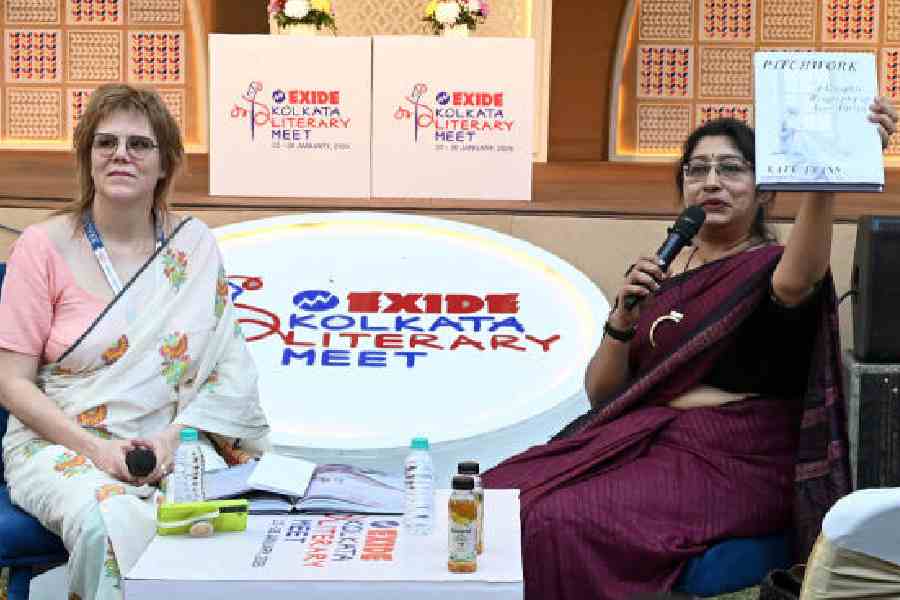
Evans spoke to us on the sidelines of the Exide Kolkata Literary Meet, and we came away slightly overwhelmed, not simply because of her infectious enthusiasm but also because of her wicked sense of humour. “I love Jane Austen! I absolutely adore her,” gushed Evans when we caught her over her evening tea, the Makaibari cup in her hands glinting in the light of the author’s lounge. “I’ve got a literature degree, so the first question I’m often asked is why I decided to (write the book as) a graphic novel. But it’s kind of like I’ve got a film running in my head when it comes to working on projects like these… I read all the available information, and then the story takes shape very instinctively in my head. It’s like writing a screenplay, followed by a process of editing, to get it down to the minimum number of words, because there’s such a restriction in terms of space. But (the book) was so much fun to do, even though I had to zone out the rest of the world for months!”
The word “fun” is an understatement. As a reader, what hooks one about Patchwork is its attention to detail, the signature artwork itself, and the fact that it is created out of Austen’s own words, taken from her correspondence and juvenilia. Evans essentially stitches together fragments of Austen’s letters, early writings, and biographical records, much like a quilt itself — tiny scraps forming a larger, vivid whole. The name is appropriate on multiple levels, including the way the book takes inspiration from Austen’s literal patchwork coverlet, while also symbolising the piecing together of her life, her novels, and the fabric of Regency society into a single narrative tapestry.
Austen is, admittedly, one of those evergreen writers who has been studied to an extensive degree. Multiple adaptations of her works exist, thesis papers are written ever so often, conferences held, and courses taught at the college and university level. She is among those names synonymous with English women writers of the canon, and the six novels she has left behind have carved their names into the annals of English literary history. The four that were published in her lifetime (Sense and Sensibility, Pride and Prejudice, Mansfield Park and Emma) did not bring her much fame; Northanger Abbey and Persuasion were published posthumously, and she abandoned another novel, Sandition, well into 12 chapters due to illness before she was able to complete it. Austen also left behind three volumes of juvenile writings in manuscript, an epistolary novella called Lady Susan, and an unfinished novel, which was later entitled The Watsons. However, since her death, her works have rarely been out of print, which only speaks of the following she amassed over the centuries.
When Austen’s 250th birth anniversary was celebrated in December last year, celebrations were held in the literary community all over the world, with brand new editions of her books being released by major publishing houses, a year-long series of festivals, talks, workshops, and performances at Jane Austen’s House, as well as special programming by universities and media outlets such as BBC Radio and The Sunday Times in England. It was thus only appropriate to have Evans attend the Kolkata Literary Meet in January this year, and the conversation she had with Professor Debnita Chakravarti to discuss her undertaking of Patchwork was equally insightful.
THE INDIAN THREAD
Austen had multiple ties to India, as is well known — her father’s sister, Austen’s aunt Philadelphia, was part of the 18th-century “fishing fleet” that moved to India from England in 1752, after which Philadelphia married Tysoe Hancock, an East India Company surgeon, and lived in Bengal from 1759 to 1765. Philadelphia’s daughter, Elizabeth, was the “goddaughter” of Warren Hastings, but speculations were rife that Hastings was her biological father, especially considering that Eliza was named after a stillborn daughter of the governor-general. Eliza grew up to marry “Comte” Jean-François Capot de Feuillide, who was guillotined during the French Revolution, after which she returned to England and married her cousin Jane’s favourite brother, Henry, in 1797. Due to her upbringing in India and life in France, Eliza was considered exotic and worldly by the Austen family and acted as a direct model for many of Jane’s characters. Her being close to the teenage Jane, 14 years her junior, encouraged Austen’s writing, and her dramatic tales of living outside England greatly influenced Jane’s early stories. Not to forget, plenty of Indian memorabilia, for lack of a better term, taken forcibly during the colonial rule from our corner of the country now find residence in museums across England, and these objects, though unsettling reminders of colonial extraction, also serve as a lens through which Austen’s family connections to India can be understood, thus adding yet another layer of complexity to the cultural patchwork that shaped her life and, indirectly, her fiction.
Evans’s Patchwork stitches together fragments of letters, anecdotes, and historical detail to almost create a living, breathing portrait of the writer. We begin our conversation asking how one approaches the task of condensing an entire life into a graphic biography — a format that is, by its very nature, brutally restrictive. “You have to do someone’s whole life from birth until death in a certain number of pages,” Evans explains, spreading her hands as if to indicate the enormity of what that entails. However, Evans makes it clear that that compression does not necessarily mean uniformity; she is thoughtful about which episodes earn more texture, and thus more importance, on the page. “I have to find the images and the words that summarise the periods of her life, and some of them I’ll put more texture into because there’s an episode that is comedic or important,” Evans says. “But there are also some that I have to gloss past.” Inevitably, this involves a certain degree of artistic manipulation — not fabrication, Evans is quick to clarify, but reordering. For example, Austen undertook a trip to London while in the process of writing Emma, but in Evans’s rendition, the London trip is placed after the completion of both Mansfield Park and Emma. Evans is upfront about her ‘manipulation of events’: “I would have had to create an artistic hole in what I’m doing otherwise,” she says, and she does not attempt to hide it at all.
The book includes detailed notes at the back precisely so that readers can track any point at which the narrative departs from actual historical records. “I’m not entirely wedded to the actual sequence of events,” Evans tells us, “Because I have the ability in the notes to say any point where it departs from the truth.” It is an honest and elegant solution to the perennial problem facing any biographer who must transform the messiness of a lived life into the clean arc of a readable story.
The visual research that went into the book was, by Evans’s own account, staggering. The Internet, she discovered fairly quickly, is of limited use when one is trying to render the precise curve of a Regency banister, or the exact silhouette of a horse-drawn carriage. “You try tapping ‘Regency table’, and it’ll take you to an antiques website, and it’ll show you a Victorian table and a Regency inkwell,” Evans says, with the particular exasperation of someone who has spent a great deal of time being led astray by search engines. Instead, Evans turned to country houses and period museums, which allowed her to surround herself with the actual material culture of the era. We ask her about the research process, and she heaves an audible sigh. “Oh, my gosh, it was so much,” she groans. “There was a hell of a lot of visual research that went into it. But country houses were very useful, because you can’t really find examples of Regency furniture on the Internet.”
Evans then goes on to describe an average day in her information-hunting process: most notably, she mentions the Georgian Museum at No. 1 Royal Crescent in Bath, where she photographed quills, nightstands, and washbasins, pored over cartoons and paintings from the period, and subjected them to critical scrutiny for what they chose to represent and what they omitted. “I could do you a whole talk on that,” she tells us, only half-joking. Even the visit to Clive House in Shrewsbury — where she encountered a palanquin seized from Siraj-ud-Daulah during the colonial plunder of the subcontinent — fed into her understanding of the material and imperial world that formed the backdrop of Austen’s England, even if Austen herself rarely addressed it directly in her fiction.
THE PERSEVERANCE OF THE PEN
The conversation naturally turns towards the genre of the graphic biography, and by extension, the graphic novel itself. Comics, Evans says, are themselves a growth market — a fact that sometimes surprises people in the UK, where the reading culture, she suggests with characteristic self-deprecation, has not always kept pace with that of India. “Nobody ever picks up a book back home anymore because they’re all philistines,” she jokes, before catching herself and gesturing outside the windows of the author’s lounge. “Compared to the cultured and amazing country you have here, of course,” she adds.
Evans genuinely seems to be struck by what she has observed during her visit to Calcutta: autograph hunters seeking out authors’ signatures, passengers on public transport with books tucked into their bags, newspapers being read in spaces where phone batteries might be low and Internet connection unreliable. “I haven’t seen an autographed book since the 1900s!” she exclaims. “But you seem to have such a culture of appreciation for linguistic richness here. Of course, you have 5,000 years of written history; your literature goes back so much further than ours. I’ve always found books to be quite egalitarian. There’s always a point in physically holding a book. It’s just so much nicer.”
Unsurprisingly, adaptations of Austen’s works have not escaped Evans’s scrutiny, especially considering that many on-screen versions of Austen have gone on to attain cult status in contemporary times. “There’s definitely a love for Austen,” she tells us, before noting that in Britain, the “gateway drug” in recent times often tends to be the screen rather than the page, despite adaptations not always being 100 per cent historically accurate. “I’m still not happy with the costumes for the upcoming Pride and Prejudice,” she tells us, referring to the Netflix series starring Emma Corrin that is set to release this fall.
Evans is equally eloquent in her praise for the 1995 BBC adaptation of Persuasion, and the 2020 film of Emma, both of which she singles out with particular reverence for the accuracy of costume. The 2022 Netflix adaptation of Persuasion, starring Dakota Johnson, is, on the other hand, a far cry. “I thought that was awful! It was really, really bad,” Evans says, pausing to wipe away a pretend tear from her eye. “They were trying to make it Bridget Jones. It was horrible!” (Fun fact: Both the novel and the 2001 film Bridget Jones’s Diary are loosely based on Pride and Prejudice.)
If there is one rendition, however, severely inaccurate yet in a category of its own, Evans concedes it is Bridgerton — fantasy, as she puts it, and not adaptation; a theme-park version of the Regency era with costumes that bear little relationship to historical record. And yet Evans is not entirely dismissive of it. “In a way its’s amazing that people can find something in Austen and the Regency that can spark so much creative divergence into so many other different ways,” she says of the Netflix show that has very recently delivered a sparkling fourth season, and is based on a series of books by Julia Quinn.
India’s own reimaginings of Austen do not escape Evans’s attention either. She mentions having watched the Tamil adaptation Kandukondain Kandukondain — the 2000 film based on Sense and Sensibility, starring Aishwarya Rai Bachchan and Tabu, directed by Rajiv Menon — and expresses genuine curiosity about Gurinder Chadha’s Bride and Prejudice (2004), a Bollywood-inflected retelling of Pride and Prejudice featuring Aishwarya Rai Bachchan and Martin Henderson, which she has not yet seen but is clearly eager to. “I love reinterpretation,” Evans says simply. “If it’s Austen, I don’t care. I’m watching it.”
BEYOND THE QUILT
When we ask what lies ahead, Evans is guardedly enthusiastic. She has, she says, a sense of the shape of three more biographies in her mind — a shape she cannot entirely explain, but trusts wholeheartedly. Two are of women from a period similar to Austen’s, with, she hints, “a very different kind of fire and spirit” from the silently subversive Austen. The third is a person still living, which means the project must wait. “Fortunately, they’re older than me,” Evans says, with the particular brand of dark humour that surfaces periodically throughout the conversation. “I just have to wait.” She will not name any of the three, unfortunately, despite gentle prodding. The shapes are there, held in reserve, filling themselves out gradually as she begins to read and research. “As I start getting my teeth into it, more little pieces fall into place in my head,” she says.
The conversation ends, as it perhaps ought to, with patchwork itself — not the book, not Austen, but the actual act of placing two pieces of fabric together. We ask what the word means to her now, after everything: the 26 months of work — “Yes, 26 months. Because I’m insane” — the 14-hour days, the months without a single day off between February and May, as Evans tells us, in which she “could just forget about the rest of the world, and say ‘sorry, can’t do the part, the talk, the thing — (I’m doing) the book, and it’s too much fun’”. The answer, when it comes, is unexpectedly tender. “At the end of the day, patchwork is still my happy place where I go and switch off,” Evans says, laughing. “Where, after I’ve done all the talking and thinking and researching and speaking and writing, I just go back, and I put two pieces of fabric together, and they’re different colours, and they look different, and then I add a third and then add a fourth. Just my happy, happy place. There’s no words for it at all. You don’t have to change the world or save it. You just have to make it a little bit more snuggly.”
It is, one thinks, exactly what Jane Austen might have said too.