Ramprasad Chaubey is a rickshaw puller in the College Street area. He starts his day at 6am with a glass of sattu sharbat but for lunch, he needs his ruti-tarkari. Before we proceed, here’s a note. Throughout this copy, if only to be idiosyncratic, we shall refer to the chapati or roti or phulka as ruti.
Ramprasad says, “Before the LPG crisis, I used to buy four rutis, alu tarkari, mircha and a slice of onion for ₹24. Now, they are charging ₹32 for the same.” When nations are at war, even in faraway lands, the blow lands squarely on the poor man’s stomach, quite literally the man on the street. Ramprasad has had to alter his diet. He continues, “I have three rutis now. I have to send money every month to my family in Bihar. I cannot send them less, can I?”
On the pavements of Calcutta, all through the year, food stalls sell a variety of bread. These shops in office paras, outside government hospitals and courts, even in residential areas, open early in the morning and continue doing brisk business till late afternoon.
Amitava Purakayastha, who conducts food walks in north and central Calcutta, and is on top of his research, says, “Roadside ruti shops mushroomed in the 1990s as more and more people started commuting from the suburbs.”
But the story of the advent of ruti in this city of ours is much older. Amitava talks about the Chapati Movement that preceded the uprising of 1857 — something about chapatis being used by the common Indian as a kind of code for rebellion against the British — and how Bengal was not untouched by it. He also makes a reference to a company painting of the infantry of 1857. “If I remember correctly, one soldier is standing with his gun, another soldier is squatting in front of an oven, making ruti,” he says. Amitava also talks about the migrant labourers from Bihar and Uttar Pradesh who came to Bengal at the beginning of the 20th century, bringing with them their ruti-eating ways.
Ruti made inroads into the Bengali households during the rice crisis of the 1960s. Even at weddings, not rice but a variation of the ruti, the radhaballabhi, had to be served because the Guest Control Act was in place; basically a limited guest list to ensure minimum food waste.
***
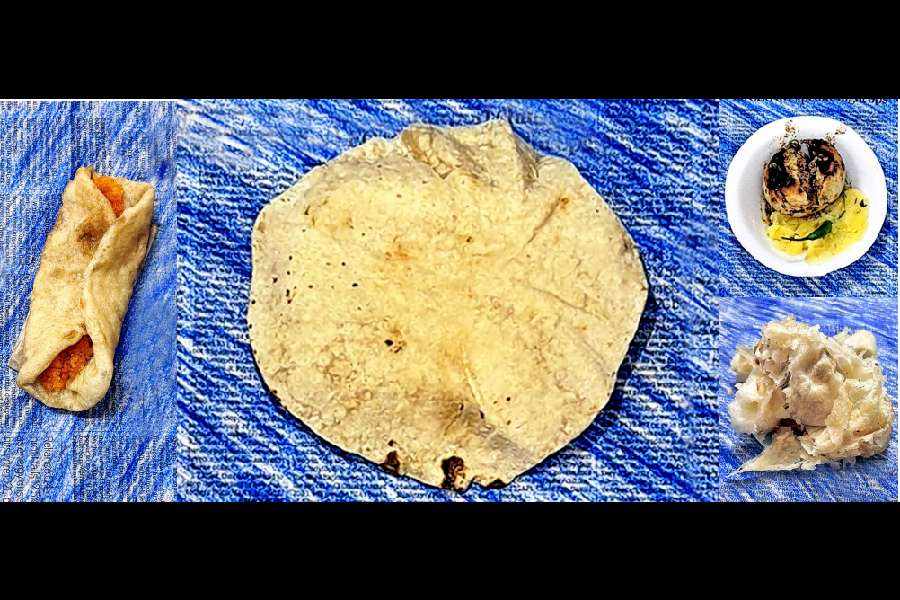
Different streets specialise in different kinds of bread. From Esplanade to Chandni Chowk right up to Central Avenue, it is puris, naan puris, haat rutis, rumali rutis, naan rutis, tandoori rutis, porotas. Then there is what is locally known as loaf ruti, which is basically a thick slice from the locally baked bread. These are served with butter and a sprinkling of sugar, or a hard-boiled duck egg with lots of pepper or ghugni.
If you keep moving northward towards Shyambazar and beyond, the scenario is not all that different, just add radhaballabhi, dalpuri, kochuri and luchi. The radhaballabhi here is seasoned with saunf, and the luchi is served with chholar dal garnished with a piece or two of coconut.
In residential areas, be it New Town or New Garia, the haat ruti rules. Ruti-tadka is a staple for those who live in the rented apartments here, mostly students and freshly minted professionals living away from home. In Bhowanipore, you will find sattu ruti, besan chilla and moong dal chilla. In Garia and Jadavpur, there are newer varieties — gol porota, trikon porota, petai porota, served with aloo kosha that has a generous sprinkling of roasted and ground jeera. These shops are located near bus stops and markets, and are the lifeline of auto drivers, toto drivers and even app bikers.
Karan Jagga runs one such stall a stone’s throw from Calcutta Medical College. He sells rutis and aloo porotas with dim kosha and salad, and also halwa puri. The dim kosha is basically a fiery red, dry egg curry. Karan’s customers are mostly rickshaw pullers, construction labourers, security guards, shopkeepers and medical representatives. Doctors too are among his regulars but they prefer to collect their parcels through food delivery apps instead of dining on the street.
Karan is more updated about the war in West Asia than any news channel. He feels the punch of rising costs every moment of every day. “Multiply LPG shortage with rise in the price of wheat, with increased price of cooking oil, with polythene bags, with…,” he goes on and on. After days of waiting and weighing in, he has increased the prices of his wares. “Two porotas in the morning and I am full till 2pm,” says Manish Prasad, who works as an electrician. “I am a regular customer. My wife works in shifts in the hospital. She cannot pack breakfast for me,” he adds.
***
The haat ruti is the basic atta ruti, and costs anything from ₹5 a piece to ₹8 a piece, depending on the locality. In office neighbourhoods, they cost more. Says Mohan Mondal, who has a shop in central Calcutta, “These use up more cooking gas because of the process involved.” In neighbourhoods with swanky highrises with fountains at the entrance and straight-out-of-the-catalogue kitchens, they sell rutis made of five to eight varieties of flour — ragi, multigrain, chakki, oats, paaniphal or water chestnut...
Pawan Das does only the basic atta ruti. His shop is opposite a government hospital in south Calcutta. He says, “When I open the shop at daybreak, taxi drivers drop by. They like to dip a piping hot ruti in a bhnaar of sweet cha.” By 7am, business is frenetic. Nurses, ayahs, doctors, chhota doctors or interns, medical representatives come, eat and leave. As the day progresses, patients and their kin stop at his shop. It is so crowded that some eat off paper plates placed on the road, right next to garbage piles and open drains. Pawan adds, “At noon, when the state subsidised lunch stall opens, a lot of people buy ruti from me as an add-on to the thali.”
Naan puri, smaller than a ruti, is leavened bread made of refined flour and deep fried. A single plate of four naan puris costs ₹24. Mohan sells naan puri with ghugni. The side-dish is thick, unlike the watery ghugni of north Calcutta and does not have any potato in it either. Until a few days ago, he also sold egg curry, aloor dum, and chhole as side dishes. But post the war and the rise in price of LPG, he has had to pare down his menu. He points to two empty cylinders, which he has tied with a chain to the grille railing.
Mohan lives on the pavement right next to his shop. You can see his bedding, his clothes and his wares stacked against the wall. He says, “I am from the Sundarbans. Commuting is impossible.” He continues, “The customer type changes as the day progresses. In the early morning hours, it is the labourers. Some eat, but most of them pack food for lunchtime. Next come the office staff, cab drivers, sales executives and owners of small businesses. By afternoon, it is mostly service people on lunch break.”
These interviews happened ahead of the elections. That particular day, Mohan has a “big order” — 124 plates of naan puri. He offers by way of explanation, “There is a meeting at a political party’s office.”
The halwa puri, smaller than the naan puri, made of maida and served with semolina halwa is popular around the Taltala area. They sell at ₹5 a piece. Chanda Mahato is in charge of one such shop. The previous owner was her father. She says, “I have named my shop Paratha Singh. I am a Bihari and am married to a Punjabi.” Her halwa is smooth, not grainy, redolent with ghee and a cheery golden yellow. She puts a serving of halwa slap bang in the middle of a puri and hands it over to customers. Says Chanda, “My customers are plumbers and electricians, most of them Hindi speakers.”
Then there is the petai porota, a kind of shredded ruti sold by the gram — ₹18 for 100 grams. The tandoori ruti is a more expensive street kin. Not many shops sell it as the oven is not easy to procure. There was a time when only restaurants sold tandoori rutis. The missi ruti, made of a mix of atta, besan and chopped onion, is even steeper at ₹20 a piece. And then there is the litti.
Now, purists will argue, but if the porota can be accommodated as a ruti, and puris and luchis too, why not the Calcutta litti served with kasundi? After all, othering is what those who have more than enough like to do. Out on the streets, it is an equal life, an equal hunger.