 |
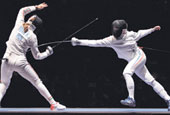
| Cutting edge: The duration of a fencing bout varies between seven and 15 minutes |
Each time Santosh Pandey steps inside the fencing arena, he feels like King Arthur brandishing his Excalibur. “It is a terrific feeling to take part in a sport that originated centuries ago,” he says. Pandey is not the only one. With India having secured the third place in the Commonwealth Fencing Championship held in Chennai last year, Indian fencers are making their mark in the international domain. And the thrill of swinging swords is evidently catching on.
Excitement constitutes the cardinal factor in fencing since the duration of a fencing bout varies from seven to 15 minutes. A fast game, it requires tremendous energy. The slightest lapse of concentration can expose a literal chink in one’s armour. “In fact, the energy required for a 10-minute fencing game matches the energy expended during a 90-minute football match,” says Calcutta-based fencing coach Ujjal Das.
Fencing as a sport began in ancient Egypt and became popular in Europe in the Middle Ages. Fencing, then known as rapier combat, was embraced by civilians who took enormous pleasure in duelling. “The sport has always been a part of the Olympic games and is beginning to prove popular in India,” mentions Pradip Kumar Das, joint secretary of the Bengal Fencing Association in Calcutta.
This, despite the fact that the fabled sabres that hog the limelight in the game are expensive. “Electronic swords can cost as much as Rs 3,000 and need to be replaced if they are broken,” says Das.
There are three kinds of fencing: foil, epee and sabre. In foil fencing, the target is the chest, in epee it’s the full body and in sabre, it’s the portion above the belt. Both foil and epee involve straight hits whereas sabre demands chopping for scoring points.
Players need to be adequately dressed in order to prevent injuries and facilitate smoothness in the game. Chest guards, jackets, masks and track suits are part of the gear necessary to take part in this glamorous and risky activity.
The principal object of fencing is to hit the opponent. The swords used have buttons on their tips. These emit a signal on contact with the chest wires. “The wires are attached to the swords, jackets and masks and a touch on the body enables the player to score a point if the tip of the sword makes contact,” explains Pandey.
The basic skills to be mastered in fencing are the on-guard position, the step backward, the lunge and recovery, and the grip. The on-guard position is the fundamental fencing position from which all fencing actions are executed. This position allows the fencer to move forward or backward with efficiency and allows the fencer to attack as well as defend. Also, it is important to bend the knees so that there is equal weight distribution on each foot. And most importantly, it is imperative to be both relaxed and alert to play well.
The Bengal Fencing Association has been trying to popularise this sport since 1993. Today, there are more than 200 enthusiasts taking part in the sport.
Says Anindita Nandan from Bhawanipore, “I have been fencing since 1998 and I think it is an excellent fitness drill.” According to Nandan, the fact that youngsters are taking part in this sport augurs well for its future. Her views are enthusiastically shared by Mitali Sarkar of Tiljala, a fashion designing student. Mitali has taken part in national championships and has won laurels. “I was introduced to this sport by a teacher and it is enormously exciting,” she reveals.
As with any other activity, in fencing too, practice leads to perfection. Practice apart, if you have enough grit, determination and that extra bout of energy, don’t hesitate to pick up your sword and prepare for the duel ahead.
Essentials
- Speed to counter opponents.
- Attention to gauge movements.
- Reflex to react quickly.
- Equilibrium to maintain balance.
- Endurance to stay in the fight.