 |
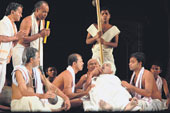
| Between life and death: A scene from Antarjali Jatra (Picture by Sanat K. Sinha) |
As evening descended upon the rain-drenched weekend of July 2-3, it was time for the curtain to come down on Odeon 2005. Just a couple of chances to catch the shows for which you were supposed to have ‘bunked office,’ and ‘cancelled vacations’ as per the inviting billboards splashed across Calcutta’s skyline. But some performances didn’t quite live up to expectations.
Like Gobardanga Shilpayan’s Antarjali Jatra (Rabindra Sadan, July 2). Of course, it had all the prerequisites of an intriguing drama, based as it was on a fascinating story by Kamal Kumar Majumdar about the old ‘koulinya protha’ ? the Hindu custom of getting young girls married to even dying men so that families could respond to konya dai (burden of having unmarried daughters). Also, the characters within the story provided ample opportunity for exploring complexities of relationships ? both traditional (father-daughter) or non-traditional (between an upper caste Hindu woman and a lower caste ‘untouchable’ man). But director Ashish Chattopadhyay dealt with the story as a simplistic narrative, not bothering to touch upon subtlties.
When Jashobati’s (Dipa Brahma) father brings her to the cremation ground to get her married, there was no indication of his inner turmoil. Jashobati’s submission to the barbaric custom she’s conditioned to accept as ‘honourable’ was clearly brought out, but what was not explored was her desperation to cling onto the only person in the burning ghat that to her represents life ? the dom Baijunath (Priyendu Shekhar Das).
Brahma went through Jashobati’s emotions mechanically. Das irritated with his exaggerated gestures ? even a greenhorn jatra player wouldn’t have performed so awfully ? and grunts of ‘kone-bou’ calling out to Jashobati. Ironically, the character, which brought some ‘life’ on stage was the ‘dying’ man. With quivering dry lips and shaking bony fingers, he was dead good!
A stark, simple set with a temple, a barren tree and yellow moon conjured up effectively a cremation ground ? evoking a sense of the space between life and death, which became, perhaps, the most symbolic dramatic device used in the play.
The plight of the Hindu woman ? specifically widows ? in the bad old days was once again the theme of the last Odeon performance this year, Kanon Pishir Jawpomala (Madhusudan Mancha, July 3). The director looked at the exploitation of the widows from a fresh perspective, using a decidedly novel idea to set up a kind of a discourse between past and present, traditional and modern with a couple of 13-year-old girls asking pertinent questions about their grandmothers’ generation. Unfortunately, in terms of treatment the play was a bit of a letdown.
While the three imaginary sequences ? in which the girls resurrect the widows from the past ? were lively and vividly conjured up, some of the other scenes suffered from a boring dialogue and overacting. The actors, with the exception of the three widows, needed to tone down. Amit tried too hard to seem relaxed. Damini’s over-the-top behaviour seemed real only at moments of crisis. Jhinuk and Tinni were unnaturally bubbly and fake. Do they, especially the precocious, no-nonsense types, act like bozo clowns or jumping jacks?