 |
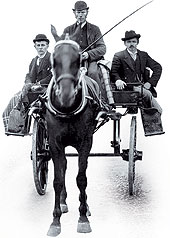
In the early decades of the last century, the US had 10 million registered cars but as many as 20.5 million horses. According to a 1992 report styled The Paradox of Progress by W. Michael Cox and Richard Alm, the country employed 109,000 carriage and harness makers in 1900 and 238,000 blacksmiths in 1910. “Only a few thousand Americans make a living in these occupations today.”
There was a move at that time to protect the industries and the jobs. Some politicians said it was necessary to keep the new monstrosities off the roads. Farmers, a powerful political group, called them devil’s carts. But in the face of a far more efficient mechanism (Henry Ford advertised his Model T as “stronger than a horse and easier to maintain”), the horse had to surrender. There are 6.9 million horses in the US now against 21.5 million in 1915. And countless jobs have been lost.
Like the men who backed the wrong horse, there are people today who are clinging on to job categories despite the fact that they are so obviously history. Look at some of the professions that are on the endangered list. They include stockbrokers, real estate brokers, automobile dealers, teachers, switchboard operators and even fathers.
Fathers you may not need in these days of cloning and test-tube babies. But the declining role of middlemen ? brokers, insurance agents, teachers (yes, they are middlemen between knowledge and students) ? is something that is not quite understood as yet.
Dhruv Nabar is a Mumbai-based stockbroker. He is teaching his son to follow in his footsteps. “Twenty years later, the only surviving brokers will be the online versions,” says an analyst. “As technology improves and spreads and people get more Internet savvy, why should they continue to rely on a bumbling (and not always honest) human interface?”
The other dimension to this is that countries are continuing to protect jobs that they should have long given up on. A recent article in the Sunday Times of the UK bemoans: “With traditional manufacturing having already fled, and call centres departing in droves, what jobs will our children do?”
| CAREERS IN CRISIS |
| Jobs that will disappear |
 CEO Stockbroker Real estate broker Teacher Stenographer Father Orthodontist Printer Switchboard operator Automobile dealer CEO Stockbroker Real estate broker Teacher Stenographer Father Orthodontist Printer Switchboard operator Automobile dealer |
| Source: From 'Churn: The Paradox of Progress' and Internet sources |
The article says that even knowledge-based jobs will be vanishing soon. If these countries continue to ride the same horse, the new engines of growth ? India and China ? will overtake them.
There are indications already. Many of the best brains who fled after IIT are now returning to India. Foreigners too are coming to this country (and China) where the jobs are. An American education is no longer a must. (There is an attempt to link this to H1-B visas. But observers think nobody will bite.) And what says it all in no uncertain terms is the cry of those who are losing their jobs. When losers occupy centrestage, you can be sure the days of glory are over.
That may be a side issue. What is important for every jobseeker now is to do some crystal-ball gazing. Look at what’s going to be hot. Tissue engineers, gene programmers, data miners and virtual reality actors, says a Time magazine list.
More important than that is to identify the disappearing tribe. Would you need an accountant tomorrow? Maybe. Would you need a CEO? Maybe not.