 |
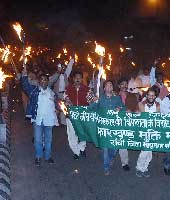
| Jharkhand Mukti Morcha activists take out a “torch-light” procession against the statehood celebrations in Ranchi. Picture by Hardeep Singh |
Jaipal alias Pramod Pahan was born on January 3, 1903, of Amru Pahan and Radhamani at the Takra village of Khunti subdivision. As a village boy, his job was to look after the cattle herd. He would possibly have remained a simple peasant and would have gone as a coolie to tea gardens in Assam when harvest failed, as his sisters did earlier (Jaipal’s letter to his close friend and associate Sitaram Jagatramka of Kharagpur, dated, November 21, 1968). However, destiny played a hand and Pramod Pahan was admitted to St. Paul’s School, Ranchi, in 1910 as Jaipal Singh and it changed the course of his life. The principal of the school, Canon Cosgrave, took him under his wings and converted him. In 1918, when Cosgrave retired from the St. Paul School and went to become the parish priest of Holy Trinity, Darlington he took Jaipal with him.
When the news got around that Jaipal had arrived in Ranchi, there was great excitement and people thronged to get a glimpse of him. He was their Chhota Saheb whose feats of achievements had preceded him to the town and were followed with pride by his folks and friends. The united Adivasi forum called Adivasi Sabha, formed in 1938 made him the president of the organisation.
As many as 65,000 people gathered to listen to Jaipal’s presidential speech on January 20, 1939. They came from all over, walked on foot for days together to have a glimpse of him as they had done in the past for Birsa, the legend. His oratory, simultaneously in English, Hindi, Sadani and Mundari, mesmerised men and women from all walks of life.
“The Adivasi movement stands primarily for the moral and material advancement of Chhotanagpur and Santhal Parganas,” he declared and set as his goal a separate administrative status for the area.
He was instantly the people’s “Marang Gomke” — their Supreme Leader. The history of the region changed henceforth. With Jaipal at the helm, there was no looking back. He worked ceaselessly for a better future for his fellow Adivasis everywhere, even beyond the frontiers of south Bihar.
Adivasi Sabha was changed into All India Adivasi Mahasabha. On the national political front, Jaipal had alienated himself from the Congress personally. He played an active role in the anti-Compromise Congress Conference at Ramgarh in 1940 in close alliance with Subhas Bose. He went against the Congress stand and supported the British in World War II and recruited men and women from Chhotanagpur for the British army.
Since 1946, he was a member of the Constituent Assembly, the Provisional Parliament and all the four Lok Sabhas until his death in 1970. As a close friend of the doyen of anthropology, S.C. Roy and Verrier Elwin and supported by Ambedkar, he led his “glorious struggle” both inside and outside the legislature to establish the Adivasi identity. With the creation of the Jharkhand Party and the induction of non-Adivasis into it in 1950, he changed the emotive cultural movement in Jharkhand into a regional political movement, free from any communal bias.
The JHP was the first legitimate political party that drew the political agenda and gave the direction to the future of Jharkhand politics. The party became so strong that it played a vital role in the formation of the government in the neighbouring province of Orissa in 1957.