 |
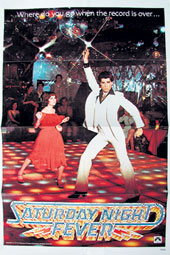
| John Travolta in Saturday Night Fever |
Contemporary music has for some time now played a significant role in Hollywood, with evolving music invariably accompanying evolving cinema. The end of the 1960s proved to be the watershed period when soundtracks ceased to simply be decoration garnishing on-screen events, and began to play a central role in conveying the core values of a film.
Indeed, the decade from 1969 to 1979 saw some of the greatest leaps forward in the use of music in films with popular music increasingly defining films and the manner in which they were made. Many of today?s most talented directors, such as Hype Williams and Spike Jonze, cut their teeth on music videos, and film directors too produced music projects. John Landis?s memorable production of Michael Jackson?s Thriller paved the way for more elaborate music videos, while Prince based a whole film around his song Purple Rain.
A rewind to some defining sounds on celluloid?
Apocalypse Now: The Doors (The End)
As an opening sequence, Francis Ford Coppola?s masterpiece is hard to beat. At the beginning of the film, a tropical treeline explodes and Jim Morrison proclaims that This is the End. Slowly, Martin Sheen?s face is superimposed with helicopter blades, and then eventually the blades mesh with the fan in Sheen?s hotel room.
The Doors track was not only evocative of the era, but its surreal nature perfectly matched the chaotic progression of the film. A brilliant combination of music and film.
Saturday Night Fever: Bee Gees (Stayin? Alive)
The opening shot of the film shows a pair of shoes walking down a pavement to the strains of the Bee Gees monster hit. With this, New York?s localised (almost secretive) world of all-night disco dancing stepped into the wide world. Bee Gees hadn?t had a hit for a long time. Until they were asked to compose the soundtrack for a film based on New York journalist Nik Cohn?s cult article ?Tribal rites of the new Saturday night? that documented the escapism of the dance floor for those at the bottom of New York?s social ladder. It was to become the biggest selling soundtrack of the decade.
Reservoir Dogs: The Stealer Wheels (Stuck in the Middle)
Quentin Tarantino?s knack for picking obscure and forgotten records for his soundtracks makes it difficult to narrow his genius musical selections down to one definitive moment. It is perhaps appropriate to include that scene with a petrol-doused policeman and a cut-throat razor that earned Tarantino not only his acclaim, but also his notoriety. As Michael Madsen?s ruthless character Mr White waltzed around the warehouse to The Stealer Wheels?s rockabilly cut, the 1992 Sundance Festival audiences clapped with pleasure and gasped with horror in equal measure.
Superfly: Curtis Mayfield (Superfly)
The 1970s were heady times for African-Americans, both politically and musically, so it is no surprise that Curtis Mayfield was to deliver a momentous musical accompaniment to one of the more high-profile of the ?blaxploitation? movies that emerged from America during this period. Tracks such as Superfly, Freddie?s Dead and Pusherman have ended up outlasting the film?s popularity, with the soundtrack being widely perceived to be among Mayfield?s best music. The soundtrack outgrossed the film itself, with the album hitting number one in the United States in 1972.
A Clockwork Orange: Beethoven
Life imitated art when skinheads began appearing at football matches dressed as ?droogs? in the wake of Kubrick?s most controversial film. By the time Orange was produced, classical music was swiftly becoming the preserve of the old. Orange?s protagonist Alex de Large, however, is passionate about Beethoven, and the composer?s dark brooding nature becomes the soundtrack to Alex?s orgiastic violence. Beethoven is also accompanied by early use of synthesisers in the film score.