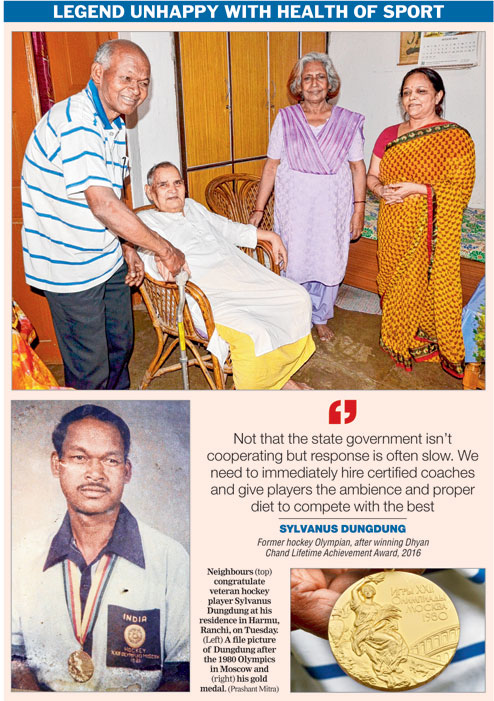
Time for total recall. It's July 26, 1980, the Olympics field hockey men's final in Moscow, where India are playing Spain. Scores are tied at 3-3. Then, Simdega lad Sylvanus Dungdung hits a long pass to team-mate Surinder Sodhi. Sodhi nicks it in. Score: 4-3, Spain sinks, India brings home gold.
In 1980, a handful of Indian homes had televisions and breaking news and social media were light years away, so master craftsman Dungdung did not get a fraction of the hype that he would have had he, say, performed the same feat in Rio.
But now, Jharkhand's hockey legend Dungdung, 67, has been named as one of the three winners of the Dhyan Chand Lifetime Achievement Award 2016.

On August 29, the President of India will award Dungdung along with other Dhyan Chand awardees Satti Geetha (athletics) and Rajendra Pralhad Shelke (rowing), apart from winners of Khel Ratna, Dronacharya, Arjuna and other awards. Dungdung will get a statuette and Rs 5 lakh as part of the country's highest award for lifetime achievement in sports.
Dungdung, now 67 and a resident of Harmu, Ranchi, is grounded as always.
" Puraskar aur samman se khush hoon but yeh sab kafi din thodi rahta hai kisi ke saath (I'm happy with the recognition, but all this doesn't stay with anyone for too long)," Dungdung said in typical plainspeak.
This candour was evident throughout, as the legend reiterated what he told this correspondent in May, that he wouldn't have applied for the award had Hockey Jharkhand not persuaded him to do so.
"I thank all those in the hockey association, the government and the jury who backed me for this award," he said. "But, I personally feel the government set-up for applying for awards is too exhaustive and at times demeaning for players. There are too many bureaucratic hassles that many players don't apply. If someone has made his/her country proud or brought laurels at any point in time, the government should come forward to recognise them and not wait for applications," he said, adding he was blaming the system and not anyone personally.
Currently working with Sports Authority of Jharkhand (SAJHA), a state government body, as a coordinator, Dungdung feels wasted in the "clerical" profile, but adds the job helps him earn his bread and butter.
"I wish I could contribute more on the ground and work with young players of today," he said.
Clearly, he is as passionate as he always was about hockey.
About the sport in Jharkhand, the septuagenarian feels that the state, once the hub of hockey, needs to reinvent itself by going beyond bureaucratic hurdles to nurture players.
"Not that the state government isn't cooperating but response is often slow. We need to immediately hire certified coaches in all places where hockey is played and give players the ambience and proper diet to compete with the best," he said.
On the health of hockey in Jharkhand, Dungdung minces no words. "Not very good. Let me give you an example about bureaucratic hurdles. About a year ago, I forwarded a file for hiring coaches. There were many deserving candidates. But government kept lingering and we lost many candidates to other states and agencies. It's a loss of our manpower and talent. We should learn to retain talent with decent jobs and pay."
This Rio Olympics, Indian hockey drew a blank. Was he disappointed, given that Jharkhand's Nikki Pradhan had made it as the state's first woman player to the Olympics this time?
"Looks like last-minute adjustments disturbed the balance of the women's team in Rio. Talking specifically about Nikki, she is a fast runner and a natural choice for forward or half-forward. All her life she's played like that. Suddenly being part of the defence did not suit her," Dungdung said.