|
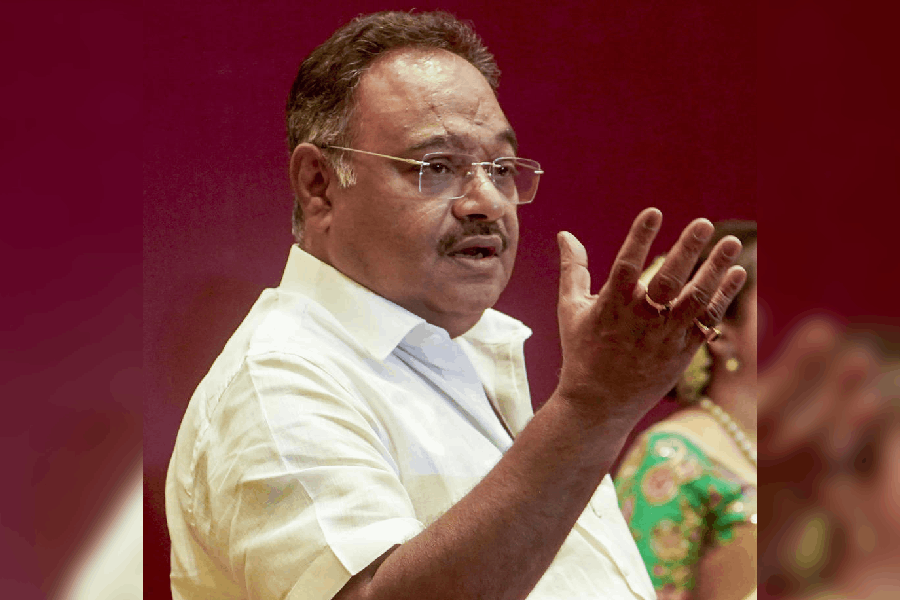
| CCL boss Gopal Singh felicitates Chitra Mudgal at the literary fest in Ranchi on Thursday. (Prashant Mitra) |
A generation brought up on Harry Potter or Chetan Bhagat may not have heard of Hindi writer Radhakrishna.
But, the eminent Hindi writer of the 20th century who lived and worked in Ranchi till his death in 1979 at the age of 69, was once described by Munshi Premchand as one of the “best five of the era”. And, it is learnt that no less a personage than Mahatma Gandhi had praised Radhakrisha’s honesty after reading his critical write-up on the Ramgarh Congress of 1940.
Doordarshan’s Ranchi Kendra reminded literature buffs of these nearly forgotten facts while hosting a two-day Radhakrishna Mahotsav in association with Central Coalfields Limited (CCL).
The festival began at the CCL Auditorium on Thursday with prominent writers and critics in attendance, including Chitra Mudgal, Prem Bharadwaj, Balram, Sunil Shrivastava, Anant Kumar Sinha, Shravan Kumar Goswami, Khagendra Thakur and B.P. Keshri.
Born in September 1910, Radhakrishna’s first short story, Sinha Saheb, was published at age 19 in Hindi Galpmala. In the five decades of his life as an active writer, Radhakrishna went on to write five novels, four collections of short stories, three plays, a collection of satirical writings and many books for children. He also regularly wrote radio-plays and contributed to various magazines.
After Premchand’s death in 1936, the writer’s widow asked Radhakrishna to edit the famous literary magazine Hans. Later, Radhakrishna also edited a number of magazines including Kahani, Maya and Adivasi.
Short stories, satirical pieces and writings for children came to him effortlessly.
“Writers like him helped awaken society and inculcate values. It’s high time writers come forward again to do so,” said CCL chairman-cum-managing director Gopal Singh.
“Though his contemporaries were influenced by Freudian or Marxist schools of thought, Radhakrishna’s writings were always balanced and that was how he created his own genre,” writer and once a close aide of Radhakrishna, Shravan Kumar Goswami, opined. Now elderly and ailing, Goswami’s address had rare nuggets of the times gone by.
Writer Mudgal agreed that good literature was a must to push society forward. “Publishers can help by spotting talents and bringing out their works.”
Poet and writer Mahadeo Toppo said Ranchi was widely known in the 1960s in the field of literature because of the contributions of Radhakrishna and Father Camille Bulcke, a Belgian priest who made the city his home.
“It is unfortunate that the present generation doesn’t remember them the way they should,” Toppo said. “I cherish the fact that I could read my first poem in Radhakrishna’s presence,” Toppo added.
Sudhir Kumar Lal, Radhakrishna’s younger son, agreed. “Barring a few exceptions, the present generation is almost cut off from literature. How do you expect anyone to know about my father and his writings?” he asked.