|
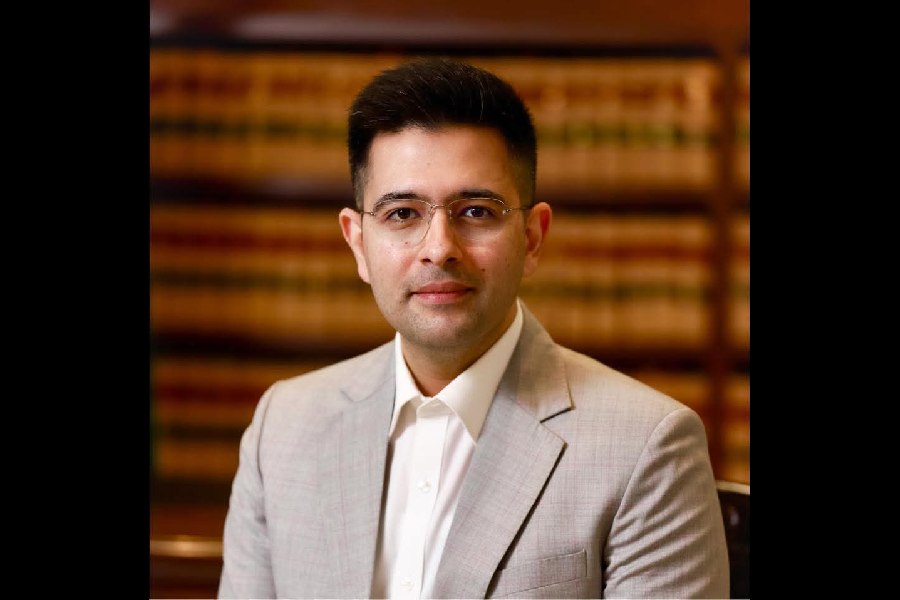
| Odissi dancer Rahul Acharya (left) and mohiniattam exponent Sulini Nair perform at the dance festival being organised at Mecon Community Hall in Ranchi. Pictures by Prashant Mitra |
Ranchi, Oct. 26: Spectators at Mecon Community Hall here were spellbound when Kapila Venu and her team presented a Sanskrit theatre form of Kerala called nangiarkoothu.
Women perform in nangiarkoothu, which was initially created to give training to the ladies so that they could master the art and perform for another art form called kudiyattam.
The performance enacted here revolved around a dialogue between Lord Krishna and his friends en route to Govardhan Mountain. Apart from describing the beauty of the mountains and the scenery around, Krishna also points out to an elephant, which is being attacked by a python and a lion simultaneously.
The message, according to the Lord, is that life is all about both good and bad experiences put together.
The artistes beautifully enacted the trauma of the elephant, which is being attacked by a python from one side and by a lion from the other. The theme of the drama is based on Sanskrit plays Ajgar Kapalitam and Govardhan Dharnam.
This was probably the first opportunity for the people of Ranchi to see a nangiarkoothu performance. As the team members were performing, the mesmerised audience could not help but watch the performance with awe and appreciate the sequence of events presented beautifully.
?India has such a great heritage,? a spectator remarked at the performance.
Kudiyattam, the grandmaster of nangiarkoothu, literally means ?acting together?. It is considered to be the earliest classical, dramatic form of Kerala. The performance of this art form is usually based on Bharatha?s Natya Shasthra.
Generally enacted inside a temple theatre, there could be two or more characters onstage during a kudiyattam performance. A ?chakyar? plays the male cast and a ?nangiar? plays the female role in the story being enacted. While nangiar plays the cymbals and recites verses in Sanskrit, nambiars, a caste of people, play the mizhavu, a large copper drum, in the background.
A kudiyattam performance could last for several days, ranging from six to 20. Enacted themes are generally taken from mythology. The Koodalmanikyam Temple in Irinjalakuda (from where the artistes have come) and the Vadakkunathan Temple in Thrissur are the main centres where these art form are performed every year.
Venu?s had learnt the art from Ammannur Madhava Chakyar, considered to be a master in the field. Chakyar was also a Padma Bhushan recipient for his consistent efforts to preserve and promote the traditional art forms of south India.
Apart from a taste of the south, spectators were also treated to art forms from other parts of the country.
S. Karuna Devi showcased a slice of Manipuri culture, when she presented Tanadere Na and Geet Govind in Tandava style.
But the audiences missed what could have been an excellent kuchipudi performance, because Jayanthi Narayan, who was supposed to perform, could not make it because of a death in her family.
Another kathak recital was by Sruti Sinha, Preeti Sinha and Pratibha Sinha, who presented the various moods of rasleela of Lord Krishna.
The programmes were well received by the audience who had come in large numbers to attend the dance festival.
Organisers have promised to try and put in more chairs in the hall from today.