
The state tribal welfare department is all set to launch a survey for screening people affected by sickle-cell anaemia, a disease that is mainly prevalent among tribal population.
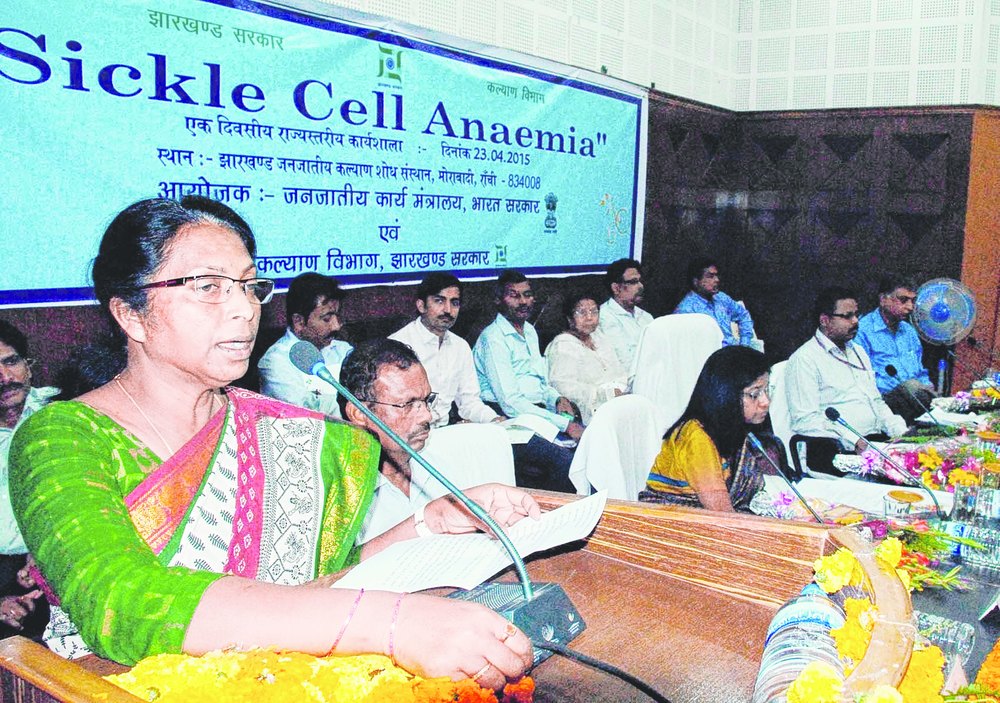
Following a directive from the Union tribal affairs ministry, a daylong workshop was organised at Tribal Research Institute in Morabadi, Ranchi, on Thursday to work out a detailed plan for the proposed statewide programme.
Sources said the first-of-its-kind drive, which was likely to kick off next week, would cover 25 lakh students over the next three months to assess the percentage of people carrying sickle-cell anaemia trait (SCT) and those totally affected by sickle-cell disease (SCD).
"The tribal population in Jharkhand does not have any knowledge of sickle-cell anaemia and how it affects human life. The survey will help the Centre and state in preparing a roadmap to check the disease," state welfare minister Louis Marandi said.
She was speaking at the inauguration of the workshop that was also attended by Union joint secretary (tribal affairs) Manoj Kumar Pingua, state secretary (tribal affairs department) Vandana Dadel, among others.
Dadel said the screening would be kicked off at government residential schools first and subsequently extended to all state-run cradles.
Addressing the gathering, Pingua said sickle-cell anaemia was a severe hereditary form of blood disorder, in which a mutated form of haemoglobin distorted red blood cells. "Therefore, there aren't enough healthy red blood cells to carry adequate amount of oxygen throughout the body," he explained.
When a person carries one gene of sickle haemoglobin and another of the normal one, the person is said to be having SCT. But, if a person inherits two genes of sickle haemoglobin, it means he is suffering from SCD, Pingua added.
There is no treatment for the disease as of now, which has prompted the ministry to take up this exhaustive survey across the country.
The ministry directed principal secretaries and secretaries of tribal welfare departments of all the states in March this year to carry out surveys to determine the percentage of the affected population.