 |
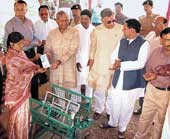
| Union rural and agro-based industries minister Karia Munda hands over papers of a rope-making machine to a woman in Khunti. Picture by Hardeep Singh |
Khunti (Ranchi), Nov. 6: The otherwise calm Dak Bungalow campus buzzed with activity and excitement here today as women who had received training in making coir ropes scurried around to put things in order.
The trainees were a happy lot because some of them were to get a “ratt” machine from local MP and Union rural and agro-based industries minister Karia Munda.
Coir Board, an undertaking set up by the ministry in 1958, has been conducting training programmes, which started in November last year to train women to make ropes from coconut husk.
Karia Munda said large-scale industries were not enough for development.
They should have the support of small-scale and cottage industries, he added.
Citing examples of China and Japan, the minister said: “The reason for the development of other countries is that they have turned their villages into productive sectors.”
“The villages in such countries specialise in making a particular product and this is a boost to the economy,” he added.
For seventeen-year-old Tunni Kumari, the day would always be special. She was thrilled to get her own machine.
She was among the 10 beneficiaries who got the “ratt” machine.
“I am very happy and excited. I have now got a chance to contribute to my family income., she said.
“With the machine I am sure I will be able to support my family and we will have a prosperous future,” she added.
In the course of Coir Board’s training programme, women are trained for two months in the use of “ratt” machine.
The machine is used to twine husk into ropes, which requires skill. The Coir Board has so far trained 70 trainees in five batches.
The trainees are told how to separate the husk and then winnow it to select the light and fine husk to make the rope.
They are then taught to use machines to twine the husk into ropes.
The trainees have to undergo a test after completing their course, following which they are eligible to acquire a machine for themselves.
“Ratt” machines have been given to 10 trainees, who have deposited a sum of Rs 2,500. The trainees are to bear 25 per cent of the cost while the Centre will give a subsidy of 75 per cent, which comes to Rs 7,500.
Coir Board chairman Christi Fernandes said the programme was started with the objective of making women self-reliant.
Women should be made capable of contributing to the income of their families and help their male counterparts, he added.
The husk in its raw form costs between Rs 12 and Rs 15 a kilo and after being made into ropes, the value appreciates to Rs 35 a kilo in the local market.
“This gives women a chance to supplement the income of their household and is also beneficial for the development of a rural area,” Fernandes said.