 |
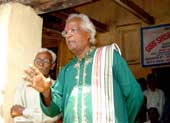
Padma Shri Shyamacharan Pati, who received the award this week at the Rashtrapati Bhavan for his contribution to Seraikela Chhau, is clearly not welcome at Seraikela, judging by the following piece penned by a member of the erstwhile royal family.
Chhau, the mask dance, has traditionally had three schools :Purulia (West Bengal), Mayurbhanj (Orissa) and Seraikela ( Jharkhand). While the family of Braj Bhanu Singhdeo has been traditional patrons of Seraikela Chhau, the writer denies any contribution by Pati to the dance-form.
While his main objection appears to be Pati?s long absence from Seraikela (for over three decades he is said to have resided at Rourkela), the writer seems even more incensed at Pati?s alleged attempts to foist a new school of Chhau dance, namely the Icha school of Chhau after Pati?s native village.
Shyama Pati, recipient of this year?s Padma Shri for Chhau, ?Seraikela?s Royal Mask Dance?, remains an enigma.
The 66-year-old self-styled Guru?s claims and boasts, carried by both print and the electronic media have only served to baffle the artistes, audience and connoisseurs of the Seraikela royal tradition of classical Chhau and its heritage.
This classical form has been watched and appreciated, among others, by Mahatma Gandhi (Calcutta, 1937), Netaji Subhash Bose (Calcutta, 1937), Tagore (Santiniketan, 1941) and Pearl Buck (Mumbai, 1933), which indicates the long tradition of the dance form.
Shyama Pati hails from a village called Icha, a seat of Icha zamindars owing allegiance once to the ex-princely state of Seraikela.
He was born into a poor, Brahmin family and left Icha about 40 years ago to seek his fortune elsewhere. He went to Jamshedpur to learn Kathak and Bharat Natyam from Guru Ban Bihari Acharya of village Tontoposi.
Following differences with his ?guru?, he migrated to Rourkela in 1970 and set up a small dance school, which, it is said, failed to pay even for his pocket money. He, however, managed to go abroad with a small team that included his wife.
While Pati returned, his wife didn?t and till today nobody knows about her whereabouts.
Six years ago, Pati at the age of 60, landed up at the Seraikela Palace during the annual ?Chaitra Parva? (the Chhau dance festival) and wanted to perform the ?Mayur? dance at the prestigious royal ?Akhara? or arena, which used to be reserved for the late Rajkumar Suddbendra Narayan Singhdeo (recipient of the Padma Shri in 1991) and Guru Kedar Sahu (Padma Shri recipient in 2004).
Prince Brahbhanu Singhdeo, founder of the ?Seraikela Chhau Nritya Kala Mandir? (1970), a dancer of international repute and senior-most member of the royal family that dates back to 800 years, politely refused him permission on the ground that Pati?s figure did not fit into the tradition of the ?Mayur? dance.
But Pati, with his street-smart manipulative skill, managed to secure permission from the Prince?s nephew, Raja Pratap Aditya, who, ironically, has displayed little interest in the dance-form. Unlike several other members of the erstwhile royal family, Pratap Aditya has shown little interest in music, art or dance.
What?s more, Pati also wanted to start the ?Guru-Shishya? parampara at the village Icha, his birthplace, after receiving funds from the Eastern Zonal Cultural Centre (EZCC) and department of culture, government of Jharkhand and Sangeet Natak Academy of Orissa.
Icha village, as everybody knows, will be submerged by the Icha Dam of the Subernarekha Multipurpose Project. Compensation has already been paid to the people and the area has been declared to be a submerged area.
How can then a government spend public money or grant for a self-styled tradition of ?Icha Chhau? when the area is under water and not known to have promoted the dance form?
It is presumed that he did so after coming to know that Prince Braj Bhanu Singhdeo had submitted a petition to revive the ?Guru-Shishya? parampara at the 17th century palace at Seraikela through his ?Seraikela Chhau Nritya Kala Mandir?.
It should not be difficult to investigate the claims made by the self-styled Pandit Shyama Charan Pati and decide, once and for all, whether he has resided at Seraikela for any length of time.
The address given in his passport and the place of issue, his ration card, voters? list, his photo identity card, telephone connection and address given in his IT return and the PAN (permanent account number) card should prove conclusively whether he is a resident of Icha (Jharkhand) or domiciled at Rourkela (Orissa).
Interference by government officials and politicians, unfortunately, have put a question mark on the credibility of the 800-year-old royal tradition of Seraikela Chhau.
(Views expressed in this column are the writer?s own )