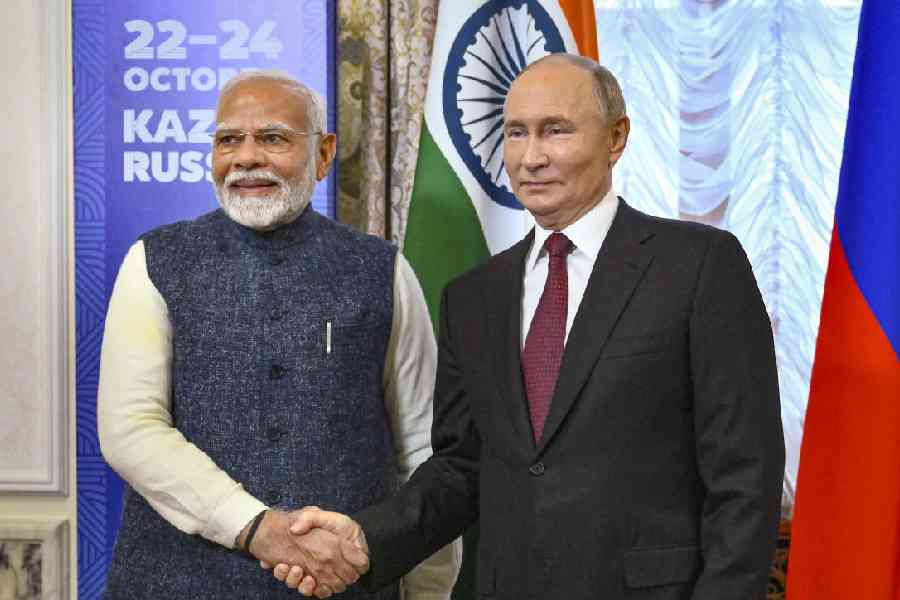
Russian President Vladimir Putin on Thursday said that Moscow will not interfere in the "delicate" bilateral relations between India and China, expressing confidence that both New Delhi and Beijing are committed to resolving their long-standing boundary disputes amicably.
In a wide-ranging interaction with the heads of major global news agencies, Putin praised both Prime Minister Narendra Modi and Chinese President Xi Jinping and said both leaders are determined to resolve the border issue peacefully.
"This is a delicate, multi-faceted relationship between India and China, and interfering into them is not a good idea. Of course, we interact with both our friends -- both India and China," the Russian President said, responding to a question from PTI's CEO and editor-in-chief Vijay Joshi.
"President Xi and Prime Minister Modi are both trying to resolve all the issues of mutual interest, including the border issue," he said.
India and China rolled out a series of measures in the last year to rebuild their relationship after it came under severe strain following the deadly Galwan Valley clashes in 2020 and the subsequent military face-off that lasted for over four years, Highlighting Moscow’s strategic equilibrium in Asia, President Putin said its decades-long partnerships with both New Delhi and Beijing grew naturally and are entirely independent of one another.
Characterising these relationships as having evolved organically, he stressed that Moscow's growing synergy with New Delhi does not come at Beijing's expense, just as Russia's deep alliance with China does not compromise its bond with India.
Putin also gave a historical background of the Russia-India-China trilateral framework.
"At one point, I suggested that leaders of India, China meet in Russia and that's how Russia-India-China was established. We had things to talk about, to agree upon, " he said.
The Russian president also touched upon frosty ties between India and Pakistan.
"We are well aware of the intricacies of the issues concerning the border between India and Pakistan," he said.
At the same time, Putin said he does not believe Pakistan was under the control of China "I don't think so," he said, adding, "Pakistan is a large country which has multi-faceted ties with different countries." "Of course, for Pakistan, it is very important to take into account the cooperation with China, " he added when asked about China-Pakistan friendship.
The Russian president also touched upon Russian's defence and military ties with India, and cited co-development and co-production of the BrahMos supersonic cruise missiles.
Putin also suggested that Russia proposed to India to work jointly on manufacturing the fifth-generation Su-57 fighter jet.
India is in the process of procuring a batch of fifth-generation fighter jets.
"We proposed our Indian friends to work together on technology, the fifth generation technology....we are ready to work with India in this field to supply (fighter) aircraft," he said.
The Russian president said his country is ready to provide India with critical technologies for major defence platforms and weapons.
Vladimir Putin also hailed Moscow’s strategic partnership with New Delhi and asserted that Western attempts to force New Delhi into scaling back its cooperation with Russia are both futile and damaging to global stability.
"India is among the world's major economies and is currently demonstrating an impressive rate of economic growth," Putin remarked, expressing confidence that bilateral trade between the two nations is on track to hit a USD 100 billion milestone in the coming years.
Putin said Russia has not seen any negative consequences of Western pressure on India to limit its engagement with Russia, suggesting that such tactics are bound to backfire.
"Everyone has understood that putting pressure on Prime Minister Narendra Modi (and India) that has the largest population in the world, is detrimental for international relations and for bilateral relations. It doesn't matter where this pressure comes from," Putin said.
"We don't see any negative consequences," he added.
The Russian president's remarks came against the backdrop of increasing disquiet in some of the Western capitals over India-Russia relations. The US has constantly been urging India to cut back its procurement of Russian crude oil.
"India is one of the leading economies of the world that has shown the highest rate of economic growth. This is not something that comes out of the blue. This is the result of the hard work that the government of India has been doing under the leadership of Prime Minister Narendra Modi," Putin said.
The Russian President emphasised that New Delhi will continue to prioritise its own national interests, adding that India's diplomatic engagement with the United States does not hinder or undermine its time-tested relationship with Russia.
"We are glad that India is developing its relations with all countries it thinks important for its national interests," Putin said when asked whether India's deep alignment with Washington creates structural friction for Russia.
Putin said Russia considers India as a "reliable partner" and it sees no negative consequences from New Delhi's bilateral relations with any other country.
"India is a great nation and democracy, and Russia will continue to expand its relations with it," he said.
The Russian president, responding to a question on the conflict in Ukraine, said he was open to resolving it and the task now is to convince Kyiv.
He also dismissed the idea that European Union countries could act as mediators in peace talks with Ukraine.
The Russian president said that the EU could help resolve the conflict by persuading Kyiv to compromise instead of supplying it with weapons.
Putin said the Ukraine crisis is a "local" issue, while the Iran issue is a global one.
"How can Russia trust people who have been harping about the need to inflict a strategic defeat on Russia for years?" he said He said Russia is ready to support any decision that could contribute to de-escalation in West Asia.
Putin also questioned Volodymyr Zelenskyy's legitimacy as the president, saying the Ukrainian leader's presidential mandate has expired.
"Will they hold elections or not? We should ask these questions," he said in response to a question.