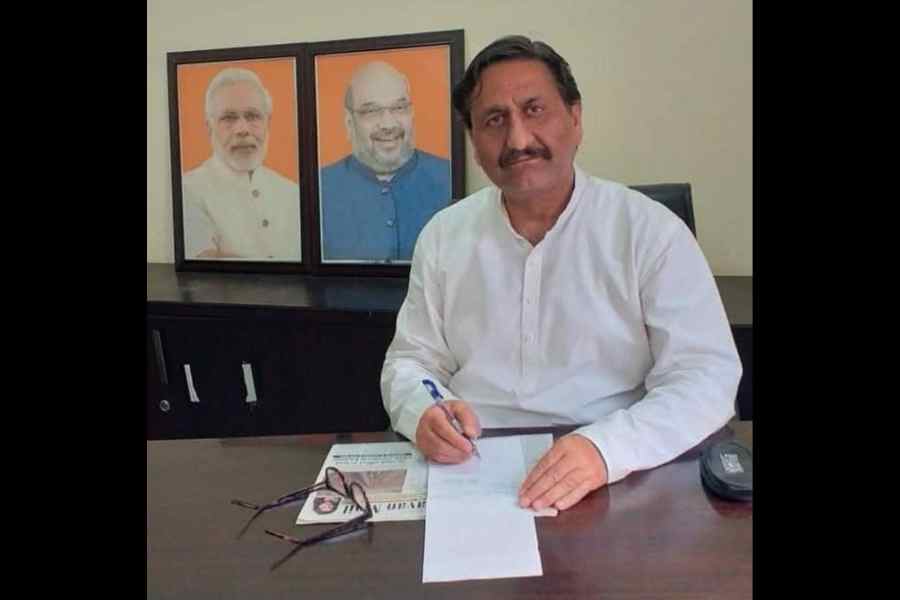
A senior BJP leader has claimed the “Indian State” is “working on” changing Kashmir’s demography by settling lakhs of Hindus from outside, appearing to confirm a fear widely expressed among Valley Muslims since the constitutional changes of 2019.
Ashwani Kumar Chrungoo, a prominent Kashmiri Pandit, said the efforts to address the “demographic challenge” were not confined to Kashmir but extended to every part of India where Muslims were, or threatened to become, the majority.
He cited Bengal — where BJP leaders have been speaking openly about driving out “Bangladeshi and Rohingya infiltrators” — Assam, and Sambhal district of Uttar Pradesh where dozens of mosques, mazars and madrasas have been demolished.
“So far as Kashmir is concerned, I believe the Indian State is thinking of addressing its demographic balancing, its demographic challenge,” he told The Telegraph.
Chrungoo drew a distinction between the “government” and the “State”, which he said was a wider entity.
“There is a big difference.... Where I say ‘State of India’, it means GOI (Government of India) and all institutional structure(s), which is not a small thing,” he said.
“I say that people are thinking on these lines (settling lakhs of outsiders here).... People are working on it.”
Many Kashmiri Muslims believe that one of the motives behind the Centre scrapping Article 370 and introducing other momentous changes was to alter the region’s demography — a stand Chrungoo endorsed.
Before joining the BJP several years ago, Chrungoo headed a faction of the Panun Kashmir, an organisation that wants a separate homeland for Pandits in Kashmir. He said such a homeland remained his personal priority.
The contentious plan envisages the creation of a Union Territory across half of Kashmir to settle returning Pandits.
Chrungoo said he would not object to an alteration of the region’s demography in general as an alternative to the homeland idea, since that would virtually turn the whole of Kashmir into a Pandit homeland.
“A lot of people say, ‘What you want in your homeland will be done in the entire Kashmir’, with the efforts of the government and the political system, efforts of national will, people living in Kashmir and outside. Which is that they will balance the population,” he said.
He said Kashmir needed to be at least 25 per cent Hindu for that to happen.
The 1981 population census had found the Hindu population in the Valley to be less than four per cent. After the large-scale displacement of Pandits following the outbreak of militancy in 1989-90, Kashmir’s Hindu population in
2011 was a little less than 3 per cent, made up mostly of non-Pandit Hindus.
Displaced Pandits put up a show of strength in Jammu this week under the banner of the “Youth for Panun Kashmir”, vowing to become “swords” for the “destruction of the enemy”.
Jammu and Kashmir has witnessed increasing polarisation between Hindus and Muslims in recent weeks following protests in Jammu against the admission of Muslim students to the Mata Vaishno Devi Medical College. The Pandit protests have now added fuel to the fire.
‘Platform’ set
Chrungoo believes the Centre has over the last six years set up a platform to change the region’s demography.
“The way I see it, (from) how the Government of India is moving forward — it is my own way of viewing it — it has taken the first decision in this respect constitutionally (by scrapping Articles 370 and 35A, which barred outsiders from buying land or holding government jobs in Jammu and Kashmir),” he said.
“The other decisions were administrative, which are so overwhelming, like if you have an elected government, it will not be a complete government of the people of Jammu and Kashmir and there will always be interference by the GOI.
“(Similarly), law and order is not with him (the chief minister). The guardianship of the administration is also not with him. They are with them (the Centre).”
Chrungoo said the Centre had also succeeded in changing the political narrative from a demand for “azadi” to that for statehood. It was now working on bringing about cultural change, he said, referring to the recent government surveillance of mosques across Kashmir.
“Only one thing remains. The Government of India must be interested in it, which is to balance the population…. I foresee this happening in the future,” he said.
“It has started happening, first in Sambhal in UP, second in Assam and third in West Bengal. They (the Centre) have their eye on that; it is in Bengal’s context (that) he (Prime Minister Narendra Modi) spoke about the demographic challenge.”
Chrungoo said the call to change the Valley’s demography had come originally from Pandits in May 1990, at the peak of militancy. Towards the end of 1990, leading Pandits had joined hands to form the Panun Kashmir, formally seeking a homeland for Pandits.
Chrungoo had previously held charge of the BJP’s political feedback department in Jammu and Kashmir.