
Dimapur, June 30: Funeral services are usually sombre occasions to reflect and ruminate and the one for NSCN (I-M) chairman Isak Chisi Swu here this afternoon was no different except that it also sent out quite a few messages to the government of India and the Naga people.
The message was in the choice of organisers (the Naga Hoho and the Eastern Nagaland Peoples Organisation) of the well-attended public funeral service at the Agri Expo campus under a scorching sun and the organisations and individuals who participated and spoke.
The organisers were two of Nagaland's leading and influential organisations which managed to get all the other leading organisations together to pay homage to Swu. In the process, they also conveyed their backing of the ongoing peace process.

Those who spoke included senior leaders of the GPRN-NSCN, NSCN (Reformation), Naga National Council (NNC), United Naga Council (Manipur) and Nagaland chief minister T.R. Zeliang of whom the NNC, NSCN and the GPRN-NSCN have serious differences with the NSCN (I-M).
Still, they were there and expectedly full of praise for Swu whom they described as a great leader of the Nagas and a man of unwavering faith in his dedication to the Naga cause but, most importantly, all of them spoke for unity among the Nagas and about fulfilling Swu's unfinished task - a final solution to the Naga problem. Despite their differences, they tried to convey that when it came to the Naga cause they were one.
Zeliang, who received the body at the airport, which was lined up with mourners waving the NSCN (I-M) blue flag, reaffirmed he that would do everything on behalf of the government of Nagaland to complete "uncle" Swu's mission.
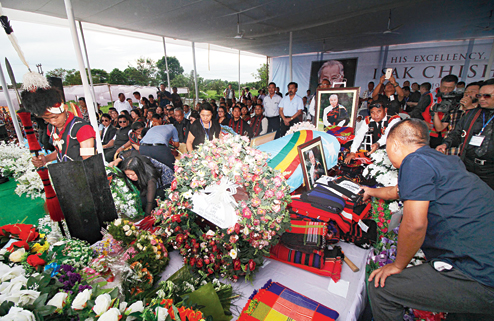
The message was also in the shared grief of mourners who came from different tribes and organisations. Students, traders, priests, pastors, businessmen, the elderly, from within the state and outside, all turned up to "welcome Swu home" one last time.
The message was also in the "unofficial" state mourning. Though the state government has not declared any official mourning, the service had its full backing: The chief minister was there throughout the over-three-hour service. Nagaland governor P.B. Acharya was not there but his speech was read out at the service.
Dimapur, the commercial capital of the state, was completely shut. NSCN (I-M) flags flew at half mast at the venue of the service and beyond as it had declared a seven-day mourning across Nagalim.
Swu's posters and banners praising him were to be seen all around, suggesting the outfit's influence.
The roads leading to the venue of the service were crammed with cars and jeeps, SUVs and autos, most occupied with mourners and most displaying the NSCN (I-M) blue flag with three lines and a star. Mourners in colourful traditional Naga attire were also present in huge numbers at the airport and at the service venue where Swu's coffin lay draped in the outfit's flag. The coffin became invisible as the wreaths piled by the time the service ended.
After the service, Swu's body was taken to Camp Hebron where the NSCN (I-M) will give him a "state funeral" at 8pm tomorrow.
The impact Swu had on the commoners was clear from the reaction of M. Lotha, a 25-year-old graduate, distributing the NSCN (I-M) flag to the mourners from 10am. "A legend has passed away. He did a lot for us Nagas," he said.
Th. Muivah, general secretary of the NSCN (I-M) and Swu's comrade-in-arms for 52 years, was "totally moved" with the "kind of homage" the mourners paid to the departed leader, summing up the overall mood.
Praising Swu leadership for making the Centre understand the Nagas' "unique history", Muivah said it was time for the Nagas to work together for the Naga cause and for "peaceful coexistence" with India which he said was ready to "offer a unique solution" to resolve the Naga issue.
Swu passed away before a final solution could be reached based on the framework agreement signed last August.
But the mood at his funeral service and beyond reflected the Nagas were as united as before in their sustained bid to secure their "unique history" as they were before despite differences between organisations/factions. Swu's funeral service has conveyed this message in no ambiguous terms.