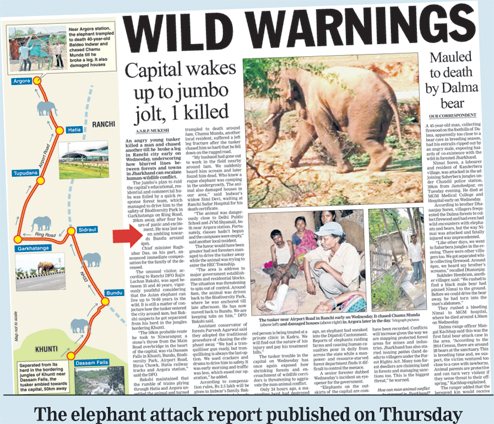

Ranchi, May 7: The young tusker, whose rampage in the capital yesterday included killing a man, has jolted the wildlife wing of the state forest department to beef up a comprehensive 24/7 elephant track-and-alert mechanism using a combination of Google Maps, GPS and quick response teams.
Geared around a proposed online interface using Google Maps, the system will track each of the 688 elephants currently on forest department records and who divide their time between Jharkhand and neighbours Odisha, Bengal and Chhattisgarh. So, if an elephant or herd is tracked dangerously close to human habitat on this real-time online interface, the nearest quick response team (QRT) will rush to the spot and troubleshoot.
Chief conservator of forests (CCF), wildlife, Rajiv Ranjan claimed work to develop an online interface using Google Maps to track 688 elephants 24/7 was on. "We held a meeting yesterday to fast-track the plan," he said. "QRTs at the level of all districts are also in the offing this fiscal year."
Though Ranchi has a QRT, which yesterday steered the elephant outside the city at 8am, within four hours from its entry, the quantum of damage proved that the existing mechanism to minimise man-animal conflict, which relies on GPS updates of elephant locations via email, wasn't good enough.
Argora's Baldeo Indwar was trampled to death and Chamu Munda fractured a leg trying to escape a similar fate. Much after the elephant had left, hoax calls kept police and forest department officials on their toes.
Ranchi SSP Prabhat Kumar kept all thanas on alert mode through the night till early morning reports today confirmed the animal had crossed Dassam Falls and was walking towards Bundu.
"Currently, all divisional forest officers send GPS location of elephants in their area via email. But this email business has failed because though we know the elephant's location, we don't know what it would be up to in another few hours or any other detail," admitted CCF (wildlife) Ranjan.
"That's why tagging GPS with Google Maps will allow us to locate movements and collate possible threats on a real-time basis. We will know more clearly where the elephants are, what likely routes are and damages expected," he claimed. "No more rumours, false alarms or unnecessary panic for animals or humans."
He promised this financial year, QRTs would be in place across districts comprising elephant experts, tranquilliser specialists, and others. "A month ago, we trained 35 officials how to tranquillise animals at a special camp in Jamshedpur," he said.
In another two months, the Wildlife Trust of India (WTI) would submit a detailed study on elephant corridors, which would help them fine-tune their plan, Ranjan added.
"The government of India roped in the WTI to study elephant corridors linking states. In March, they held talks with us and are doing their groundwork. Based on their report, further corridor upgrade can be taken up," he said.
Ranjan cited two reasons why the elephant came calling to the capital.
"A weaker male elephant is often abandoned by its herd, compelling it to take a different route. Perhaps, that's why it was angry. The second possibility is that it got separated from the herd. We have driven it back to the same route from where it came and are keeping an eye on it," said Ranjan.
Though a one-off incident in the capital, wildlife experts don't deny the larger threat - elephants losing age-old forest habitats and corridors to humans. "More than deforestation, fragmented corridors and forests drive elephants out of their homes," Ranjan said.