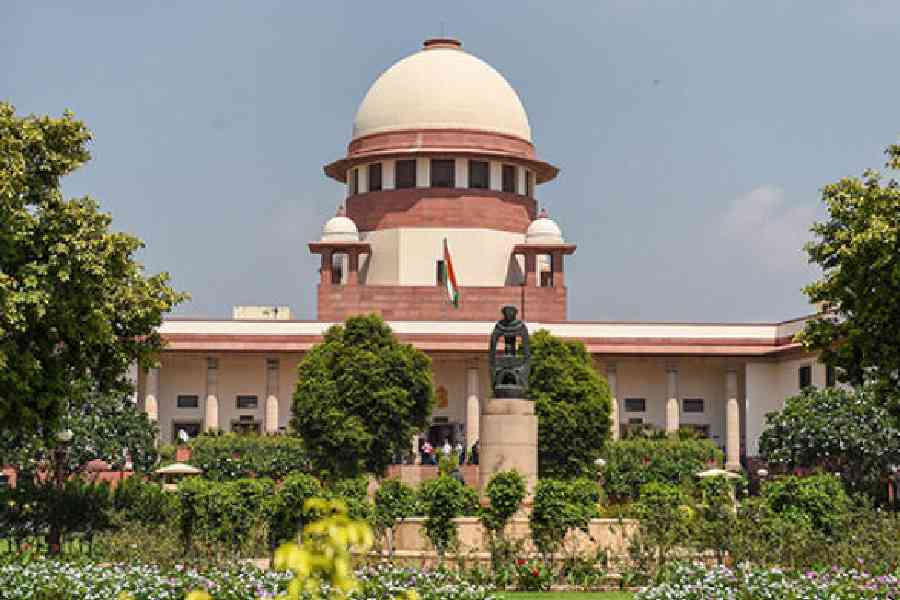
The Supreme Court on Tuesday said it was for Parliament to decide on a uniform civil code on inheritance, adoption, marriage and such matters, refusing to strike down the Muslim Personal Law (Shariat) Application Act, 1937.
Quashing the Act may not be the way to provide succour to Muslim women as it will result in a “vacuum” until Parliament enacts a new law on the subject, the bench said.
“You have a very good case, but would it not be appropriate for this court to defer it to the wisdom of the
legislature, which has the mandate to enact a uniform civil code as per the directive principles of State policy?” the bench said.
Petitioner Poulomi Pavini Shukla had sought a declaration that the Shariat Act ran counter to the Constitution, particularly Article 14, as it discriminated against
Muslim women in the matter of property inheritance rights.
Under the 1937 law, Muslim daughters receive a lower share of property than Muslim sons. Hindu and Christian women, in contrast, enjoy equal property rights with their male siblings.
Justice Joymalya Bagchi observed: “This court has already recommended a uniform civil code (in earlier judgments). See, for a Muslim man, he can divorce unilaterally by any procedure you follow. But can we declare all bigamous relations founded on personal law as invalid? No. So we have to defer to legislative power to bring fundamental duties in effect.”
Chief Justice Surya Kant said: “You are challenging the 1937 act? Then what will apply? What about the vacuum?”
He underlined that if the 1937 law was struck down, Muslim women would have no remedy left under which they can seek their inheritance rights.
Advocate Prashant Bhushan, appearing for the petitioner, suggested that Muslim women can be directed to seek their rights under the Indian Succession Act, which vests men and women with equal property rights.
He cited how the apex court had struck down the practice of instant “triple talaq” as unconstitutional despite its sanction under personal law.
“Does the Indian Succession Act apply to Muslim women?” Justice Kant asked.
“Remember, when you strike down a law, you create a vacuum. In our anxiety for reforms, we may deprive them (Muslim women) even of what they are now getting.”
The bench, which also had Justice R. Mahadevan, said that even if the 1937 law was struck down, Muslims would continue to be governed by their personal law under Article 372 of the Constitution.
Article 372 states that all laws in force immediately before the Constitution’s commencement on January 26, 1950, would remain in operation until altered, repealed, or amended by a competent legislature. The intention is to prevent a legal vacuum.
Bhushan argued the court could always say that the Indian Succession Act would govern Muslims as inheritance was related to civil rights and did not concern “essential religious practices”, which are governed by Article 25 of the Constitution.
The bench adjourned the matter for a detailed hearing but set no specific date.