The Internet Freedom Foundation on Tuesday termed the Centre's temporary block on the messaging app Telegram a "band-aid" solution to exam fraud, arguing that the move is both constitutionally questionable and contradicted by the government's explanation for the restriction.
The criticism was echoed by Telegram founder Pavel Durov, who said the ban had merely "punished" over 150 million ordinary users in India while failing to stop the spread of leaked material.
The leaks, he said in a post on X, had "simply moved to other apps".
The digital rights advocacy organisation argued that the restriction would hurt ordinary users far more than organised fraud networks. It noted that thousands of students rely on Telegram for study groups, doubt-clearing sessions and educational resources in the run-up to the NEET re-examination.
The body said that platform-wide blocks are often easy to bypass through VPNs and other workarounds, allowing determined operators to shift elsewhere while ordinary users lose access to a service they depend on.
Some network analysts suggested that the restriction may be easier to bypass than intended. In a post on X, Nisarga Adhikary, the 19-year-old ethical hacker who exposed CBSE’s exam portal ‘glitch’, claimed the block appears to be operating largely through DNS-level filtering, while Telegram's underlying infrastructure remains accessible.
According to him, users may be able to restore access by changing DNS settings or using VPN services, meaning that the move may inconvenience ordinary users more than determined bad actors.
There have been conflicting claims of many existing users still being able to open Telegam using an in-built security feature of the app, while others reported to have lost access.
A user The Telegraph Online spoke to said, “You might be able to access it with a paid VPN like Nord. I tried using a free VPN app, it didn’t work.”
For students, Telegram’s features like unlimited channel capacity, persistent chat history to access past study materials, and large file sharing up to 2 GB for video lectures and PDFs is a big help when compared to mainstream messaging platforms like WhatsApp and Messenger.
Candidates pursuing NEET-UG and PG mostly take online coaching classes, where notes are easily distributed in Telegram groups and provide more seamless student-teacher communication.
Its username-based system keeps phone numbers private in public doubt-solving groups.
Constitutional overreach
The Internet Freedom Foundation also argued that Section 69A of the Information Technology Act allows the government to block specific content online, but does not empower authorities to shut down an entire platform or force it to alter core features for all users in a country.
"At the outset, it is important to note that Section 69A and the Blocking Rules of 2009 framed under it allow the Government to block access to specific 'information' on a computer resource. They do not extend to switching off an entire intermediary, still less to ordering a company to redesign its product by removing a feature for a whole country," the organisation said in a statement.
The government, acting on recommendations from the National Testing Agency (NTA), blocked access to Telegram until June 22, saying the platform was being used by organised cheating and cyber fraud networks to spread false claims of question paper leaks and scam NEET candidates. It also directed Telegram to disable its message-editing feature until June 30.
However, the foundation argued that the NTA's own account weakens the case for a blanket ban. The agency itself said it had already secured the removal of several Telegram channels, groups and bots linked to the fraud networks.
"If channel-level takedown contained the harm, the case for a blanket block collapses," the organisation said, arguing that authorities had chosen a broader restriction despite acknowledging that targeted action was already working.
The foundation also pointed to what it described as a contradiction in the government's position. While recommending the block, the NTA maintained that no leaked question paper existed outside the secured examination chain and that the security of the examination had not been compromised.
"If the exam is secure and no leak exists, what is being suppressed is rumour, and rumour cannot justify closing a platform when specific blocking and criminal prosecution remain available," the statement said.
The foundation contended that paper leaks originate within the examination system itself — among insiders or through vulnerabilities in the printing and logistics chain — while platforms such as Telegram are merely one of the channels through which the material is later circulated.
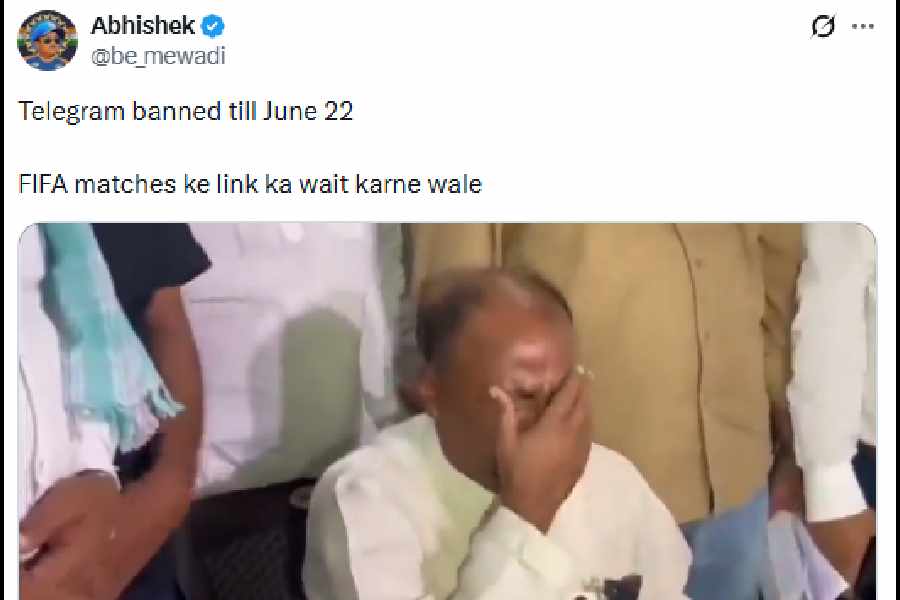
The group also questioned why the Centre has not yet made public the actual order used to block Telegram. So far, only the NTA's press release has been released, while the detailed order issued by the Union Ministry of Electronics and Information Technology remains unavailable. According to the organisation, affected parties and citizens cannot properly scrutinise or challenge a restriction if the legal reasoning behind it remains hidden.