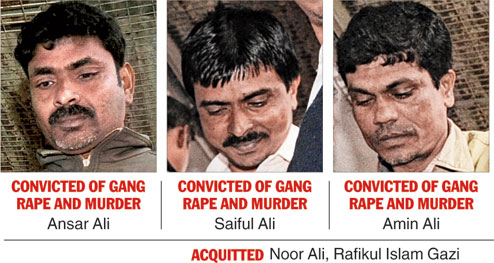


Calcutta, Jan. 28: A sessions court today found six accused guilty of either gang-raping or gang-raping and murdering a college girl in Kamduni in 2013.
But it acquitted two persons in the case that ignited a movement after the chief minister branded as Maoists a group of women who had publicly questioned her.
"Noor Ali and Rafikul Islam Gazi are being acquitted for want of evidence against them," Sanchita Sarkar, additional sessions judge, said.
The omission of Noor's name from the first chargesheet had prompted another judge to wonder aloud in another court: "Is it a chargesheet?"
The sentencing of the six convicts - three have been found guilty of gang rape and murder while the rest have been convicted of gang rape - will follow a submission from the lawyer representing the accused. The submission will start tomorrow afternoon.
The conviction of the six has been greeted with relief in Kamduni but the two acquittals - and a threat by a convict - have fuelled fears of a backlash. Some are also worrying whether the convicts will cite the acquittals in their favour during near-certain appeals in higher courts.
Ansar Ali, convicted of gang rape as well as murder, threatened the brother of the girl today while being taken to the lock-up after the verdict.
" Ami toke dekhe nebo (I will settle scores with you)," Ansar shouted at the victim's brother.
Ansar had been described by the girl's family as the key accused shortly after the incident. But in the chargesheet submitted by the CID, Saiful Ali was mentioned as the main accused.
"I was standing outside the court.... On seeing Ansar, I could not control myself. He was one of those who had murdered my sister brutally. I shouted at him saying he would face capital punishment and he threatened me," said the girl's brother.
"The conviction of the six people has satisfied us, but the acquittals are very unfortunate.... You can say that we are only 75 per cent happy," said Pradip Mukherjee, a primary school headmaster who played an instrumental role in the people's movement.
"Two of them have been acquitted.... If the others also come out later, they would hunt down the witnesses and villagers who had built the movement," said a homemaker.
Some police officers who were not connected with the investigation told this newspaper that the acquittals were "surprising".
On June 7, 2013, the second-year student who was returning home from college on a drizzling afternoon was abducted and taken inside a compound with a boundary wall where she was gang-raped in the caretaker's room. The victim died during the assault.
Ten days later, when chief minister Mamata Banerjee visited Kamduni in North 24-Parganas, she had faced a demonstration staged by the villagers who shouted slogans such as " amra kono rajniti chai na amader gramer meyer mrittyu niye (we do not want any politics over the death of a girl from our village)".
Faced with a situation Bengal had never seen before, Mamata lost her cool and described the demonstrators - most of whom were homemakers - as Maoists. She also held miscreants from Bangladesh responsible for the incident, saying Kamduni is located along the India-Bangladesh border. The border is at least 40km from the village. (All those convicted today are from villages adjoining Kamduni.)
Amid an uproar, the Mamata government had handed over the probe to the CID, which had filed its first chargesheet on June 29, 2013, in a Barasat court. The judge expressed his displeasure with the 147-page chargesheet, and had asked in the open court: "Is it a chargesheet?"
The provocation was the absence of Noor's name, which featured in the first FIR that the victim's family had lodged after the incident, in the chargesheet.
The public prosecutor had tried to impress upon the court that Noor's name was dropped as forensic evidence against him was still awaited. But the argument did not cut much ice with the judge, who had also asked: "Was there a hurry to file this chargesheet?"
In a supplementary chargesheet within a month, the CID had included Noor's name but without any forensic evidence.
As part of the forensic probe in rape and murder cases, blood samples, hair or tip of nails from both the victim and the suspect are collected and then matched to ensure whether they had come in contact.
"In case of gang rape, one doesn't need to establish rape by everyone.... Even presence at the scene of crime is enough to be convicted. But that cannot be proved by forensic evidence, and other corroborative evidence is needed to establish it. The CID could not prove that Noor and Rafikul were present at the spot," said a senior police officer.
Sources in the CID said that Rafikul was at large for over five months and had fled to Bangladesh. "Later, he was arrested from a village adjoining Kamduni, when he came back from the neighbouring country. Had he not been involved, why did he run away?" asked a CID officer.
Although the lower court's order is expected to be challenged in higher courts, a government-empanelled lawyer said the acquittals would set a precedent and help the other accused.
"The forensic evidence exists for only one of the accused, Saiful.... This means the case against the other five accused is not watertight and they may also escape conviction later," said the lawyer.
Additional reporting by Soumen Bhattacharjee