London, June 9: M.F. Husain was quite eccentric and funny. And loved by almost all who knew him. One moment he would be there chatting to you, the next moment, a bit like the Scarlet Pimpernel, he would be gone.
He was tall, slim. His sartorial style did not vary: black shirt, black jacket, black trousers, a walking stick shaped like a paintbrush, thick wavy white hair and sometimes, but not always, in bare feet.
The first time I interviewed him properly was at the home of art collector Anwar Siddiqui, who understandably feels he has lost almost a close family member.
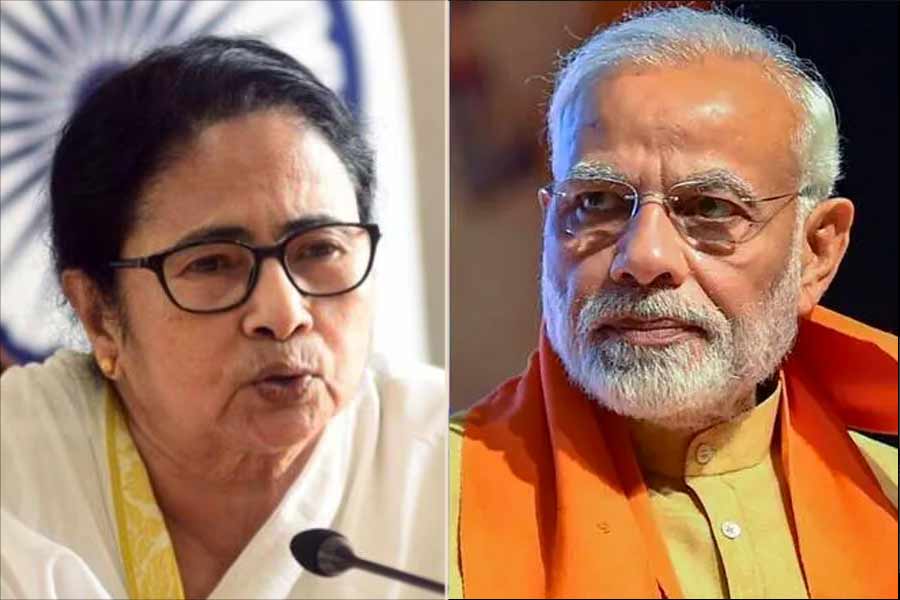
“We had a wonderful time together,” Anwar remembers. “We talked about everything.” This includes the disclosure he had painting something to give to Mamata Banerjee. It is possible this will be delivered to her.
When Anwar arranged for me to interview MF, I asked about how he had started as a painter of Hindi cinema posters. These were invariably giant hoardings, now considered to be works of art by western galleries, but back in India when one film ended, the same hoarding was used to promote the next movie.
No one thought of preserving them. Sometimes, the paint just got washed away by the monsoon, said MF. The consensus is that none of MF’s original posters have survived but Anwar is not so sure. “They might come out now,” he says. “Someone somewhere may have one.”
So where did MF live in London?
Good question.
Sometimes, he stayed with Anwar but I have also met him at the St James Court Hotel (now called the Crown Plaza). Recently, he had the use of a couple of apartments in and around Mayfair in the West End.
He needed space. And he did talk quite a lot about how he loved to paint sitting on the floor with everything scattered around him. On occasions, he just turned up if there was a party at Indar Pasricha’s fine arts gallery in Connaught Street near Marble Arch.
According to Indar, what made MF such a great painter was partly his technical expertise. “He had a wonderful calligraphic line. He could rightly be compared to Picasso. MF is certainly one of the greatest painters of the 20th century. He took Hindu subjects, Muslims subjects, Parsi subjects, he truly belonged to the nation. I would say he belonged to the sub-continent because he had a following in Pakistan as well.”
Today, both Srichand (SP) Hinduja and Lord Gulam Noon wanted to share their anecdotes about MF. SP got MF to do his daughter’s wedding card back in 1987. “I gave the concept to him and he was very quick,” recalls SP, from his home in Mumbai.
“There were four cards — one for the sangeet, one for the mehndi, one for the wedding and one for the reception. Guests kept the cards and framed them. When we launched our Swiss bank in 1994, he did paintings to symbolise eight religions and our Vedic philosophy. They are in the bank vault but we copied them and gave 1,000 copies to guests. These, too, have been framed by many people.”
Noon tells me a story going back to 1936. “He painted a portrait of my late elder brother, Mohammed Hussain, who died at the age of 26. We got the painting for a princely sum of Rs15!” The painting is in Noon’s office with his collection of more than 100 cricket bats.
When MF dropped in last year into his office, “I got him to sign the painting on the back, because in his youth he used to sign his name as just ‘Maqbool’.” “I have six of his paintings,” adds Noon. One dominates the drawing room of his London apartment.
Two years ago, there was a historic meeting between the two grand old men of Indian art’s “progressive movement”— MF and S.H. (Syed Haider) Raza. Thanks to Tanya Baxter, who runs a contemporary art gallery in the King’s Road, Chelsea — and represents their work — Husain and Raza, who were then 93 and 87 respectively, sat next to each other, having a drink and a good gup shup.
Tanya is very upset by Husain’s passing. “Apart from his extraordinary genius and his huge contribution to art around the world, Husain was an extremely kind and charismatic man whose gentle presence touched us all, particularly my children. To them, he seemed a Father Christmas figure. His artistic legacy will continue, but Husain the man will be sorely missed.”
At the end of today’s Christie’s auction, groups of people gathered, instinctively aware something big had happened. Hugo Weihe, the auctioneer, said that to have two of MF’s paintings on the day of his death “is a moving moment”. “He was one of the greatest masters and we knew him as a friend. He held the banner for Indian art since independence. We have been proud and honoured to have handled his work. In fact, Ganga Jamuna, painted in 1971, sold for $1.6 million and set a world record at auction.”
There was Prajit Dutta, a partner in Aicon Gallery, who said: “It really feels like the passing of an era. He represented something much bigger than an individual artist. He represented a whole life force. It manifested itself in the way he moved the Indian art market. It was that whole ethos that Indian art had a place in the world and needed to assert its identity in a self-confident form.”
Rohit Gandhi, who runs Pallet Art Gallery in Delhi, said: “It’s a real pity he passed away in London, and not in India.”
Amol Vadehra, whose family run the Vadehra Art Gallery in India, was with him in Qatar in January this year and spotted an Indian restaurant, Star of India, as they were crossing the street. MF risked a wry joke: “Son of India ko to bahar nikal diya (they have expelled the son of India).”
I remember MF coming into the Washington Hotel in Mayfair two years ago just as Shah Rukh Khan was receiving an honorary degree from the University of Bedfordshire. Shah Rukh immediately salaamed MF and made sure there was room for him in the front row.
Since I sat immediately behind MF, we could chat in between the formal speeches. I urged him, as I did whenever I met him: “MF, please go back, nothing will happen, Rushdie went back, nothing happened.” MF just smiled.