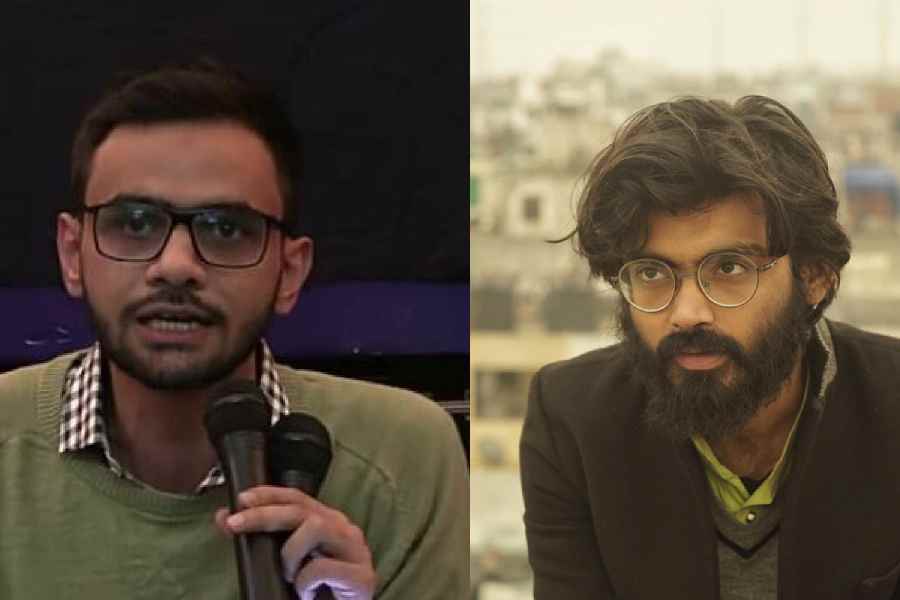
“Alleged masterminds” Umar Khalid and Sharjeel Imam must remain behind bars in the 2020 Delhi riot conspiracy case, the Supreme Court ruled on Monday while granting bail to five co-accused whose roles it found “peripheral”.
Dismissing the bail pleas of Umar and Sharjeel — who have spent five and six years, respectively, in jail awaiting trial — the bench said there was “direct, corroborative” evidence of their “prima facie… central and formative role in the alleged conspiracy”.
They can again seek bail — restarting the process from the level of the trial court — only after the prosecution has completed examining the “protected witnesses”, or after one year from Monday, the court said.
It paved the way for the release of Gulfisha Fatima, Meeran Haider, Shifa-ur-Rehman, Mohd Saleem Khan and Shadab Ahmed, saying their “alleged involvement is confined to facilitation or participation at a different level”.
“To disregard such distinctions would itself result in arbitrariness,” the bench of Justice Aravind Kumar and Justice N.V. Anjaria said, imposing stringent bail conditions and clarifying the relief to the five did not dilute the charges or presumed their innocence.
These five appellants must now approach the trial court to complete the bail formalities before they can be freed.
All seven are accused, under the anti-terror law UAPA, of conspiracy in connection with the February 2020 Delhi communal riots that claimed more than 50 lives.
Umar has been in custody since September 13, 2020, and Sharjeel since January 28, 2020. The court was dealing with a batch of bail pleas challenging the long imprisonment of the seven as a violation of their fundamental right to life and liberty.
“In the case of the alleged masterminds, i.e., Sharjeel Imam and Umar Khalid, the prosecution material comprises direct, corroborative, and contemporaneous evidence, including recoveries, digital communication trails, and statements indicative of managerial responsibility,” the 142-page judgment authored by Justice Kumar said.
“In contrast, the involvement of others is sought to be established mainly through associative or peripheral conduct. The court cannot ignore that where evidentiary strength varies materially between accused persons, the need for continued detention likewise varies.”
The judgment said both Umar and Sharjeel were alleged to have exercised command authority and possessed the ability to mobilise or influence individuals within and outside their immediate circle.
Such allegations, when supported by preliminary material, compel heightened caution relating to the possibility of their interfering with witnesses or reactivating dormant networks, it said.
Co-accused with no independent capacity to mobilise resources or exert organisational leverage do not present the same systemic risk, the judgement added.
“The material (against Umar and Sharjeel) suggests involvement at the level of planning, mobilisation, and strategic direction, extending beyond episodic or localised acts. The statutory threshold under Section 43D(5) of the Unlawful Activities (Prevention) Act, 1967, (bar on the grant of bail) therefore stands attracted qua these appellants,” the court said.
Some of the bail conditions it imposed on the five co-accused:
- Each must execute a personal bond of ₹2 lakh with two local sureties of an equal sum to the satisfaction of the trial court.
- They cannot leave the National Capital Territory of Delhi without the trial court’s permission.
- They must surrender their passports.
- They must furnish their current addresses, contact numbers and email addresses to the investigating officer and the trial court, and cannot change these details without seven days’ advance notice.
- Each appellant must personally appear every Monday and Thursday, between 10am and noon, before specified police stations.
- The appellants must not directly or indirectly contact, influence, intimidate or attempt to contact any witness or person connected with the proceedings. They cannot associate with any organisation linked to the subject of the FIR/ final report.
- They cannot make, publish or disseminate any information, statement, article or post — in print or via the electronic or social media — on the case or its participants until the trial ends.
- They cannot participate in any programme or address or attend any gathering or meeting, physically or virtually, till the trial ends.
- They must appear at every hearing unless exempted by the trial court and must do nothing to delay the proceedings.
- If any of them commits any offence during the pendency of the trial, the prosecution can seek the revocation of bail.
- For any breach of the bail conditions, the trial court can cancel bail after hearing the appellant.