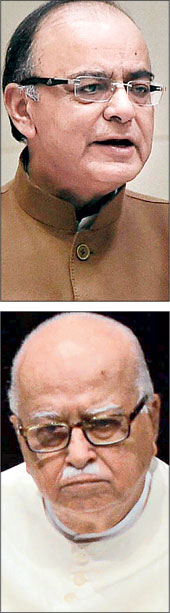

New Delhi, Dec. 23: When Prime Minister Narendra Modi equated the allegations against Arun Jaitley in the DDCA controversy with the hawala money-laundering case against L.K. Advani, hoping that like the BJP veteran his finance minister would emerge "pure" from the "trial by fire", for many in the party the connect resonated in history.
In a sense, the BJP's history begins with the declaration of Emergency on June 26, 1975.
The BJP's ideological parent, the RSS, born in 1925, had no role to play in India's struggle for Independence. The Sangh located a context for its raison d'etre after Partition and the transfer of population between India and Pakistan. The experiences of the Hindus who fled Pakistan fed into its beliefs in the concept of a "Greater India" or "Akhand Bharat".
But after Jawaharlal Nehru's nation-building enterprise subsumed whatever communal feelings there may have existed into a greater cause, the RSS and later the Jana Sangh, the BJP's predecessor, found themselves marginalised in the polity. Until the Emergency breathed life into the Jana Sangh.
Jaitley was arrested in 1975 and lodged in the Tihar jail for 15 months. He was then an activist of the Akhil Bharatiya Vidyarthi Parishad, the RSS's student arm, and a convenor of Jaya Prakash Narayan's Committee for Youth and Students' Organisations.
His political baptism took place in the prison cell. Although Jana Sangh leaders like Atal Bihari Vajpayee and Advani were kept in the Bangalore jail, he learnt about them during his Tihar stint.
In 1979, when he married Sangeeta Dogra, the daughter of Congress veteran Girdhari Lal Dogra, Advani was present with Vajpayee and Indira Gandhi. By then, he was deep into legal practice in Delhi.
However, Jaitley forged a deeper association with Advani in September 1990 when Advani kicked off his Ram rath yatra to Ayodhya.
BJP old-timers recalled Jaitley preparing notes for Advani's daily media briefings.
The BJP was then supporting V.P. Singh's National Front-Left Front government from outside. When north and west India were consumed by communal riots, he pressured Prime Minister Singh to give in to the VHP's demand for a Ram temple.
In his autobiography, My Country, My Life, Advani wrote that Jaitley and S. Gurumurthy, the Chennai-based chartered accountant, who was a key adviser of Advani, were the conduits between the government and the VHP and helped the government frame an ordinance that gave part of the "disputed" territory to the Ramjanmabhoomi Trust. The ordinance was later recalled.
Jaitley was then an additional solicitor-general in the NF-LF government. He resigned after the BJP withdrew support to it.
However, Jaitley did not associate himself with the "temple movement" as did several of his BJP colleagues, notably Pramod Mahajan and K.N. Govindacharya.
In the 1991 general elections, he was one of Advani's campaign managers when he won from New Delhi very narrowly against film star Rajesh Khanna.
On the legal front, Jaitley defended Advani in court after the CBI filed cases against him and other BJP-VHP leaders for the Babri mosque demolition.
Their proximity grew when in 1996, Jaitley defended Advani against charges in the hawala scam that Modi alluded to.
Advani tried hard to secure a Rajya Sabha berth for his protégé but Vajpayee opposed him.
Advani recompensed for his failure by appointing Jaitley as the BJP's spokesperson, a position that enhanced his national profile.
Later in 2003, Advani fought hard to get Jaitley back into Vajpayee's cabinet as the law minister after the former Prime Minister had him repatriated to the BJP as a general secretary.
Jaitley started to get disillusioned with his mentor in 2005 when Advani increasingly came under the influence of his former political secretary, Sudheendra Kulkarni.
Like his other colleagues in the BJP, he thought Advani had crossed the red lines of ideology laid down by the RSS by praising Mohammad Ali Jinnah during his Karachi trip.
But he did not entirely distance himself from Advani, who ensured that Jaitley and Sushma Swaraj got the Rajya Sabha and Lok Sabha Opposition leaders' posts in 2009.
However, well before the 2014 elections, Jaitley was among the first in the BJP to figure out that if his party was to wrest power from the Congress, it was time to effect a serious makeover right at the top by projecting a new leader and make a clean break with the past.
Modi was his choice and he embarked on his enterprise to help package and project him as the BJP's Prime Minister candidate. Advani had by them receded far away from Jaitley's political consciousness.