 |
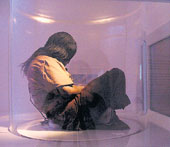
| The 15-year-old girl found in Llullaillaco, Argentina |
New Delhi, Oct. 2: Using hair from bodies of children found preserved in the Andes mountains, archaeological scientist Andrew Wilson has pieced together a chilling tale of children fattened and killed in ritual sacrifice 500 years ago.
UK-based Wilson and his colleagues elsewhere have used chemical signatures in scalp hair of the children to reconstruct events in their final months and show that they had been prepared for sacrifice a year before their deaths.
The researchers studied the frozen remains of a 15-year-old girl discovered on a mountain top in Peru in 1996.
In 1999, they found the remains of another 15-year old girl, a seven-year-old boy and a six-year-old girl, all in a stone structure at the height of 6,700m in Llullaillaco, Argentina, the world’s highest archaeological site.
The 15-year-old, found in Llullaillaco, may have died anytime between 1430 and 1520.
The Peru girl had received a blow on her head, similar to what had been earlier observed in another Andes body.
The new study, published yesterday in the US’s Proceedings of the National Academy of Sciences, has helped scientists determine how their diets changed and how they were moved high up the mountains just before their deaths.
“The really chilling thing is that they were earmarked for sacrifice and their diets improved a year before death,” said Wilson at the University of Bradford. “Whether they knew what was coming to them is not clear,” he told The Telegraph.
Historical accounts and earlier archaeological findings had suggested that child sacrifice was practised in the Andes during the rule of the Incas in Peru and Argentina from the 12th century to about the mid-16th century.
The analysis of chemicals in hair samples showed for much of the time, the children ate a poor diet, mainly vegetables like potatoes. But 12 months before the sacrifice, the diet improved dramatically, enriched with maize and meat.
“In effect, the countdown to their sacrifice had begun a considerable time prior to death,” said Wilson, a Welcomm Trust Bioarchaeology Fellow.
Diet changes get reflected in chemical residues in hair which typically grows 10mm each month. Hair chemistry can also change with altitude because of decreasing oxygen in the atmosphere. Chemical changes in the children’s hair samples also suggest that they began their journey up the mountains from Cuzco, the Inca capital.
While there was evidence of a blow on the head of the 15-year-old girl found in Peru, scientists said, the cause of the death of the other three children found in Argentina remains unclear.
“It looks to us as though the children were led up to the summit shrine… drugged and left to succumb to exposure,” said Timothy Taylor, a team member also at the University of Bradford.
An earlier study on the body of the boy from Llullaillaco had suggested that he had died of terror. There was vomit and diarrhoea on his clothes, indicative of a state of terror.
His vomit was stained red by a hallucinogenic drug called achiote, traces of which were also found in his stomach and faeces. “But examinations also showed signs of crush injuries on the body,” Wilson said.
Researchers believe the children of local communities were picked for sacrifice by the Incas to use fear to govern. “The treatment of such peasant children may have served to instil fear and facilitate control over remote mountain areas,” Taylor said.
Many questions about child sacrifice in the reign of the Incas remain unanswered. “We don’t know when it started or when it stopped,” Wilson said. “But it could have come to an abrupt end with the Spanish invasion.”
A combination of accumulated archaeological and literary evidence suggests that human sacrifice has been practised in history across diverse cultures in several parts of the world, including central America, Europe, Asia, and West Africa.
The 15-year old Llullallaico girl went on display for the first time at a museum in northwest Argentina last month.