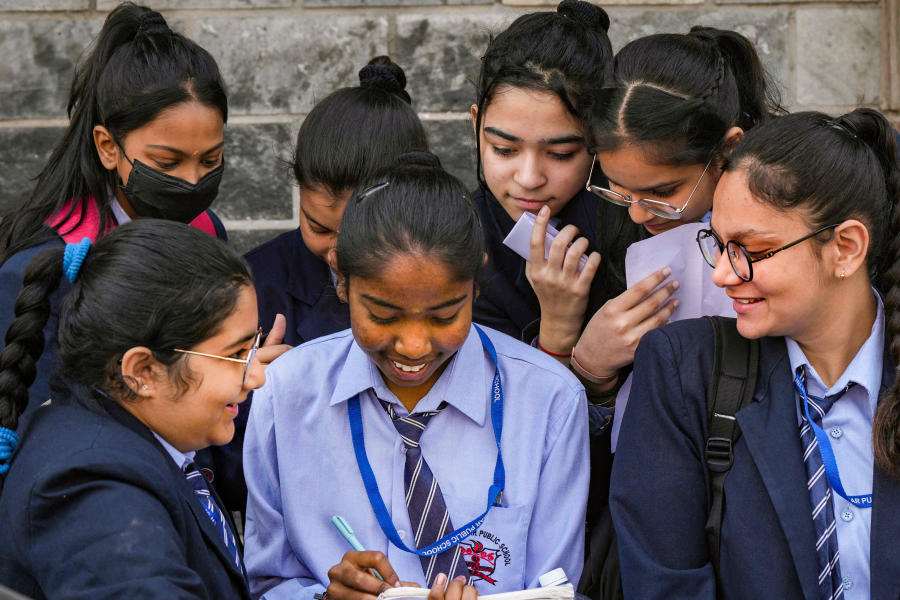
The Central Board of Secondary Education (CBSE) is changing how Class-12 board exam answer sheets are evaluated.
From 2026, the board will implement on screen marking (OSM), shifting fully to digital evaluation for Class-12 exams. With this move, post-result verification of marks will no longer be required.
The decision was outlined on Friday during a workshop conducted by CBSE for school teachers and principals.
Officials explained the structure and functioning of the OSM system, which replaces physical evaluation with digital assessment of scanned answer scripts. However, the evaluation of Class-10 answer books will continue in physical mode.
“Post-result verification of marks will no longer be required and there will be a reduced manpower requirement for verification as there would be no scope for any totalling errors,” examination controller Sanyam Bhardwaj said.
“In the older system, students would seek verification to check for discrepancies in the whole numbers or missing numbers. In the new scheme of digital evaluation, such discrepancies would be eliminated at the outset,” he added.
Under the new system, answer sheets will be scanned and uploaded to a secure digital platform where examiners can assess them remotely.
The shift is expected to address common issues that led students to apply for verification after results were declared, especially errors in totalling or unchecked answers. CBSE officials said the transition has been in preparation for some time.
“Before taking a final call, we analysed lessons from past experiences, redesigned systems, carried out dry runs, identified glitches, took stakeholder feedback, conducted global testing and reinforced the safety and security protocols,” Bhardwaj said.
The board conducts Class-10 and Class-12 examinations annually in India and in 26 countries, covering nearly 46 lakh students. Managing evaluation at this scale has long required coordination across thousands of examiners and centres.
Bhardwaj said the move will improve coordination and reduce manual intervention, besides eliminating totalling errors.
"The option for digital marking is not only environmentally sustainable but will ensure faster evaluation with wider teacher participation. Teachers can remain in their schools and continue their regular duties,” he said.
With Class-12 shifting to digital marking and Class-10 continuing in physical mode, CBSE is taking a phased approach.
For students, the most immediate change will be the end of post-result verification requests based on calculation errors, an annual process that often followed the declaration of results. From 2026, that chapter closes for Class-12 candidates.