Calcutta, Nov. 12: On a chilly night in the early 1990s, cops from Burrabazar police station picked up a suspect on the charge of threatening a local businessman. The suspect and his friends knew who could help him out but, in the pre-mobile era, they could not contact him.
The friends then found a way out: they scoured the police stations in the neighbourhood and found their would-be benefactor relaxing in a station in south Calcutta.
“Bhaiji was so thick with the police that he used to spend most of his time with them. At nights, he would go to one of the police stations in the city and kill time there. Nobody ever stopped him,” recalled a former associate who claimed to have been with Bhaiji for over three decades before falling out two years ago.
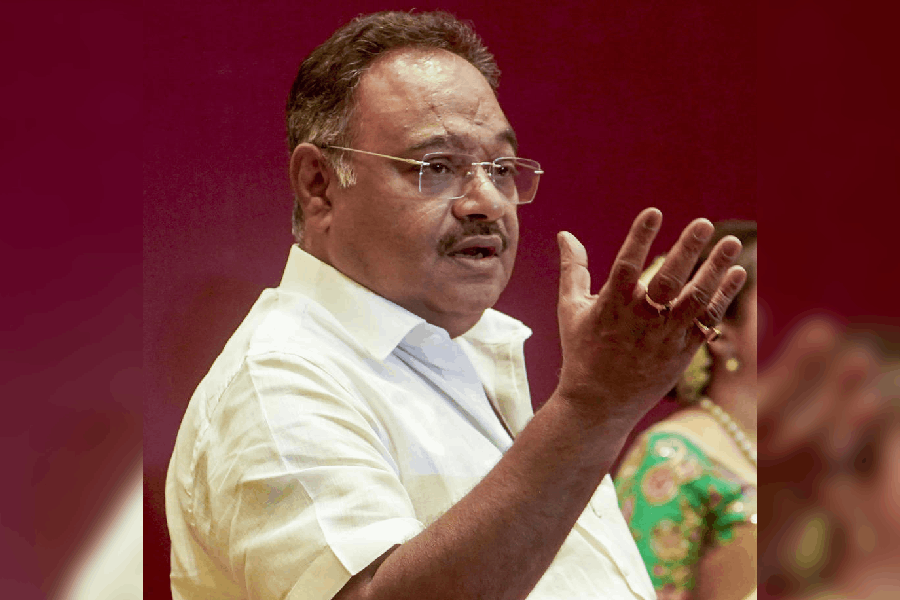
The associate claimed “Bhaiji” was Ratan Lal Nahata, the tenant and claimant of 9A where two bouncers were gunned down on Monday.
Nahata, in his mid-70s, could not be contacted to corroborate the claims of the purported associate but several real estate players recalled he was the “go-to man” in the 1980s and early 1990s if they found themselves in sticky situations associated with law enforcement, legal affairs and administrative requirements.
“He could just walk into the chambers of the top cops at Lalbazar (the Calcutta police headquarters). Officers-in-charge stood up when he walked into a police station. He knew the right people and knew which strings to pull to get his work done,” said the associate.
Nahata reposed more faith in police officers than in politicians. “Politicians will ultimately engage a cop to get the work done. Then why not engage them directly?” the associate said, referring to Nahata’s alleged motto.
Three years ago when a local politician dropped in to demand money, Nahata brandished his gun and the problem melted away, the associate said.
Others have fonder memories of Nahata and his gun. Nahata, who possessed an arms licence, often entertained a close circle of friends and associates with his shooting skills when in a good mood. “Bhaiji used to toss a coin in the air and shoot it into pieces. I never saw him missing,” a friend claimed.
Nahata, who traces his roots to 10 Armenian Street in central Calcutta where he stayed with his family who had a diamond business, made a name for himself when he was young.
In the early 1970s, associates and friends said, Nahata caught the attention of Jaichand Sethia, known for running gambling dens and swinging deals with the help of the police.
But by the mid-1970s, the two had split up over a dispute between two partners in Burrabazar.
When someone approached Nahata with a property dispute or an administrative matter gone awry, he could be trusted to provide “advice” and arrange contacts to get the person out of the jam.
In Burrabazar, several traders spoke of how Nahata helped them out of a situation after a fire in a market in the past decade.
But Nahata is never known to have fallen foul of the law. The erstwhile associate also credited him with “ethics”. “Once we were vacating a property. One of us spotted a CD player and wanted to keep it. Nahata snatched it and dumped it in the Ganga. Within a week, he bought a new CD player and gave it to that person,” the associate recalled.
Others, too, attributed his rise to his personable nature. “Bhaiji was neither vain nor of bad temper. He never let these things distract him from his objective. He would go to the extent of touching a person’s feet if he sensed that the person was miffed with him,” said an associate who left Nahata in the earlier part of the last decade.
Nahata was generous, too. “When he would come to the police station, he would start from the constable at the gate and go on to the highest ranking officer,” said a police officer. “People trusted him immediately. And once they came in contact with him, they would go nowhere else for help,” an associate added.
But in the mid-1990s, Nahata appears to have reached the twilight zone. His contacts in the police were retiring one by one and Nahata’s failing health was also standing in the way. The condition of his knees limited his mobility.
9A, the Short Street property at the centre of the storm, also dragged him to controversy. A promoter from Burrabazar, who said he had met Nahata two years ago, said he never showed the property deed to anybody. “He had with him a swank brochure, on plans to develop the property. He would try to persuade promoters into paying an advance by saying that he wants to build a highrise with all amenities,” the promoter said.
Nahata met Mamta’s mother in the late 1980s and arranged for her to stay in a room near the property. Mamta’s mother moved in with her two sons and daughter. Nahata was affectionate towards the children and used to drop and fetch Mamta from school, an associate said.
After Mamta’s mother died, her two brothers migrated but she stayed on and ensured that she got good education.
But some sources suggested that for the past few years, Nahata was not happy with Mamta. “Bhaiji often alleged that Mamta was controlling all the finances and did not give much importance to what he said,” an associate said.
Nahata did not marry. When his friends told him to tie the knot, he would say: “I may get killed anytime. I do not want to risk the future of a woman.”
LEGAL STATUS
CASE I
Where: Calcutta High Court
When: 2011
What: Rumi and Rakhi Sein, grandnieces of 9A owner Sailabala Sein, file petition seeking exclusive property rights to Ratan Lal Nahata
Order: Court rejects general application (GA 778 of 2011) for immediate provisional relief. Rumi and Rakhi wanted the Surekas to be restrained from dealing with the property
Reason: Rumi and Rakhi claimed ownership on the basis of an unprobated will of Sailabala of 2003, executed shortly before her death. However, the court noted that the property was already sold to Heartline Estate in 1999 by a lawyer Shibaji Banerjee who claimed to be possessing a power of attorney of Sailabala.
The order found the transaction between Nahata and the Sein sisters to be “most unusual” given that the former already knew about Heartline’s claim to the property. “It is hardly rational for any prudent person to part with good money to acquire a property from an executor (Rumi) and a legatee (Rakhi) with knowledge that the testator (Sailabala) may not have had title to the property at the time will was prepared,” the order read
lPending: Civil suit 41 of 2011 that deals with the larger question of title
of the property
CASE II
Where: Calcutta High Court
When: May 2013
What: Sanjay Sureka and others seek eviction of Nahata
Order: No interim order. Case posted for June 24, 2013. What happened on June 24
is not clear. The high court’s website does not mention the case after the May 2013
proceedings
Undertaking: Nahata assured the judge that he would not transfer, encumber or deal with the property without the permission of the court
CASE III
Where: Calcutta High Court
When: August 2013
What: Nahata challenges the decision of Calcutta Municipal Corporation against issuing mutation to him
Order: The municipal body is free to consider the Surekas’ application for mutation on its own merit and in accordance with law
Rider: Both are claiming title over the property, the court said. The litigation (civil suit 41 of 2011) is pending in the court. The mutation will ultimately abide by the result of the suit