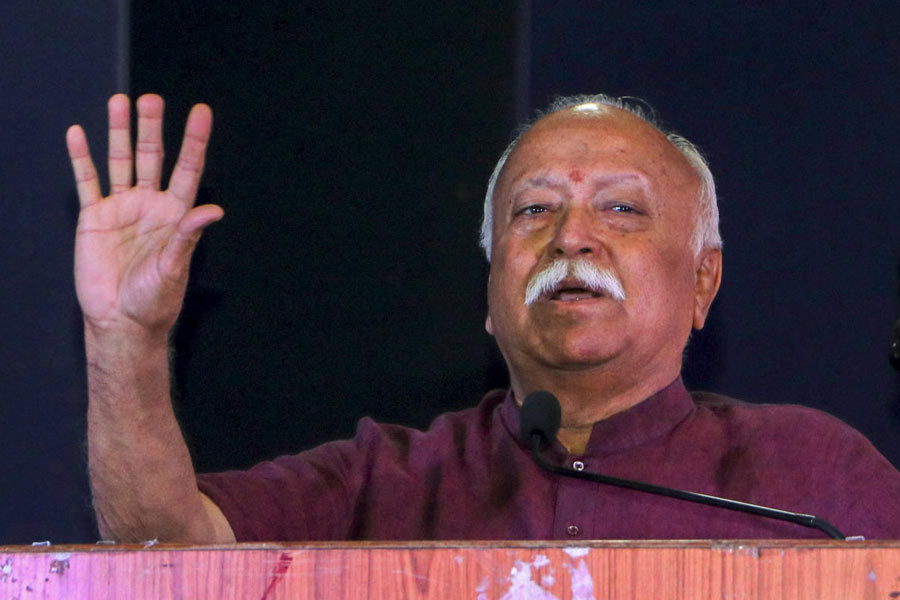
Rashtriya Swayamsevak Sangh (RSS) chief Mohan Bhagwat has recalled Mahatma Gandhi observing that British had created a false narrative about India lacking unity before their rule.
“Gandhiji wrote in (his book) Hind Swaraj that it was a false narrative taught to us by the British that we were not united before they came," Bhagwat said, speaking at the national book festival in Nagpur on Saturday.
Written by Gandhi in Gujarati in 1908, and translated by him into English in 1909, Hind Swaraj has 20 chapters and is written in the form of a dialogue between the reader and the editor of a journal/newspaper.
"The English have taught us that we were not one nation before and that it will require centuries before we become one nation. This is without foundation. We were one nation before they came to India.
"One thought inspired us. Our mode of life was the same. It was because we were one nation that they were able to establish one kingdom. Subsequently they divided us," Gandhi had written in the book.
Bhagwat said India’s concept of ‘rashtra’ is ancient, organic and fundamentally different from the Western idea of a nation.
"We do not have any argument with anyone. We stay away from disputes. Having a dispute is not in our country's nature. Being together and fostering fraternity is our tradition," he said, adding that other parts of the world evolved in situations filled with conflict.
"Once an opinion is formed, anything apart from that thought becomes unacceptable. They close doors to other thoughts and start calling it ‘…ism'," he remarked.
“We use the word nationality, not nationalism. Excessive pride about the nation led to two world wars, which is why some people fear the word nationalism," Bhagwat said.
If we consider the definition of a nation as understood in the Western context, it typically involves a nation-state with a central government managing the region, he said.
However, India has always been a 'rashtra', even under different regimes and during periods of foreign rule, the RSS chief added.
India’s nationhood was not born out of arrogance or pride but out of deep interconnectedness among people and their coexistence with nature, he said.
“We are all brothers, as we are children of Bharat Mata, and there is no other human-created basis such as religion, language, eating habits, traditions or states. Despite diversity, we remain united as that is the culture of our motherland,” he said.
He also stressed the importance of knowledge that leads to wisdom and underlined that practical understanding and living a meaningful life matter more than mere information.
True satisfaction, he said, comes from helping others — a feeling that stays throughout life, unlike temporary success.
Interacting with young writers at the event, Bhagwat said the advent of technologies like artificial intelligence (AI) cannot be stopped, but we should remain its masters and maintain our dignity while dealing with it.
AI should be used for the benefit of mankind, to make humans better, he said.
To a query on the challenge of globalisation on language and culture, the RSS chief said, "It is an illusion currently. The real era of globalisation is yet to come, and India will bring it." India has had the concept of globalisation right from the beginning, and it is called 'vasudhaiva kutumbakam' (the world is one family), he said.
"We don't make a global market, but we will make one family, which will be the real essence of globalisation, and that era is yet to come. Hence, remove the fear or misunderstanding about globalisation from your heart," Bhagwat said.
Except for the headline, this story has not been edited by The Telegraph Online staff and has been published from a syndicated feed.