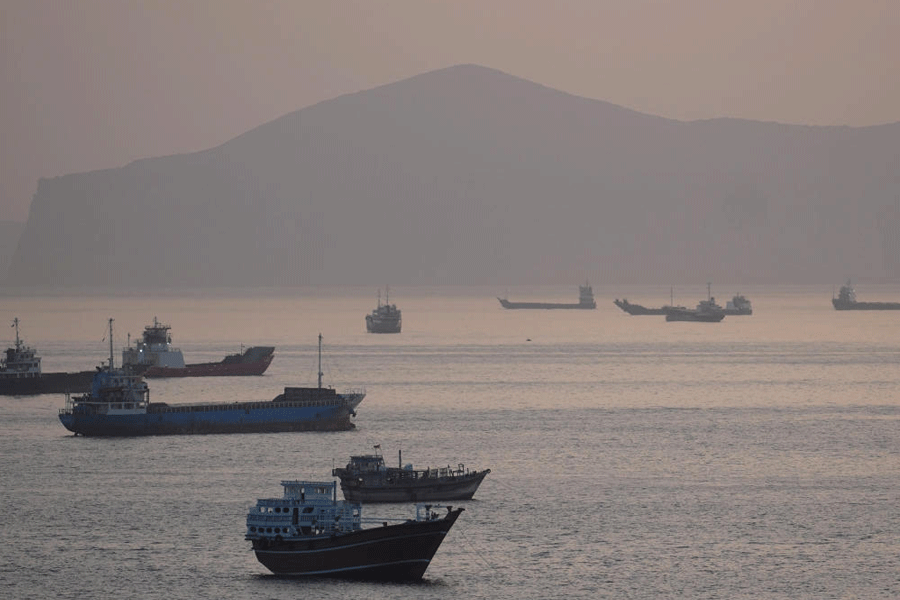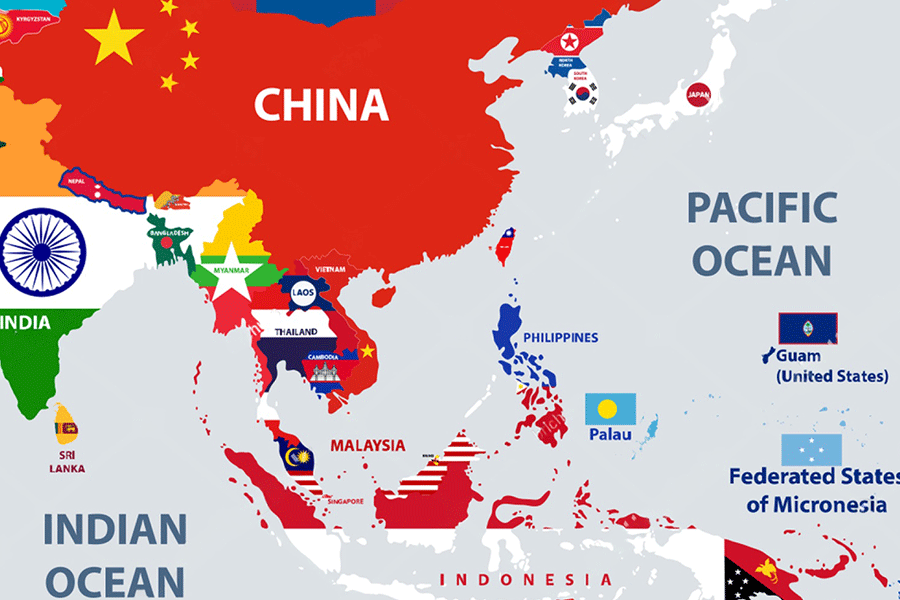
China is taking advantage of the fact that much of the world’s attention is fixed on tensions around the Strait of Hormuz and has quietly stepped up its presence in waters much closer to India. A third Chinese “research” vessel has now entered the Indian Ocean region, adding to a small but growing flotilla operating across the Indian Ocean and the Arabian Sea.
The latest ship, the Shi Yan 6, sailed into the Indian Ocean via the Sunda Strait, a narrow tough to navigate seaway between Java and Sumatra. It has declared its destination as Malé, the capital of the Maldives, which in recent years has become a regular port of call for Chinese vessels operating in the region.
It is not alone. Two other Chinese “research” vessels are already active across these waters. The Da Yang Hao arrived in late February and has since moved westwards, sailing closer to Africa. Another similarly named ship, the Da Yang Yi Hao, which first arrived in December, has been crisscrossing the Indian Ocean and the Arabian Sea between India, Pakistan and the African coast.
On paper, these ships are engaged in scientific work. In practice, their capabilities have drawn sustained scrutiny from Indian security planners. The Shi Yan class of vessels focuses on mapping the seabed, while the Da Yang class studies sub-surface conditions and scouts for minerals. Crucially, many of the areas being surveyed lie close to India’s submarine operating routes.
The distinction matters. By studying the shape of the seabed, the Shi Yan ships can help build highly detailed underwater maps. The Da Yang vessels go a step further, drilling and analysing what lies beneath. Such data have clear dual-use value: in submarine warfare, understanding underwater terrain makes it far easier to identify potential hiding spots, navigation corridors and surveillance blind zones.
China’s deployment of these vessels around India is not new, but it has intensified in recent years. The current pattern can be traced back to 2022, when the Chinese tracking ship Yuan Wang 5 docked at Hambantota port in southern Sri Lanka. The port itself is a sensitive issue – leased to a Chinese company for 99 years after Sri Lanka was unable to service its debt – giving Beijing a strategic foothold along key Indian Ocean shipping lanes.
The arrival of the Yuan Wang 5 caused alarm in New Delhi, not least because one of its roles is to track missile and satellite launches – capabilities directly relevant to India’s defence programme. Under pressure from India, and reportedly also from the United States, Sri Lanka subsequently restricted Chinese research vessels from docking at its ports.
Since then, many of these ships have shifted their logistics hub to Malé. The Shi Yan 6 itself first visited the region in 2023. By 2024, several Chinese vessels – possibly eight to 10 – were operating in these waters. In the following year, their focus appeared to shift slightly farther from India’s immediate coastline, with increased activity closer to Diego Garcia, another strategically sensitive location.
Unsurprisingly, the Indian Navy keeps a close and continuous watch on these movements. Maritime experts note that Chinese survey vessels often return to the same locations repeatedly, gradually building up a highly detailed and layered picture of the seabed and sub-surface environment.
Under international maritime law, countries can apply to the International Seabed Authority for permission to explore the ocean floor. China has made extensive use of this framework and now operates roughly 50 research vessels across the Pacific and Indian Oceans. The United States maintains a fleet of a similar size.
India, by contrast, operates a far smaller fleet of around 10 to 12 research vessels. There is also a structural difference: Indian ships are largely run by civilian scientific bodies such as the National Institute of Oceanography and the Ministry of Earth Sciences, whereas Chinese vessels are widely seen as having closer links to the country’s navy, reinforcing concerns about their strategic role.
New Delhi is now trying to narrow that gap. Among its most ambitious projects is the Matsya 6000, a deep-sea submersible capable of diving to 6,000 metres with a crew of three on board, part of a broader push to strengthen India’s scientific and strategic presence in the depths of the Indian Ocean.