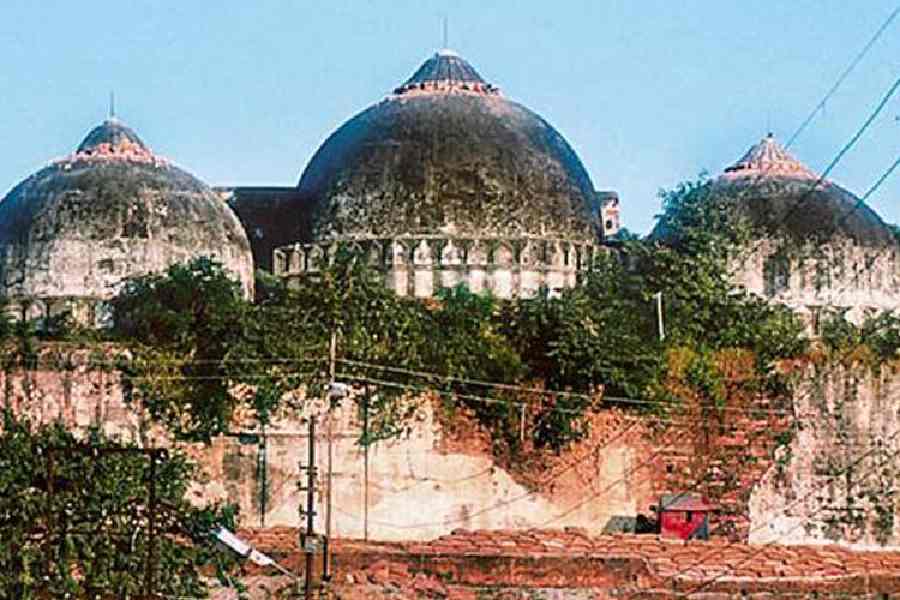
Delay in the construction of a mosque in Ayodhya has raised many eyebrows after suspended Trinamool Congress leader Humayun Kabir’s declaration that a replica of the Babri Masjid would be built in Murshidabad.
While delivering its 2019 verdict that paved the way for the construction of a Ram temple at the disputed site in Ayodhya where the mosque stood before it was demolished in 1992, the Supreme Court had ordered the central and Uttar Pradesh governments to allot five acres of land to the Sunni Central Waqf Board to build a mosque at some other place in the district.
With no options left, the champions of the Babri Masjid had accepted five acres in the Dhannipur area of Ayodhya, about 20km from the site of the demolished mosque.
That was six years ago. Not a structure has been built on the land since.
A "grand" Ram temple has come up at the once-disputed site. Prime Minister Narendra Modi consecrated the idol of Lord Ram at the temple last year and hoisted its “Dharma Dhwaja” last month.
The Sunni Central Waqf Board, a state government outfit, has been evasive on the reasons behind the delay in the construction of the mosque.
Many BJP leaders, including former MP Vinay Katiyar, have declared time and again that they wouldn’t let the alternative mosque come up anywhere in Ayodhya. The central and the Uttar Pradesh governments have been mum on the issue, which has led observers to allege a “silent acceptance” of the Hindutva leader’s claim.
The Sunni board had formed the Indo-Islamic Cultural Foundation for the construction of the mosque within a few months of the court verdict. Zufar Ahmad Faruqi, the board’s chairman, was made the head of the foundation.
A map of the proposed mosque was uploaded on the designated website of the Ayodhya Development Authority two years ago, but the foundation didn’t submit supporting documents. As a result, the map was rejected. Rules mandate the submission of land documents along with the map of the structure sought to be built. Failure to do so leads to the automatic rejection of the application after a few months.
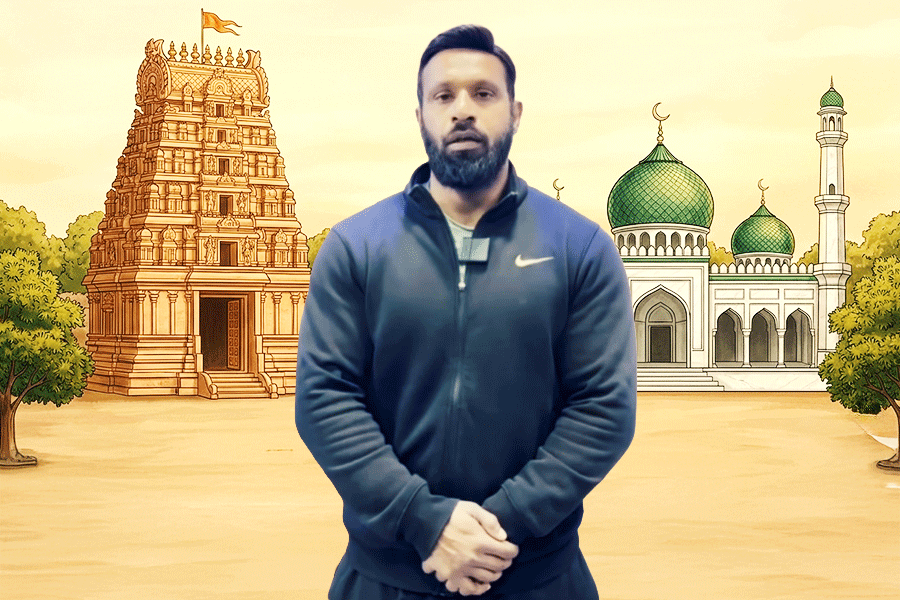
Faruqi, the board chairman, said: “We uploaded a map of the mosque two years ago but didn’t submit the supporting documents, resulting in the automatic disapproval of the map. We didn’t pursue it because the map was also disapproved by the foundation in a meeting held in Mumbai six months ago.”
Faruqi didn’t explain why the foundation submitted the map in the first place if it did not want to take the process forward.
“The map the foundation had got prepared had two oval-shaped minarets, but the members objected to the design. They are against any modern architectural structure. We are preparing a new map in which there are five long minarets and one dome. We are not working under any external influence. The mosque will be named after Prophet Mohammed,” he said.
“The estimated cost of the mosque will be ₹65 crore, but we have managed to collect only ₹3 crore till date,” he added, making it clear that its construction wouldn’t be possible at the moment.
Atahar Husain, the secretary of the foundation, said: “We had formed a committee to raise funds but it didn’t work.”
Iqbal Ansari, whose father Hashim Ansari was a plaintiff in the Ram Janmabhoomi-Babri Masjid case, said: “It is unfortunate that they have not started constructing the mosque. They would have built it if they were serious about it.”
Tauqeer Ali, a villager of Dhannipur, said: “We believe the waqf board and the foundation are under pressure not to do anything. A large number of rich people have visited the place where the mosque is proposed to be built and told us that they want to fund it, but the foundation was not showing any interest in their offers.”