“I’m in a fever of work since the trees are in blossom and I want to do a Provençal orchard full of enormous brightness.” Vincent van Gogh wrote to his brother Theo in 1888, shortly after arriving at Arles in February of the same year.
He was indeed “in a fever of work” as this one year became the most prolific period of his career when he produced masterpieces like Sunflowers, The Yellow House, and Starry Night Over the Rhône.
David’s fascination with Spring can be seen as a continuation of admiration of this seasonal rebirth. David perceived varied meteorological conditions as a medley of visual possibilities; a new “way of seeing”: “There is no bad weather. There are only different kinds of good weather.”
In April 2025, David Hockney celebrated his largest retrospective, David Hockney 25, where over 400 works were on display at The Louis Vuitton Foundation in Paris. David passed away on June 11. He was 88.
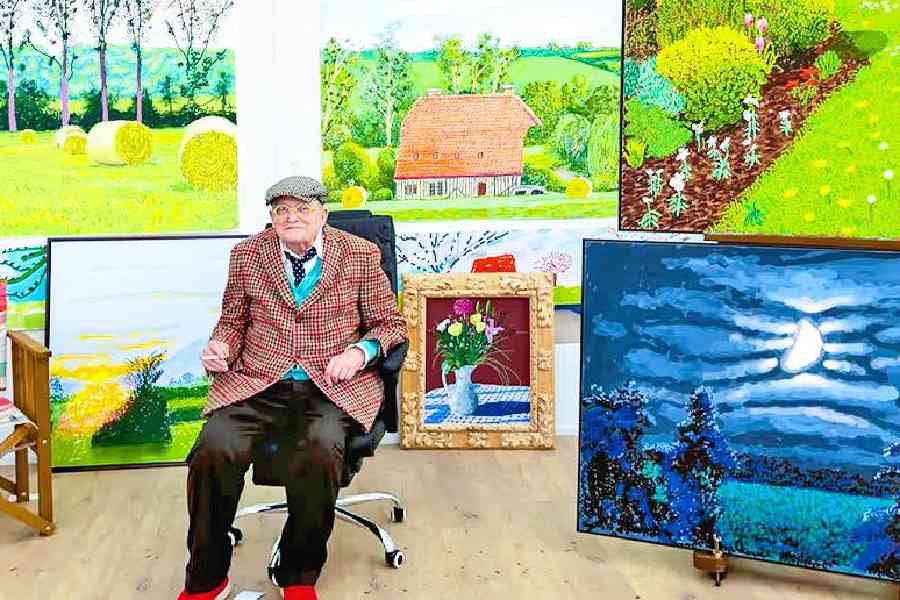
Twenty-five years of witnessing and painting, of being an undaunted optimist at 87, being bound to a wheelchair, donning the most striking of checkered suits, of being the only person who would dare to visit Westminster Abbey in yellow Crocs, and of always looking at Spring like a child discovering it for the first time.
Born in Yorkshire, David describes Yorkshire’s whimsical weather as a “gothic gloom”.
“I’m painting landscapes in Yorkshire because you can’t photograph them. The camera can’t get the beauty of this; it just can’t get the space, the thrilling space I’m in.”
At the Royal College of
Art, he was among the seminal students to introduce popism in Britain. His rebellious self was expressed not just through his bleached hair
and round oversized glasses, but also in being himself.
At 23, Hockney drew We Two Boys Together Clinging, and the daring Two Men in a Shower. In 1960, homosexuality was still a crime in England, but that never deterred him from addressing the subject openly through his art.
In California, he discovered his singular obsession, the swimming pool, which remains central to many of his most iconic paintings — A Bigger Splash (1967) and Portrait of an Artist (Pool with Two Figures) (1972). David finds the glistening of the blue tiles in the pool capturing the flat Los Angeles light way seductive than the human beings around him.
Hockney’s largest work to date, comprising 50 canvases, Bigger Trees near Warter, was completed in six weeks in 2007 before the spring set in. French philosopher and art critic Yves Michaud commented: “What an odd thing, to do such a big painting, with so many panels, like a manifesto of sorts, which now belongs to British art history and the history of art of landscapes. It’s like he’s the third man in a theatre piece where Turner and Constable are the principal actors.”
History is precisely what David made by always watching, always working, always evolving, even when the world stood still.
At 82, David created over 116 works, including his memorable A Year in Normandie, where, inspired by the Bayeux Tapestry, he drew a saga of the Norman landscapes.
The Arrival of Spring opened in the Royal Academy of Art in August of 2021. The change in hues came alive in his choice of new painterly tools, an iPhone and iPad. David always embraced change and technology. His earliest work on the digital medium of a Yorkshire landscape can be traced back to 2011, a year after Apple launched the iPad.
Last Summer, when the Paris retrospective was announced, covering all his famous works and many unseen ones from private collections between 1955 and 2025, Halcyon Gallery of Bond Street in London opened an exhibition with David’s paintings from the gallery’s collection.
Titled The Eternal Spring, the show was a testament to his diverse and joyful oeuvre. In July last year, I had the opportunity to visit Halcyon and the exhibition. The walls were painted in bright greens and yellows, and at the entrance was one of the many renditions of his swimming pool and a quote: “If you see the world as beautiful, thrilling and mysterious, as I think I do, then you feel quite alive.”
The show was compact, comprising works of acrylic, charcoal, pencil, and a few using digital tools. The most striking feature of the show was quite a few portraits of Celia Britwell, British textile and fashion designer and David’s close friend and a frequent sitter for him since the 1960s.
Celia remained one of the few recurrent humans in David’s portraiture besides himself and his mother. Celia functions as a human counterpart to David’s repeated depictions of trees, gardens, and spring landscapes.
One can say Celia is to David’s portraiture what Normandy is to his landscapes: a familiar subject through which he investigates seeing, memory, and temporality: “New ways of seeing mean new ways of feeling; you cannot divorce the two, as now aware, you cannot have time without space and space without time.”
David affirmed his existence through art. His landscapes, like his life, were transient; seasons come and go, trees bloom and fade; the value lies not in permanence but recurrence. David’s Spring is the celebration of this recurring affirmation against mounting anxieties and grappling pessimism of human life.
Is it ever possible to bid adieu to this Spring? After all, as David quipped: “Do
remember they can’t cancel the spring.”