 |
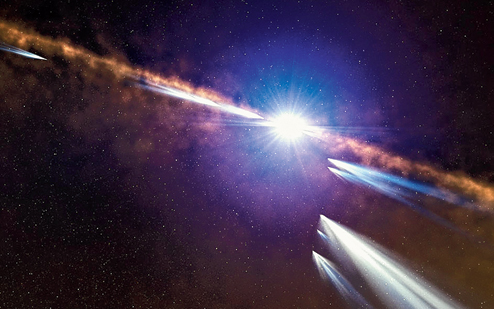
| An artist’s illustration of comets orbiting the star Beta Pictoris. Picture by ESO |
New Delhi, Oct. 23: Two distinct families of comets orbiting a toddler star about 63 light years from the Sun are promising astronomers an unprecedented peep into the early history of the solar system about 4.5 billion years ago.
An international team of astronomers has documented 493 individual comets orbiting Beta Pictoris, a star only 23 million years old and surrounded by a disc of gas and dust and a planetary nursery populated by comets and asteroids.
The scientists yesterday announced the results of eight years of observations of Beta Pictoris and its orbiting comets, which point to two distinct families.
One is a family of old comets whose orbits appear to be controlled by a massive planet, while the other family seems to have emerged from the break-up of a massive object after a collision. The findings appeared today in the journal Nature.
“This is a window into our own past,” said team member Alain Lecavelier des Etangs at the Institute of Astrophysics, Paris.
“We’re witnessing events similar to what took place in our own solar system about 4.5 billion years ago,” he told The Telegraph over the phone.
Astronomers had first detected comets orbiting Beta Pictoris in 1987, and more comets around other stars since then. But the new study is the first to provide a detailed statistical analysis of the orbits of a large sample of comets outside the solar system.
Early in the history of the solar system, scientists say, comets — through their collisions with Earth — may have deposited water and key organic compounds that served as the building blocks of life on the planet.
The solar system itself has multiple families of comets, which are giant snowballs of frozen gases, rock and dust. Comets that orbit the Sun in less than 200 years — the so-called short-period comets — come from a zone called the Kuiper belt that lies just beyond the orbit of Neptune.
But long-period comets originate from a zone called the Oort cloud, a nursery of comets far beyond the orbit of Pluto.
From 2003 to 2011, des Etangs and his colleagues analysed over 1,000 observations, using an observatory in Chile, to determine the orbital properties of the comets orbiting Beta Pictoris.
“These exocomets (comets existing outside the solar system) give us clues about mechanisms at work in the solar system just after its formation,” Flavien Keifer, the study’s lead author from the Institute of Astrophysics and Tel Aviv University in Israel, said in a media release from the European Space Organisation.
Studies of Beta Pictoris in 2003, 2008 and 2009 had suggested that the star has a planet about nine times the mass of Jupiter orbiting it at a distance of between eight and 15 times the Earth-Sun distance.
The new study suggests that comets from one family have low rates of release of gas and dust as they approach the star, an indication that these comets have exhausted their core material.
The comets from the other family are on nearly identical orbits and are highly active, suggesting that they had a common origin, perhaps the break-up of a large object whose fragments are still orbiting the star.