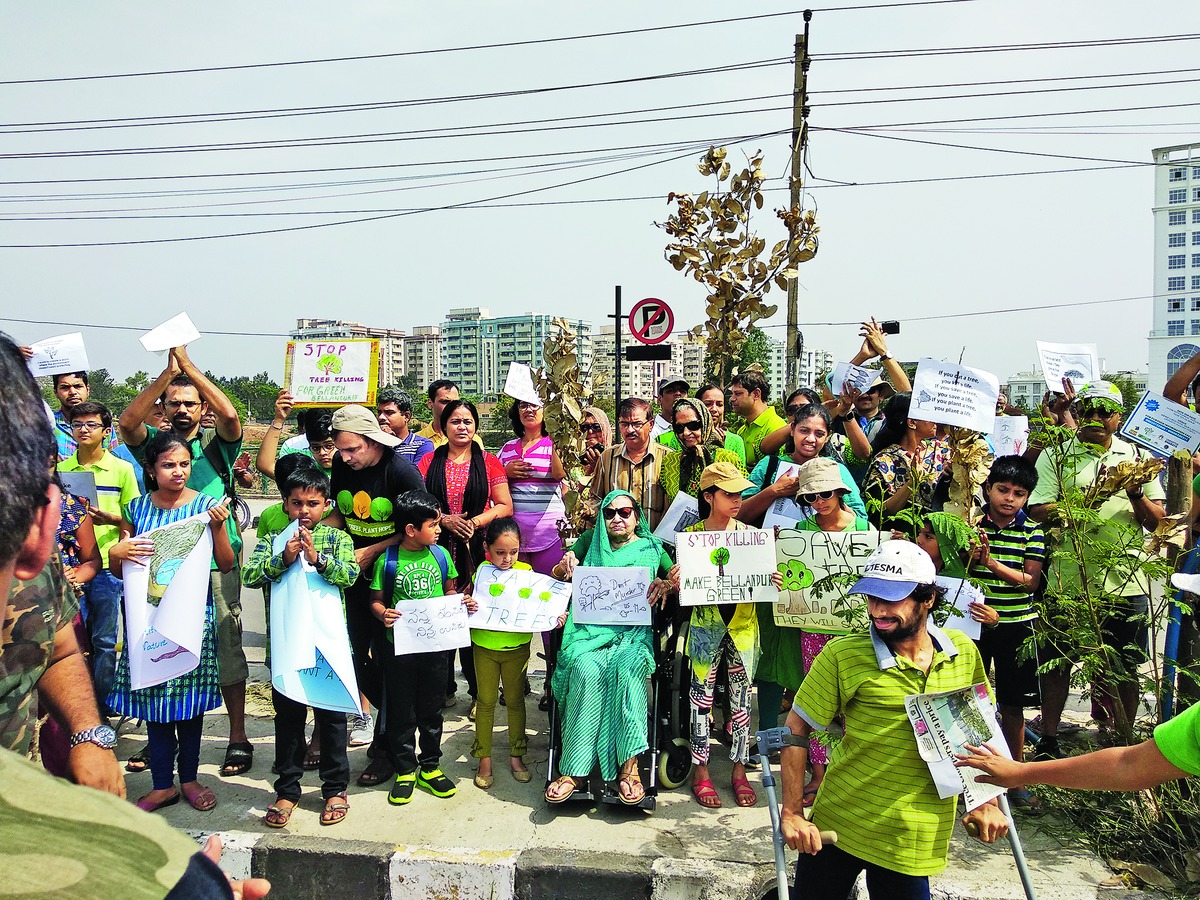


(top) civic activists in Bangalore

Surekha Shivashambi, a Bangalore-based human resources executive with a multinational company, sets aside one day of the week for civic activism. Anything could be an issue - potholes, tree-felling, animal welfare, pollution, even illegal mining.
She started in a small way a few years ago with animal welfare but recognised the power of citizens getting together for a common cause in 2017, when a large number of angry Bangaloreans took on the Karnataka government against the building of a steel flyover in the middle of the city. "The flyover would have meant felling of a thousand trees. What started as a small protest snowballed into a mass movement," she recalls. The Karnataka government decided to shelve the plan.
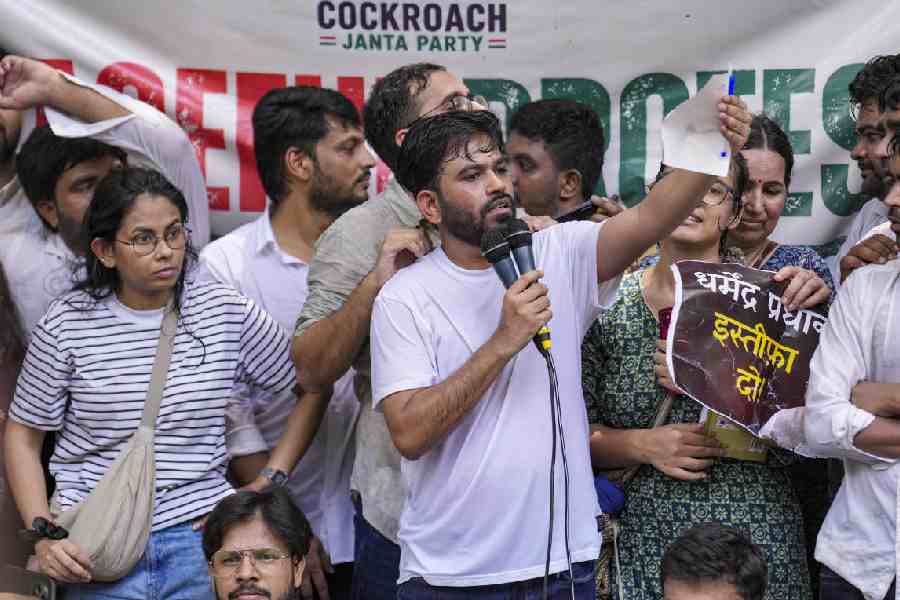
The success spawned a new wave of activist groups in the city. These days, it's not uncommon in Bangalore to see young professionals, mostly on weekends, standing alongside roads with placards espousing some cause or the other.
"We could achieve so much if that would happen in Delhi," says Chhavi Methi, a housewife. For a few weeks, she travelled 25 kilometres every morning from her home in Noida to south Delhi to hug trees and mobilise others to stall a government plan to cut 17,000 trees to make way for new roads and residential colonies for bureaucrats.
Methi and thousands of activists heaved a sigh of relief recently when the National Green Tribunal (NGT) took notice of the protests and the petitions, and ordered government agencies in Delhi not to go ahead with the cutting of trees until further orders. "Delhiites have shown, perhaps for the first time, that they care for this city. Academics, students, retired civil servants and professionals have joined hands and pledged to keep up the fight. Policymakers can no longer take us for granted," says Methi.
With more and more inhabitants of large cities coming to the conclusion that they cannot depend on local politicians, municipal bodies or even the builders to care of their needs, a consciousness has probably taken root among some sections that civic action is the way forward.
Public protests are no longer limited to full-time activists marching with placards, shouting slogans or going on hunger strikes trying to draw attention of the authorities. Civil society groups are ready to stand up and be counted, more than ever before.
"Sit-ins and protests by caste groups or vote banks get instant attention from politicians, while protests by concerned citizens on issues like environment are largely ignored. But with more and more people getting together, the politicians and government agencies will recognise that we, the middle-class people of this country, matter," says Anil Sood, lead petitioner in the Delhi tree felling case.
Actor and activist Prakash Belawadi says protests are only set to grow as people realise that they have a stake in the spaces they inhabit. He contrasts it with the 2011 India Against Corruption protests led by Anna Hazare that attracted huge numbers. "Corruption as an issue has a wide appeal. But civic issues never attracted residents of India's Silicon Valley as most were busy with their careers and buying homes. Now the same people are coming to terms with the fact that the city infrastructure around them is crumbling and the future of their children is at stake," he says.
The people of Chennai, for instance, woke up to the deep rot that had set in only after the 2015 floods. "Most remained apathetic to the encroachment of lakes and river beds happening around them. But when the floods happened, everybody wanted to know what hit them and how to prevent such a situation in future," says Jayaram Venkatesan, convenor of Arappor Iyakkam, a Chennai-based activist group.
Hundreds of resident welfare associations (RWAs) join Venkatesan each time he organises public audit on encroachment of lakes and riverbeds, pollution by industries, disposal of waste and corruption. The result of these actions from concerned citizens, some argue, is that it will become harder for politicians, bureaucrats and crony capitalists to push through projects that are bad or unfriendly to the masses.
The main grouse of the middle class, though, remains the apathy of the municipal bodies. "We want to know how our money is used," says Shivashambi. The budgets of the municipal bodies are fairly large. While Chennai's budget outlay is Rs 5,000 crore, Bangalore's stands at about Rs 9,000 crore and Mumbai and Delhi have bigger ones at Rs 27,000 crore and Rs 15,000 crore, respectively. "We should hold them accountable for every penny they spend. Only then will they fear citizens. Same is the case with politicians," says V. Selvarajan of Green Circle, a Delhi-based group.
Results can be achieved and there are quite a few. A sustained campaign by a large number of citizens against the Tamil Nadu Directorate of Vigilance and Anti-Corruption (DVAC) that had not filed a single case against bureaucrats for years despite a budget of Rs 50 crore per year, resulted in the DVAC conducting as many 61 raids against corrupt officials in the last one year.
Vijay Nishanth, a Bangalore-based environmentalist, is chuffed with the victories that Bangaloreans have picked up in recent times. The latest is the Karnataka state government putting a stop to quarrying and mining around Bannerghatta National Park on the outskirts of the city. It was a campaign that lasted months. "These mines were violating every environmental law and they were also affecting the movement of elephants along the corridor designated to them. People used to come together on weekends with their children to protest, some did social media campaigns and others pressurised local politicians to act," Nishanth says.
What has also helped take the fight to the authorities is the involvement of artists. It was Baadal Nanjundaswamy, a "pothole artist" in Bangalore who turned a 15-foot pothole into a blue-green pond and put a 12-foot fibre-glass crocodile in it resulting in the image going viral on social media. The road was repaired overnight. He continues to do such innovative things on issues as varied as garbage disposal and polluted lakes. But Nanjundaswamy says what makes a real difference is sustained activism. "I just highlight issues. Citizens fighting on the streets are the heroes," he says.
Similar is the case with well-known Carnatic vocalist T.M. Krishna, who recently joined artistes to cut an album highlighting the mercury pollution caused by multinational Unilever's thermometer factory in Kodaikanal, Tamil Nadu. Titled Kodaikanal Still Won't, the album has gone viral. "This is our way of raising an important issue. We are pointing to a problem that needs urgent resolution," says Krishna.
It's not an all-India phenomenon though. Mumbai gets hit by floods each year, potholes are common and civic agencies are clearly failing but there is something about the city that doesn't see the kind of activism that other cities are witnessing.
"More often than not, Mumbaikars are quite numb to issues that surround them. You cannot blame them either. After all, just about everything is wrong, from the potholes to the sewage system to indiscriminate buildings and corruption," says Zoru Bhathena, a businessman and an activist who has been at the forefront of protesting against felling of trees for the Mumbai metro project. "Mumbaikars are awake on social media though," he says but rues that it doesn't help that much.
But social media, according to Belawadi, has helped several campaigns in spreading the message and also organising protests. "Social media has been a liberating force. People need not depend on the benevolence of traditional media to get their points of view across. Twitter, Facebook and the hashtag SteelFlyoverBeda played a huge role in stalling that project," he says.
The civil society groups, however, remain aloof to issues that may be critical but do not affect them directly. "There is a certain comfort zone of the middle class and they may not participate outside this zone. Environment, traffic or, say, garbage clearance are issues that are at their doorstep, but they will back out of issues that concern other sections of the society, especially the marginalised," says Krishna and cites the example of Thootukudi protests against a copper plant that resulted in the death of protesters and also the case of Kodaikanal mercury pollution.
Agrees Jayaraman, who was part of the India Against Corruption protests and also a former Aam Aadmi Party member. "We have to realise that governments get emboldened when we remain silent to the problems of others. The civic society awakening is good but it should be for causes big and small," he says.
This is not the time to nitpick, argues Nishanth. He says, "We have to let the activist groups flourish and gain confidence so that they can make a difference in the true sense of the term. We can then enlarge our horizon."
This is not the time to look back, says Belawadi. "We have to keep at it. Civic activism is here to stay and get stronger."