 |
London, April 28: Just when he feared he was being forgotten, Indian-origin Waris Hussein is in the news and in demand as debut director of Dr Who, the BBC’s most successful franchise which is celebrating its 50th anniversary this year.
The BBC is currently making a drama about how the Dr Who series, unpromising to begin with but eventually to turn into its biggest money-making machine, came into being.
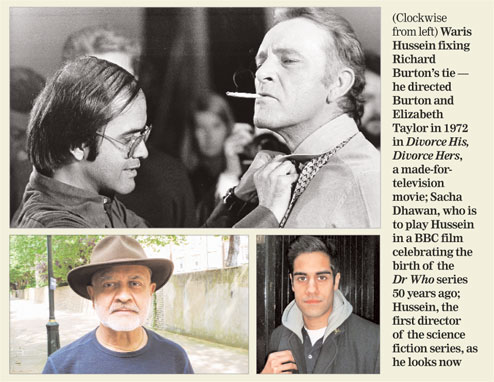
The crucial role of Waris, now 74, is to be played by a 29-year-old British Indian actor Sacha Dhawan.
Waris considers this surreal: “How many people are portrayed while they are still living? OK, (the playwright) Alan Bennett has been portrayed on stage. And you have Helen Mirren playing the Queen.”
The first episode of Dr Who, with William Hartnell, a 55-year-old actor in the title role, was broadcast by BBC Television on November 23, 1963 — a day after President John F. Kennedy’s assassination which threw broadcasting schedules into disarray.
The science fiction series reflected British eccentricity at its most engaging. For example, Dr Who (now in his 11th reincarnation) still travels in what looks like a blue police phone box but this is really his spacious Tardis, which whirls him through time and space as befits his status as a “Time Lord”.
Dr Who has had many enemies, none more popular than the Daleks, which have appeared in 97 episodes, usually with their war cry, “Exterminate”.
And it all began with an Indian in the driving seat.
Waris finds it amusing he was a 24-year-old fresh out of Cambridge when he was given the job of directing Dr Who’s pilot episode, An Unearthly Child. “I was the very first Indian-born director in drama (at the BBC). I was the youngest,” he recalls. “Dr Who came to me because no one else wanted to do it. They did not realise what they had on their hands.”
“We were given no money, we were given the worst possible conditions to work at Lime Grove studios, the equipment was antique, the authorities did not have any faith in it, and then it became a huge hit,” he says.
The start was so unpromising that Waris and Verity Lambert, the first woman producer at the BBC, thought they would get the sack. But very soon, Britain was hooked.
Waris returned in 1964 to direct the third series of seven half-hour episodes, featuring Dr Who and Marco Polo — the latter have, sadly, all been lost by the BBC.
'Marco Polo was my next production after the first four,' explained Waris, who directed a total of seven episodes of Dr Who. 'I was preparing it while the episodes after mine were airing. I left the show after the seventh episode was finished.'
Now BBC Television has commissioned a 90-minute drama, An Adventure in Space and Time, about how Dr Who began, which will be broadcast on November 23, this year.
“Mark Gatiss has written the screenplay,” says Waris. “He also writes for Sherlock (a series about Conan Doyle’s famous detective but set in modern times).”
“I spent time with Mark and gave him my thoughts, but the main thrust of it is based on William Hartnell,” Waris goes on. “It is about the creation of a legend. Prior to Dr Who he (Hartnell) was a working actor in many secondary roles. But he was never really a star. When we approached him he didn’t want to do it. It took us two expensive lunches for him to say yes. He played the role until 1966 and left because he kept forgetting his lines.”
In the dramatisation by Gatiss, the role of Waris has gone to Sacha.
Waris is happy with the choice of Sacha. “I went to the read-through — Sacha is from the north, he is from Manchester and has a natural north country accent. I had to sit with him and say, ‘Now listen, Sacha, my life is quite different from yours.’ He came home and recorded me. ‘Look, Sacha, we all come from different backgrounds. I went to private school and I went to Cambridge. This is my accent.’ He got the essence of me very well, I thought. He is a talented kid.”
If Waris is judged by the work he has done and the famous actors he has directed in a career spanning half a century, he is probably the most successful Indian-origin director there has ever been.
Among his collection of photographs is one of Waris straightening Richard Burton’s tie, while a cigarette is held languidly in the actor’s mouth. That was taken in 1972 when Waris spent four months in Italy and in Germany directing Burton and Elizabeth Taylor in Divorce His, Divorce Hers. “It was the only television they did together,” he says. “It was the end of their marriage, ironically.”
Waris has the notion of turning the experience into a film along the lines of My Week With Marilyn. “It was a mixture of laughter and tears. It is me as a young Indian director coping with the two biggest stars in the world.”
Waris is reassessing what he should do next, having spent the years from 1980 to 2012 in America. “You get a point in your life when you say you have done this — what can I do next?”
Waris was born into a well-connected family in Lucknow on December 9, 1938, and came to England in May 1947. Both he and his sister, Shama, four years his junior (she was production manager on Richard Attenborough’s Gandhi in 1982), were on their mother’s passport.
Attia Hosain, an artistic person in her own right, decided not to return to India when the country was partitioned in August that year. She died in London in 1998, leaving behind two novels, Phoenix Fled and Sunlight on a Broken Column. Waris’s father had passed away in 1982.
After his years away in America, Waris felt he would not be recognised by today’s British Asian community. But Waris is happy that the 50th anniversary celebrations of Dr Who have brought him back into the reckoning.
On April 7, Waris was interviewed by Sue MacGregor on BBC Radio 4 in The Reunion and caused a global stir by suggesting Dr Who had become too sexualised.
His regret is that “there is an element now, and I know we’re living in a different era, of sexuality that has crept in. The intriguing thing about the original person was that you never quite knew about him and there was a mystery and an unavailability about him. Now we’ve just had a recent rebirth and another girl has joined us, a companion, she actually snogged him.”