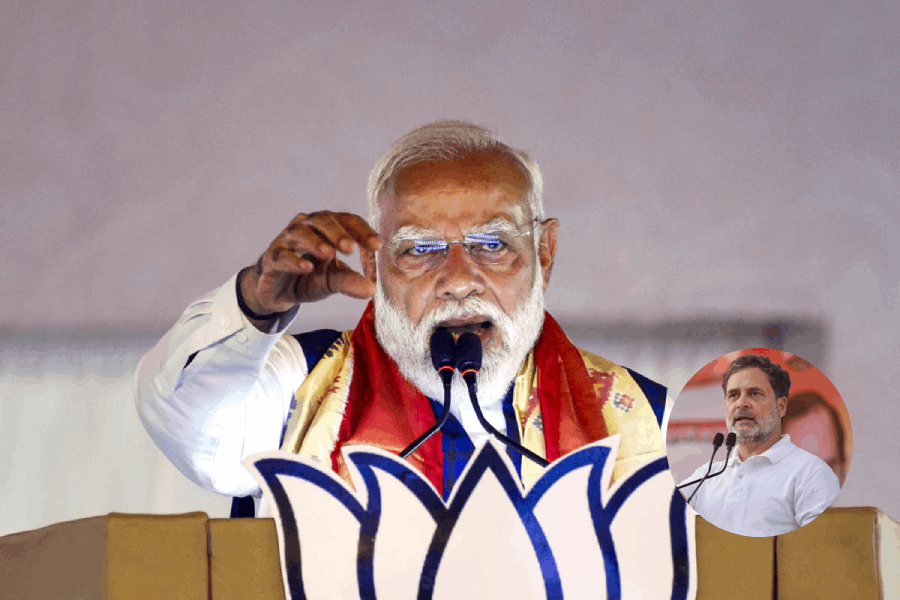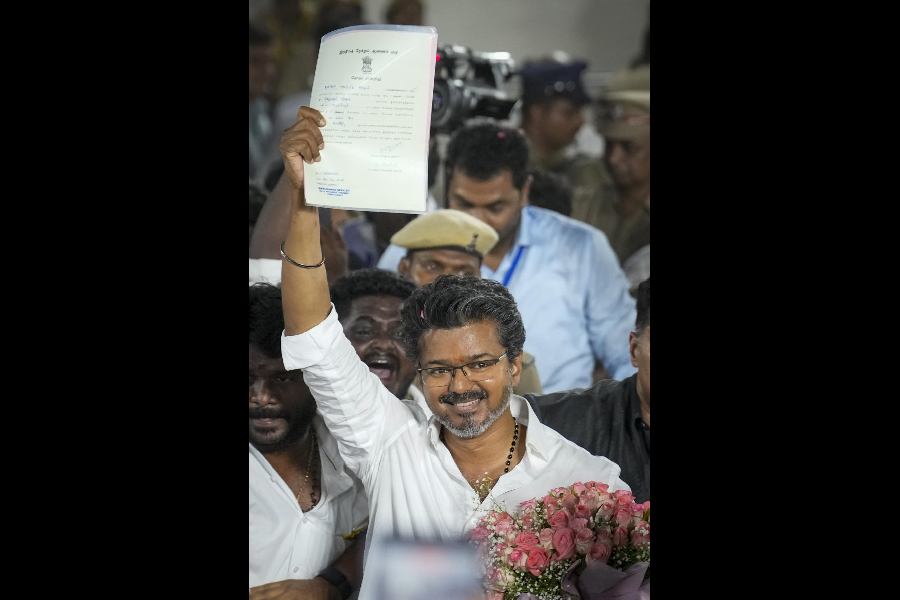
Actor Joseph Vijay and his fledgling Tamizhaga Vettri Kazhagam have generated all the excitement this Tamil Nadu election, the stunning first-time performance drawing comparisons with another film hero’s triumphant poll debut a half-century ago.
There are, however, significant differences between M.G. Ramachandran’s sweep to power in 1977 and Vijay’s somewhat chaotic success that remained short of an absolute majority till late Monday evening.
While MGR’s party, the AIADMK, claimed the legacy of the Dravidian Movement, Vijay’s ideological contours seem fluid if not hazy, his progress seemingly powered by the restless energy and enthusiasm of his young supporters.
Since he formed his party just two years ago, the 52-year-old TVK leader has variously claimed to be “pro-MGR” and “pro-Kamaraj” without much clarity, identifying himself with past opponents of his “only political foe”, the ruling DMK.
If the adulation of his young fans has driven his campaign, it has also threatened it — none more so than in September last year when 41 people died in a stampede at his rally in Karur.
Vijay drew not just censure for his party’s poor organisational skills but moral condemnation for quickly leaving the scene without meeting
the injured.
Yet his near-evangelical hold over his flock remained undiminished as he alleged a DMK conspiracy to hurt his campaign. His hordes of fans continued to swarm to his specially designed campaign bus or speed-chase it on the
national highways, risking their lives.
Vijay did cancel several poll rallies in the aftermath of the tragedy but received a boost when the Election Commission allotted the “whistle” symbol to his party.
The actor — a dropout from Chennai’s Loyola College where he pursued a BSc in visual communication in the early 1990s — and his fans quickly played up the whistle as an anti-establishment symbol of romantic defiance by
the youth.
Vijay went about his campaign kissing and garlanding MGR statues, apparently luring away a sizable chunk of the AIADMK’s young voters while describing its ally BJP as “our ideological foe”.
His high-pitch cinematic one-liners prefacing his brief campaign speeches and his “Naan varen (I am coming)” pronouncements sent his young audiences into ecstatic roars of affirmation.
His male and female fans dressed themselves in the TVK flag’s colours. Hundreds of them went into raptures on social media about the party’s flags being aflutter even on the streets of “Tamil Eelam” (Jaffna in northern Sri Lanka), seeing in it a portent of Vijay eventually helping resolve the Lankan Tamils issue.
“I voted for Amma and the AIADMK for decades; but this time everyone in our family voted for the ‘whistle’ as the AIADMK has lost its sheen,” a domestic help in Chennai, who had travelled 142km to her village in Arani to vote, told The Telegraph.
Vijay’s call for a “vote for change” apparently struck a chord with tens of thousands of first-time voters across genders, castes and religions.
As the poll date approached, younger voters “psychologically compelled” their elders at home to “also vote for Vijay”, Arul, a cab driver from Ramanathapuram, told this newspaper.
Political analysts suggested this had been possible partly because of the high proportion of young women in Tamil Nadu’s workforce, who provided for their elders and therefore had a purchase on them.
The TVK brought out “mini-manifestos” — parts of which Vijay would read out from his bus at different places — focusing on “youth issues” such as drug abuse and jobs. He promised motorcycles for the young besides making a host of pledges to women, fisher-folk and religious minorities.
Of the nearly 4.88 crore people who voted in the Tamil Nadu Assembly polls, some 12.51 lakh were first-time voters. Vijay seems also to have enjoyed substantial support among the Dalits and minorities, segments of whom had got disgruntled with the DMK despite Stalin’s welfare measures.
The visible strains in Congress-DMK ties following seat-sharing differences — with a Congress lobby advocating an alliance with Vijay, instead — also took a toll on the DMK. Poor coordination between the DMK and the Congress helped Vijay particularly in the southern districts.
Despite being short of dependable candidates, the TVK fielded nominees in all but one of the state’s 234 constituencies.
By late Monday evening, Vijay was set to win the Perambur seat in Chennai, and Tiruchy (East) in the heart of the Cauvery delta, his party poised to pick up seats from across regions.