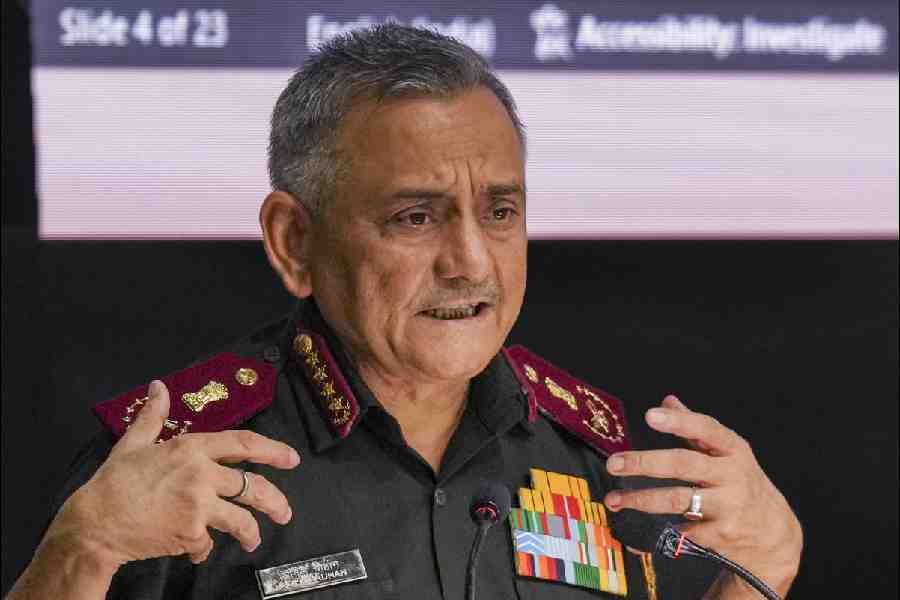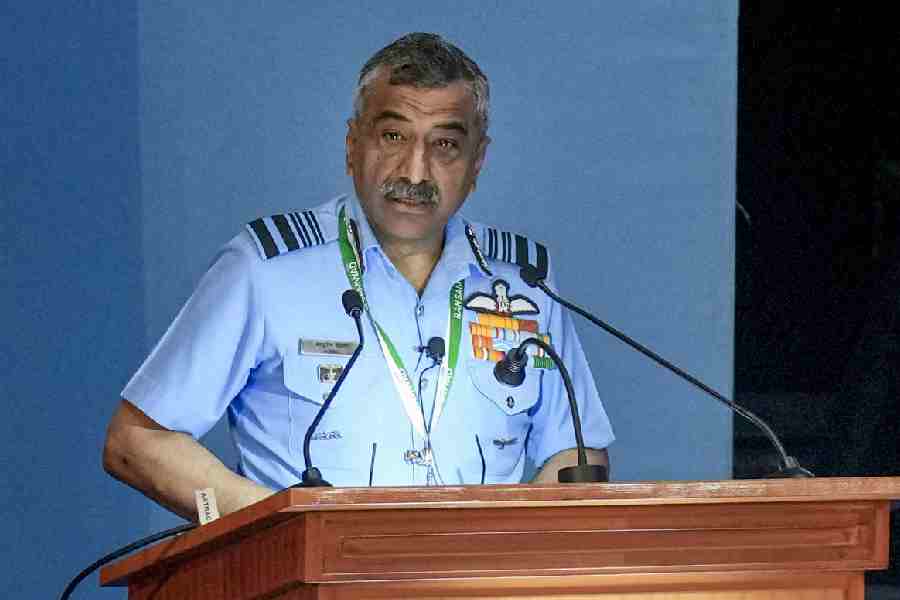
Chief of Integrated Defence Staff Air Marshal Ashutosh Dixit on Thursday said atmanirbharta (self-reliance) in defence was not just about making weapons in India but also ensuring technological sovereignty.
“Atmanirbharta in defence is not just about making weapons in India. It is about controlling architectures — software, encryption, data standards and upgrade cycles. Without that control, we are dependent on others at the worst possible time,” he said at Ran Samwad 2026, a tri-service seminar in Bengaluru, while speaking about India’s defence production.
He flagged the concerns with an aim to prevent foreign dependency, especially during critical moments, by securing control over algorithms, data and chips that drive modern platforms.
The remarks come at a time when India has cleared a proposal to procure 114 Rafale fighter jets from France for the Indian Air Force (IAF) and six P-8I long-range maritime reconnaissance aircraft from the US for the navy.
As many as 114 Rafales, manufactured by the French firm Dassault Aviation, will be procured under a government-to-government framework, with 90 to be manufactured in India and the rest likely to be procured in fly-away condition.
Sources said the French government was reluctant to provide India with the source code for the Rafale fighter jets’ electronic systems, which would have allowed India to modernise them independently, limiting the aircraft’s full operational independence.
After Operation Sindoor, military veterans have flagged delayed equipment procurement, overdependence on imports for critical defence technology, inadequate air-defence systems and drone warfare preparedness, saying India needs to effectively address these pressing issues to prepare for modern warfare.
“Despite the Narendra Modi government’s ambitious project of self-reliance in the defence sector, India is still dependent on imported military inventory. If critical components are imported and assembled in India, then India cannot be atmanirbhar (self-reliant) in the defence sector,” a retired lieutenant general told The Telegraph.
India, he said, does not have enough indigenous capability to produce artillery guns, sonar systems, light combat helicopters and radars but the government has been claiming to make India a defence manufacturing hub for the world.
“In the absence of enough indigenous capability, how can India achieve self-reliance in the defence sector? We need to first build up indigenous capability and develop new technologies to boost domestic manufacturing in the defence sector,” he said.
Air Marshal Dixit said India’s environment gave thrust to multi-domain operations (MDOs) as the country faces threats that do not respect domain boundaries.
He flagged the shifting landscape of global security, pointing out that the distinction between wartime and peacetime was fading as nations face constant contestation across multiple domains. “India’s environment makes this transformation urgent — not aspirational. We face threats that do not respect domain boundaries,” Dixit said.
He noted that along the northern borders with China, surveillance drones, satellite monitoring, electronic warfare and rapid force mobilisation coexist in a state of permanent readiness. He said that in the maritime domain, sea lines of communication intersect with space-based surveillance, undersea competition and carrier-based power projection.
According to Dixit, the threat is evolving with each passing day on the western border (with Pakistan). Hybrid threats — misinformation campaigns, cyber intrusions targeting power grids, and drone swarms over sensitive installations — deliberately blur the line between peace and conflict.
“These threats cannot be addressed by one service. They cannot be addressed sequentially. They must be addressed simultaneously, across domains, in a synchronised coordinated response,” Dixit said.
On the ongoing West Asia conflict, he said it was a sharp reminder that sea lane disruption, energy supply shocks and regional instability could affect India’s interests without a single adversary targeting
us directly.
“Preparedness must be multi-domain from the outset. That is why the MDO is not a future option. It is a present imperative,” he said.
Citing the Russia-Ukraine war, the Air Marshal said the early stages of the conflict showed how a smaller force — using commercial satellite imagery, space-based communications, secure digital networks and precision fire — could impose disproportionate costs on a larger one.
“And closer home, our own experience with Operation Sindoor underscored, sharper than any doctrine document ever will, that jointness is the need of the hour. Integrated operations coordinated across services and domains in real time define the new standard. That lesson must be embedded into how we train, how we equip and how we fight,” Air Marshal Dixit said.