
New Delhi: Three medics' associations today released an advisory for doctors and parents on the management of extreme premature babies saying guidelines appeared necessary after an incident in which doctors in a Delhi hospital declared a live premature baby dead.
The advisory has iterated that premature babies of 28 weeks gestation or older and 1000gms or more are considered "viable," and outlined options doctors and parents may jointly exercise when facing dilemmas involving babies born before 28 weeks, the associations' officials said.
The officials of the Indian Medical Association, the country's largest association of doctors, the Indian Academy of Pediatrics, and the National Neonatology Forum said the policy advisory will be sent to 276,000 IMA members, 26,000 IAP-member pediatricians, and 7,000 neonatologists across India. The policy specifying resuscitation and ventilation practices for extreme premature babies will also be sent to the Union health ministry and all state health departments, the officials said.
"We've outlined best practices that take into account medical consensus about viability of extremely premature babies," said Krishan Kumar Aggarwal, the IMA's national president.
Doctors at a Max hospital branch in northwest Delhi hospital had earlier this month declared a 23-week gestation premature baby dead and packed him in a polythene bag. The parents noticed movement in the bag and found the boy alive and took him to another clinic where he died a few days later.
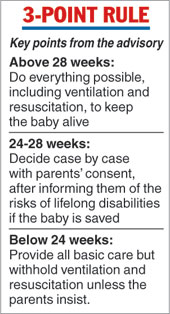
The IMA-IAP-NNF advisory implies that doctors should do everything possible, including ventilation and resuscitation, of preterm babies 28 weeks gestation or older, and decide how to manage preterm babies between 24 and 28 weeks on a "case-to-case" basis with the full informed consent from parents.
"The 24 to 28-week period is a grey zone - some babies may survive when full medical support is provided to them, but may require up to three months stay in incubators or hospitals," said Anupam Sachdeva, president of the IAP.
But, Sachdeva said, medical studies suggest a significant proportion of 24 to 28-week gestation preterm babies who survive may develop deficits involving the brain, eyes, or lungs. Doctors need to clearly inform parents the likely costs of trying to keep such babies alive and the risks of lifelong disabilities, he said.
"For parents, these are excruciatingly painful dilemmas, but they need to make informed choices," Sachdeva told The Telegraph. "There may be parents who want to do everything they can to save these babies - in such cases, doctors should also whatever they can."
The advisory however suggests that ventilation and resuscitation is not required for preterm babies below 23 weeks gestation. In such cases, doctors should provide all the basic care and comfort to the babies but need not attempt to provide ventilation or resuscitation unless demanded by parents.
"Most hospitals and doctors are likely already practicing this policy - but we believe a formal advisory will help clear confusion and help the public understand," said Alok Bhandari, secretary of the NNF.
The associations' officials said their advisory is not intended to influence the inquiry into the Max case being conducted by the Delhi Medical Council.
The Delhi government cancelled the hospital branch's license last week, citing irregularities, including not maintaining medical records of the premature live baby.
The cancellation has evoked widespread anger across the medical community with senior doctors questioning the wisdom of shutting down a hospital for alleged mistakes by doctors.
The IMA-IAP-NNF advisory has cited neonatal resuscitation 2015 guidelines from the American Academy of Pediatrics and the American Health Association that say: "There is no evidence to support the use of any particular delivery-room prognostic score presently available over gestational age assessment alone, in preterm infants at less than 25 weeks gestation."
Senior doctors who are not familiar with the details of the incident at Max said they can only speculate about what might have happened. It is possible, they say, that the 23-week baby's heart and breathing had stopped, prompting the doctors to declare death.
"There would have been no signs of life - but it is possible the baby was still in a revivable condition," a senior doctor not associated with Max said. Even adults whose hearts have stopped beating might be revived within a few minutes through cardiopulmonary resusciptation, the doctor said.
For a preterm baby in a state of hypothermia - lowered body temperature - this window of opportunity may run into hours, the doctor said. The baby may have been declared dead when its heart had stopped and the polythene might have raised body temperature, reviving the heart, the doctor said, asserting that this sequence of event is "pure speculation