
Laxman Rao cannot remember a time when people were so close-fisted, even when it came to their cup of tea. "We have a chaiwala PM, but people think twice before buying even a cup of tea," he says.
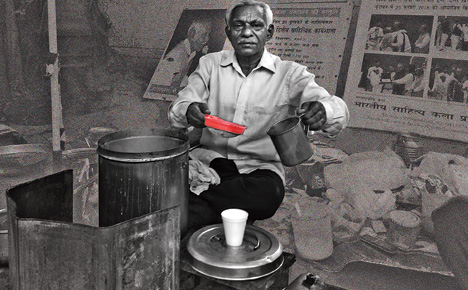
Rao should know; he has been in the business of selling tea for the last 25 years. A huge pakhar, or fig, tree on central Delhi's Vishnu Digamber Marg is his karmabhoomi; under its shade he runs his open-air tea stall.
"Rao sahib", as he is known and admired by regulars at his stall, was arguably the most well-known chaiwala in Delhi before a certain Narendra Modi checked into 7, Race Course Road - now called the Lok Kalyan Marg - in May 2014. He is known as the person who sells tea and writes books - there are 24 of them to date, all written in Hindi, on a variety of subjects ranging from love and longing to essays on politics and life.
Prime Minister Modi and his party miss no opportunity to harp on his chaiwala antecedents. But for Rao, it is a serious business that runs his house. His books have brought him fame. "A bit of money also," he says. "But not enough to quit making tea," he adds.
Rao looks frail for his 65 years, wears a pencil-thin moustache and oversized shirts and trousers. He is quick-witted and can quote Socrates and Shakespeare whenever he wants to make a point. He brings up Macbeth when he talks about the insecurities of a ruler as he sits cross-legged on a time-worn wooden plank balanced on a careful arrangement of bricks. In front of him are a kerosene stove, a lantern, a paraphernalia of tin containers, jugs and measuring mug, and a pan in which he boils his tea. He points to a stack of styrofoam cups and says, "Those were not there when I first started selling tea."
Piled on a waterproof mat are the books he has written, bearing titles such as Ramdas, Ahankar, Dansh. Since it is drizzling that day, he has thrown over them a transparent sheet of polythene.
So, how has Rao's tea journey been ever since Modi became the Prime Minister? He replies, "I used to sell a cup of tea for seven rupees in 2014 or maybe eight rupees. I sell it for 10 now. But don't ask me if my profits have increased."
Rao's tea is atypical - sugary, earthy, a churn of spices and herbs. The most favoured cuppa is, however, the ginger-laced, milky chai - had ideally with a slice of Delhi winter on the side. Regulars don't even have to ask him for their blend of tea; he knows who prefers what.
The rupee may be plumbing new depths but the economy, the government claims, has been galloping with lakhs of jobs being created every passing month. Then, of course, India is said to be the world's fastest growing economy among the large countries. Says Rao, "I don't know the impact of the falling rupee on our country but I can tell you that a hundred rupee note has no value these days. And if the economy is doing so well and there are jobs, where are all these people with jobs? Why are they not coming out on the streets after office hours and having tea?" He complains that even the autorickshaw drivers, who used to mill around his stall, seem to have gone missing of late.

But then he, too, has hiked tea prices by 25 per cent in the last four years. Rao shakes his head. "Four years ago, I used to earn around Rs 15,000 per month minus all the expenses. I make the same amount of money today or even a little less. The number of people who used to come to my stall has gone down. You cannot call it moving forward. My life hasn't changed at all. In fact, I have seen the quality of life going down among the people I know."
He whips out his red sieve and strains a fresh batch of tea - a cheery brown with a whiff of ginger and then fishes out a mathri, the savoury snack accompaniment. We continue to chat. It is not all gloomy, he seems to think, at least not for one section of the society. "If anybody has gained because of Modi, it is the industrialists. In my opinion, they haven't done anything wrong if they have gained. They helped Modi become the PM and it is natural for them to expect something in return." Rao's sarcasm flavours the tea he serves.
Once again he steers the conv-ersation to his bottom line. To how when he used to look into his cash box at the end of the day in 2014, it would have in it around Rs 1,200. That amount hasn't changed even after four years. If he is repetitive you cannot blame him, this is his reality.
Chai has been a bit of a casualty and so also books. "A book is a luxury for people. They find it difficult to part with Rs 200 for it. I earn less from my books than what I used to a few years ago," says Rao, reminding us that his books can now be read on Kindle and purchased on Amazon.
An enthusiastic supporter of Modi when he rode to power in 2014, Rao is more muted now. He says, "The PM promised and I believed. The opening of bank accounts and demonetisation raised hopes. But I am now convinced that our PM talks a lot. His plans are grand but they fail to take off."
He recounts how he was excited for the country when demonetisation happened and thought black money would finally vanish. But it was not long before he discovered that it was a hare-brained plan. "Tea sales nosedived and the introduction of Rs 2,000 notes meant that I had no change to offer to people who were ready to buy my books. I didn't sell a single copy after demonetisation for three months. In fact, sales haven't recovered after November 2016."
It was his thirst to see his name on the cover of a book that brought Rao, the son of a farmer from Maharashtra, to Delhi. That was in July of 1975. It was in the middle of the monsoons that Rao landed in Delhi with the single aim of making it big as a Hindi novelist, becoming famous like Gulshan Nanda, his idol.
"I fulfilled my dream of becoming an author, within three years of arriving here," he says. He self-published his first book after several rejections from publishers. "I had Rs 6,000 then. My plan was to buy a small house, but since no publisher was ready, I thought I would publish the book, and it would sell so well that I could buy a bigger house," he laughs. Rao continues to live in a rented house with his wife and two sons a few kilometres from his stall. He says, "This tree I am sitting under has got bigger but the size of my house has remained the same."
From 1975 to now, Rao has worked as a daily wage labourer, a waiter at a dhaba, as a shop assistant at a paan-bidi shop. Before settling down as a chaiwala, he sold paan and cigarettes for a while. He has also remained dogged in his pursuit of education. He says, "I was 37 when I passed my Class XII exam. At 50, I did my BA and at 63, I completed my MA."
He has self-published 18 books and feels uneasy unless he writes at least 1,000 words a day. Since his stall is right next to Hindi Bhavan, many who frequent his shop are familiar with his books, discuss them over cups of steaming tea. He likes it when people do that, and then the discussions inevitably turn to politics, such is the climate.
Rao navigates the space with some balance. He likes the Rashtriya Swayamsevak Sangh (RSS) but not its pracharaks. "They are publicity hungry," he complains. He admires the Jana Sangh, the predecessor of the BJP. "The party, as it is now, has a lot of people with criminal cases," he says with a wooden expression.

With general elections less than a year away, Rao fears that the situation will get worse before it gets better. He tells The Telegraph, "Communal divisions will get worse and elections will be fought on issues such as terrorism, appeasement of Muslims and other such divisive topics. More people will be asked to go to Pakistan. The Muslims of India will again be questioned about their patriotism."
Rao has an opinion on every issue, from bullet trains to loan waivers and everything in between. A lot of it is shaped by the many conversations at and around his stall, fuelled by his cups of tea. He says, "I can tell you that Modi's graph has fallen by 80 per cent since 2014. Even hardcore supporters of the BJP say that he has been bad for small businesses and jobs. But then I also get to hear that Modi will be a good man to keep the Muslims under control."
He continues, "I fail to understand how Muslims have hurt India and why many people don't want them to be treated as normal citizens. You cannot become a good Hindu by burning their homes or lynching them. You become a good Hindu by being a good human being."
Rao likes to keep his politics close to his chest but he is very open about his admiration for Indira Gandhi, whom he met in 1984, months before her assassination. He calls her the "strongest leader" India had ever seen. "I presented her my books and she had a few encouraging words for me. She was a graceful leader."
He has seen quite a few prime ministers addressing the nation from the ramparts of the iconic Red Fort, just a few kilometers from his stall, and he has been listening to Modi for the last four years.
He has a word of advice for this PM. "From one chaiwala to another," as he puts it. "Running down your rivals and focussing on winning elections is the job of your party. You are the Prime Minister of this country. Those who voted against you are also the citizens of this country. Act with dignity, be large-hearted and open-minded."
Jai Hind.