
New Delhi, June 13: Whenever Megha Nagpal, 22, smells smoke she feels "scared". Whenever she reads about a stampede, she feels "uneasy".
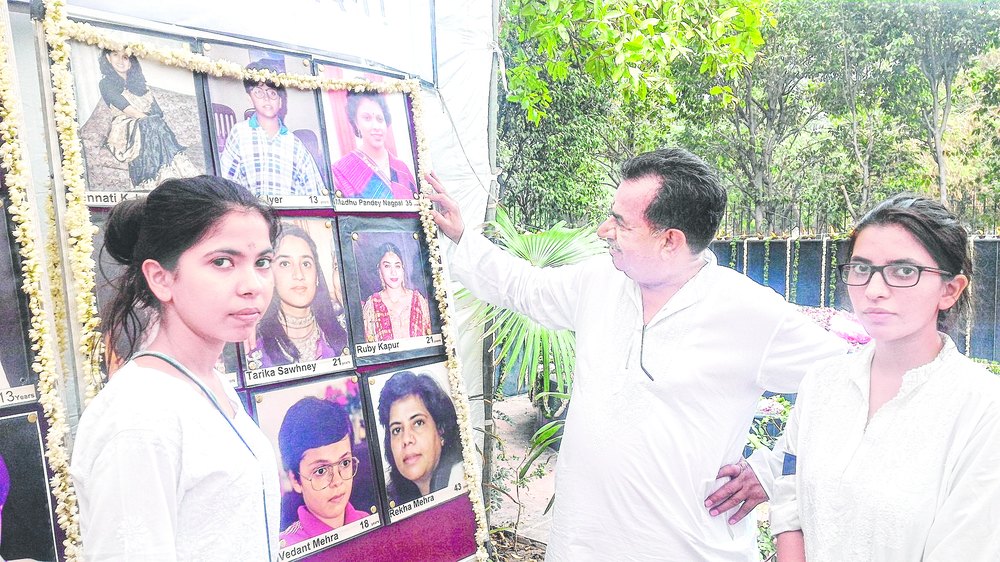
These experiences switch on one of the Miranda House student's earliest memories - of June 13, 1997, when she lost her mother in the Uphaar cinema fire that killed 59 people.
Every June 13 these past 18 years, Megha, sister Surabhi and their father Shyam have been visiting the Smriti Upavan, a public garden where the tragedy is remembered with an annual puja.
The backdrop to an artificial cascade at the garden is inscribed with the phrase: "Until justice rolls down like water and righteousness like a mighty stream."
It's a line paraphrased from the biblical Verse 24 of the fifth chapter of the Book of Amos, written in the eighth century BC when the Jewish faith was supposedly at its lowest ebb.
The words resonate with the families of the Uphaar dead, who are still waiting for justice in the form of longer jail sentences for the hall's owners, brothers Sushil and Gopal Ansal.
A four-year-old Megha had accompanied mother Madhu and a few relatives to Uphaar to watch the matinee show on the opening day of the J.P. Dutta war film Border.
"I saw two women leave midway. Did they have a premonition? I don't know. I wish we had left," said Megha, who is studying for a master's in literature.
"When the lights went out after the fire started and people began screaming," she recounted, "I somehow drifted towards my relatives. I must have passed out after that."
She woke up in a hospital bed. "I had a burning feeling inside my throat because of the smoke. I couldn't breathe. That feeling that comes with smoke scares me even today."
Surabhi was 11 months old at the time. Shyam never remarried. He brought his daughters up alone, taking care that the trauma didn't scar them for life or sow a phobia of cinemas in their young minds.
Both children continued to watch movies in theatres but Megha can still not bring herself to watch Border.
"My mother had (reportedly) been able to escape the hall. But she went back to get me," she said, her voice choking.
Five persons including the Ansals were convicted of causing death by negligence and handed two-year terms in 2007, and seven others given seven years for culpable homicide. The Ansals' sentences were reduced to a year in 2008 and, after five months in jail, they received bail.
The rest - Uphaar employees and municipal, power board and fire brigade staff - served jail terms of various durations.
Last year, the Supreme Court upheld the verdict against the Ansals but differences over their sentencing resulted in a reference to a three-judge bench. A separate case for tampering of evidence has been dragging on for nine years at a Delhi court.
"We moved three applications for an early hearing (for the sentencing) in the last one year," said Neelam Krishnamoorthy, president of the Uphaar victims' association that has waged the legal battle all these years. She lost both her children to the blaze.
"We have not even been granted an appointment with the Union law minister, Ravi Shankar Prasad. It's shocking that despite the Supreme Court recommendations for uniform safety measures in cinemas across the country in 2011, no action has been taken yet."