I regularly receive letters from patients saying, “I exercise. I walk for at least half an hour every day.”
But what does this really mean? Is it a leisurely stroll with a friend, a casual trip to the bazaar or intermittent housework-related walking?
Walking is a natural skill acquired around the age of one; many people lose this ability gradually as they grow older. They develop a side-to-side waddle with inefficient forward propulsion.
Almost every recommendation for physical fitness and/or weight loss advises walking. It is gentle on the joints and muscles, not very taxing physically and is considered excellent for overall fitness. Regular walking improves circulation by opening up the coronary and cerebral arteries and promoting collateral blood flow. It reduces the risk of heart attacks and has been proven to delay dementia and cognitive decline.
Ironically, walking itself is surrounded by many contradictory recommendations. With pedometers, people could count the number of steps taken per day, and 10,000 steps (approximately 7-8 kilometres) became the benchmark. However, this recommendation was actually a marketing slogan from a pedometer company, not a scientific one. Research has since shown that health benefits actually begin much earlier, at around 7,000 steps per day. The total distance covered also depends on stride length; taller individuals cover more ground per step. For most adults, it takes 1,200 to 1,500 steps to walk one kilometre.
A bare minimum of 150 minutes of activity per week is currently recommended.
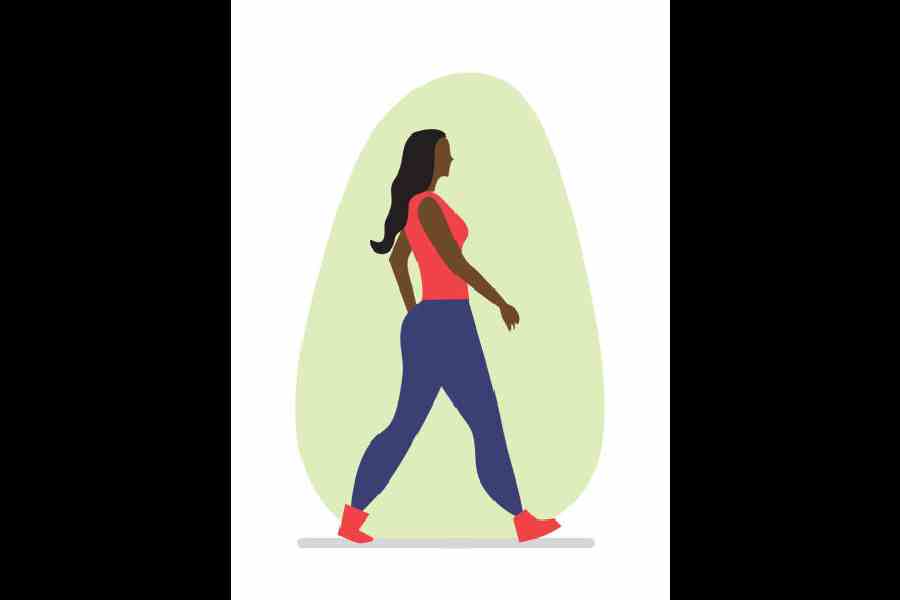
When walking for physical fitness, certain guidelines should be followed. Keep the head up and look straight ahead 10-20, keeping the chin parallel to the floor. The shoulders and back should be relaxed. The arms should swing freely from the shoulders, not the elbows, and should move straight forward and backwards, not sideways across the body. The back should remain straight and not arched. Strike the ground with the heel and push off with the toes.
The speed at which you walk is also important. While walking for exercise, singing should be impossible, but speaking in short sentences should be possible. If you are able to carry on a comfortable conversation while walking, you need to increase your pace.
Once you become an efficient walker, you can naturally progress to running. One way to do this is to alternate walking with slow jogging. Many people follow the 10-step rule, 10 steps walking, followed by 10 steps running. Another method is the three-minute rule — walk for three minutes, then jog for three minutes. No fancy equipment is required. Most songs last three to four minutes, so listening to music facilitates alternating between walking and running.
To prevent injury, start walking slowly to warm up your muscles, then gradually increase your speed. Stretching before walking is not recommended. Instead, stretching after walking helps maintain flexibility and mobility. Performing six Surya Namaskars (instructions are easily available online) is simple and effective.
Motivation can sometimes wane if you walk the exact same route at the exact same speed every day. You could refresh your routine by alternating walking with jogging, incorporating inclines or stair climbing, or even walking backwards part of the way.
If weather conditions or safety concerns prevent walking outdoors, you could exercise safely indoors by practising figure-of-eight or infinity walking.
Walking does not require travel time to a gym or much equipment and is, therefore, not expensive. In addition to its numerous health benefits, its simplicity makes it far more likely that you will remain consistent, making walking one of the most sustainable forms of exercise available.
The writer has a family practice at Vellore and is the author of Staying Healthy in Modern India. If you have any questions on health issues, please write to yourhealthgm@yahoo.co.in