In the 1980s when a businessman died, there was a tussle over his last rites. His Sindhi family wanted a cremation; his second wife said he’d converted to Christianity and claimed his body for a burial.
When BSP leader Kanshi Ram passed away, there was a squabble between his siblings and his political protégé Mayawati over his body and the last rites. It required court intervention and police protection before he was cremated according to Buddhist rites. Fortunately, he was a bachelor, so it was not a “two wives” showdown.
When Gulshan Kumar met with a tragic end after underworld shooters gunned him down, there was a standoff between his family and his close associate Anuradha Paudwal. The family gave him a funeral in Delhi, where hundreds gathered. Even though it was a solemn occasion marked by grief and shock, necks craned to catch a glimpse of Anuradha when she appeared for a swift farewell to her professional mentor.
Wherever a man has had a companion outside marriage, his death has always drawn attention. When Amjad Khan succumbed to heart attack, he left behind a wife and three kids who were devastated. In the midst of this grief, the entry of his special friend Kalpana Iyer had to be handled delicately. It was only when Kalpana went and sat by his body that the family made a request to her to move from there. She spent the rest of the night downstairs with friends like Sarika.
The spotlight gets harsh for the “two wives” or “the other woman” when a man passes on. But the death of either of the women in a triangle does not generate a similar funereal debate. When Smita Patil died, leaving behind an infant who was only a handful of days old, there was no confusion. Raj Babbar was the man everybody paid their condolences to. His wife Nadira even attended Smita’s last rites, as did Hema Malini. Five years prior, Hema had married her married man and delivered her first child Esha. A situation Smita was in before she died after childbirth.
In 2012, there was no ambiguity when cancer claimed Mona Kapoor. Husband Boney Kapoor did the last rites with his kids Arjun and Anshula Kapoor by his side. Six years later, when his second wife Sridevi died under mysterious circumstances, all four of his kids were there with no debate over who should claim her body.
But there was tension when Mazhar Khan died. Zeenat Aman had two sons with him before they had a contentious divorce. Although it was not a classic “two wives” scene when he passed away, but because there had been so much acrimony, his family did not want Zeenat to go near his body. It was only when mutual friend Shashi Ranjan took her arm and led her to his body that Zeenat got to say goodbye to her former husband.
When a couple in an extramarital relationship splits and moves on with families of their own, there’s less friction in the air. When Nargis Dutt passed away, Raj Kapoor’s arrival was much-awaited. He did come wearing his trademark white kurta and black sunglasses. Sunil Dutt received him with grace and Nargis’s funeral was conducted sans drama.
But multi-marriages sometimes have a way of getting knotted up, even if a man is divorced from his previous spouse. One can see the legal drama being played out between Karisma Kapoor and former husband Sunjay Kapur’s estate after his bizarre death in London.
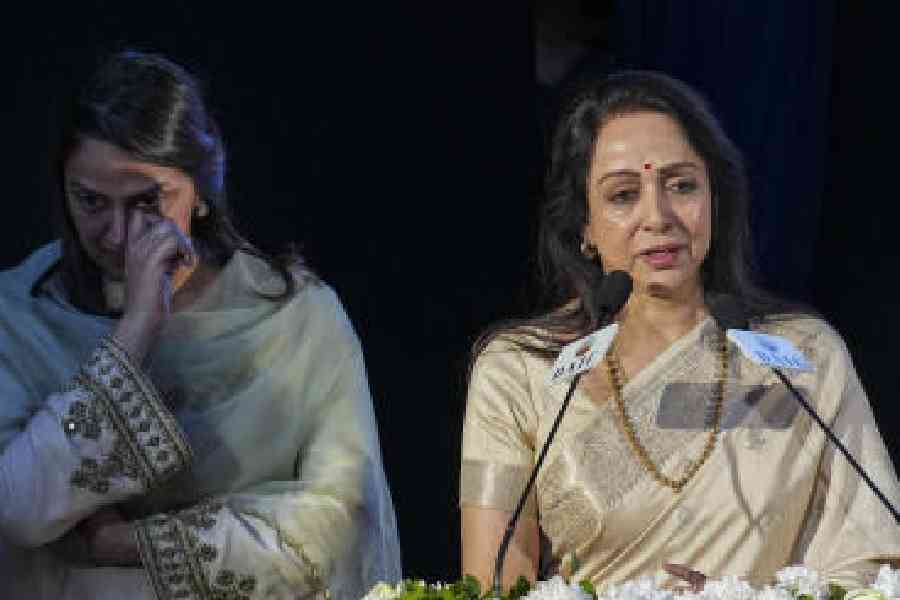
However unwelcome it may be, the glare on the families is unavoidable when a man passes on. So, even if Dharmendra spent the last years of his life in the comfortable belief that he’d handled his two families with relative ease, manufactured stories on Hema’s absence at the Deol prayer meeting have been distasteful. Sunny with mother and siblings, and Hema with her children, handled the moment without a public tamasha. Can we leave it at that?
Bharathi S. Pradhan is a senior journalist and an author